Afghanistan military strikes on Pakistan and Durand Line dispute
Source:The Hindu ↗
Why It Matters
The stability of the Af-Pak region directly affects India's security environment, particularly concerning cross-border terrorism and regional militancy. The historical border dispute along the Durand Line provides critical geopolitical context for foreign policy dynamics and security challenges in South Asia.
Summary
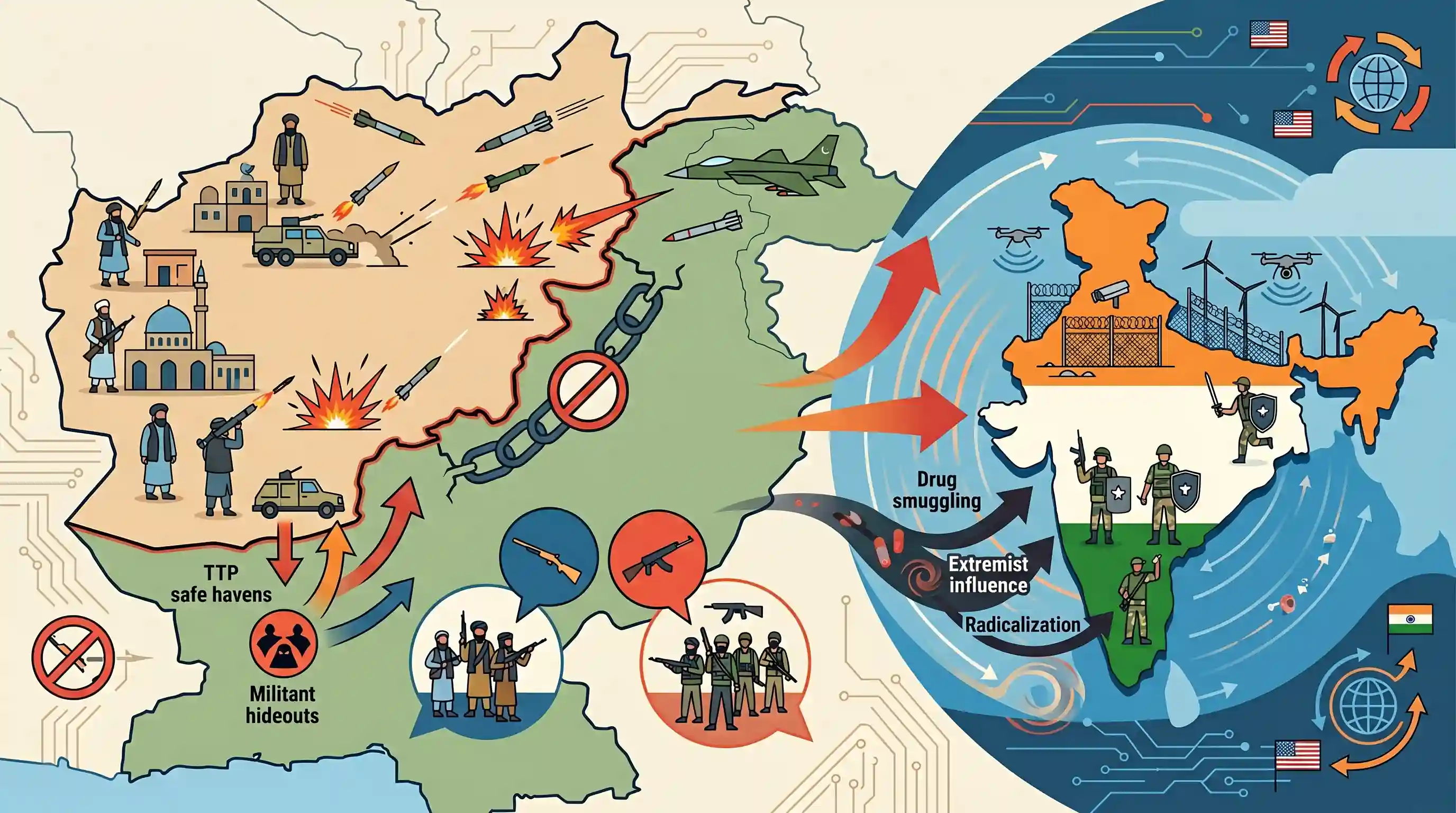
Escalating military confrontations between Afghanistan and Pakistan have spotlighted deep-rooted tensions over cross-border militancy and the disputed Durand Line. Afghanistan launched retaliatory military strikes against Pakistani army posts following Pakistani airstrikes on Afghan soil, which Islamabad claims were aimed at eliminating Pakistani Taliban (TTP) safe havens. The clashes underscore a deteriorating relationship between the Taliban-led Afghan government and Pakistan, exacerbated by Kabul's ongoing refusal to recognize the 2,611-kilometre border and mutual accusations regarding the harboring of militant groups.
Key Points
- Afghanistan's military launched strikes on Pakistani military bases along the Durand Line in retaliation for earlier Pakistani airstrikes.
- Afghan officials claim to have captured Pakistani army outposts and inflicted casualties, assertions which Islamabad has firmly denied.
- Pakistan conducted airstrikes on Afghan territory, maintaining they targeted hideouts of the Pakistani Taliban (TTP), a group blamed for surging domestic violence.
- The 2,611-kilometre Durand Line remains a fundamental source of geopolitical tension, as the Afghan Taliban refuses to formally recognize it as the international border.
Important Terms
Pakistani Taliban (TTP)

A Deobandi jihadist militant organization (Tehrik-i-Taliban Pakistan) primarily operating along the Afghanistan-Pakistan border, aiming to overthrow the Pakistani state and impose Sharia law.
UPSC context
GS Paper III: Internal Security/Terrorism. Critical for understanding cross-border security threats and India's regional stability concerns.
Taliban
Referring to the Afghan Taliban (Islamic Emirate of Afghanistan), the de facto ruling authority in Kabul since August 2021, characterized by a nationalist and Islamist governance model.
UPSC context
GS Paper II: International Relations. Key for neighborhood policy and India's 'engage but not recognize' diplomatic strategy.
Durand Line
The 2,640-kilometre boundary between Afghanistan and Pakistan, drawn in 1893 by the British. It remains unrecognized by Afghanistan, causing persistent bilateral and ethnic (Pashtun) friction.
UPSC context
GS Paper II: International Relations/Border Disputes. Essential for understanding South Asian geopolitical fault lines and tribal dynamics.
Strategic Depth
A Pakistani military doctrine seeking a friendly Afghan government to avoid a two-front war scenario with India and to provide tactical space in the event of conflict.
UPSC context
GS Paper II: India’s Neighborhood Relations. Explains the shift in Pakistan’s Afghan policy and the resultant blowback.
Afghan Defense Ministry
The administrative and command body of the Taliban-led government in Afghanistan, responsible for national defense and retaliatory military actions against border incursions.
UPSC context
GS Paper II: IR. Important for tracking official state responses in the escalating Af-Pak conflict.
Pakistani military
The unified armed forces of Pakistan, primarily the Army and Air Force, which conduct counter-terrorism operations and airstrikes against alleged militant sanctuaries in neighboring territories.
UPSC context
GS Paper II & III: International Relations and Security. Focuses on the role of non-civilian actors in regional geopolitics.
Prelims Trap
"The Afghan Taliban officially recognizes the Durand Line as the settled international boundary."
Despite Pakistan's historical backing of the Taliban, no Afghan government (including the current Taliban regime) has ever formally recognized the 1893 Durand Line.
Static Concepts Connected
What is Pakistan's 'Strategic Depth' doctrine regarding Afghanistan?
- Military buffer: The strategy seeks a compliant Afghan regime to provide fallback space for Pakistan's military in the event of a conventional war with India.
- Proxy blowback: Pakistan historically backed the Afghan Taliban to secure this geopolitical depth, which has now backfired as Kabul provides sanctuary to anti-Pakistan TTP militants.
Which key international borders were drawn by British colonial commissions?
- Durand Line (1893): Demarcated by Sir Mortimer Durand, dividing ethnic Pashtun territories between British India (now Pakistan) and Afghanistan.
- McMahon Line (1914): Proposed at the Simla Convention, separating Tibet from British India (now India's Northeast); actively disputed by China.
- Radcliffe Line (1947): The official partition boundary dividing British India into the independent dominions of India and Pakistan.
Cross-Topic Patterns
Blowback of Proxy Warfare
Pakistan's historical distinction between 'good' (Afghan Taliban) and 'bad' (TTP) terrorists has collapsed, directly mirroring India's long-standing warnings at the UN about state-sponsored terror blowback.
Wakhan Corridor Mapping
The Wakhan panhandle, created as a 19th-century 'Great Game' buffer between British India and the Russian Empire, remains critical as Afghanistan's sole direct border with China.

Expect a 2026 Prelims mapping question on the Wakhan Corridor's bordering nations or a matched-pair question on colonial border lines.
Linked PYQs · 3
Linked PYQs · 3
- 2022PrelimsGS1
Consider the following countries: 1. Azerbaijan 2. Kyrgyzstan 3. Tajikistan 4. Turkmenistan 5. Uzbekistan Which of the above have borders with Afghanistan ?
- 2020MainsGS3
Analyze internal security threats and transborder crimes along Myanmar, Bangladesh and Pakistan borders including Line of Control (LoC). Also discuss the role played by various security forces in this regard.
- 2020MainsGS3
For effective border area management, discuss the steps required to be taken to deny local support to militants and also suggest ways to manage favourable perception among locals.
