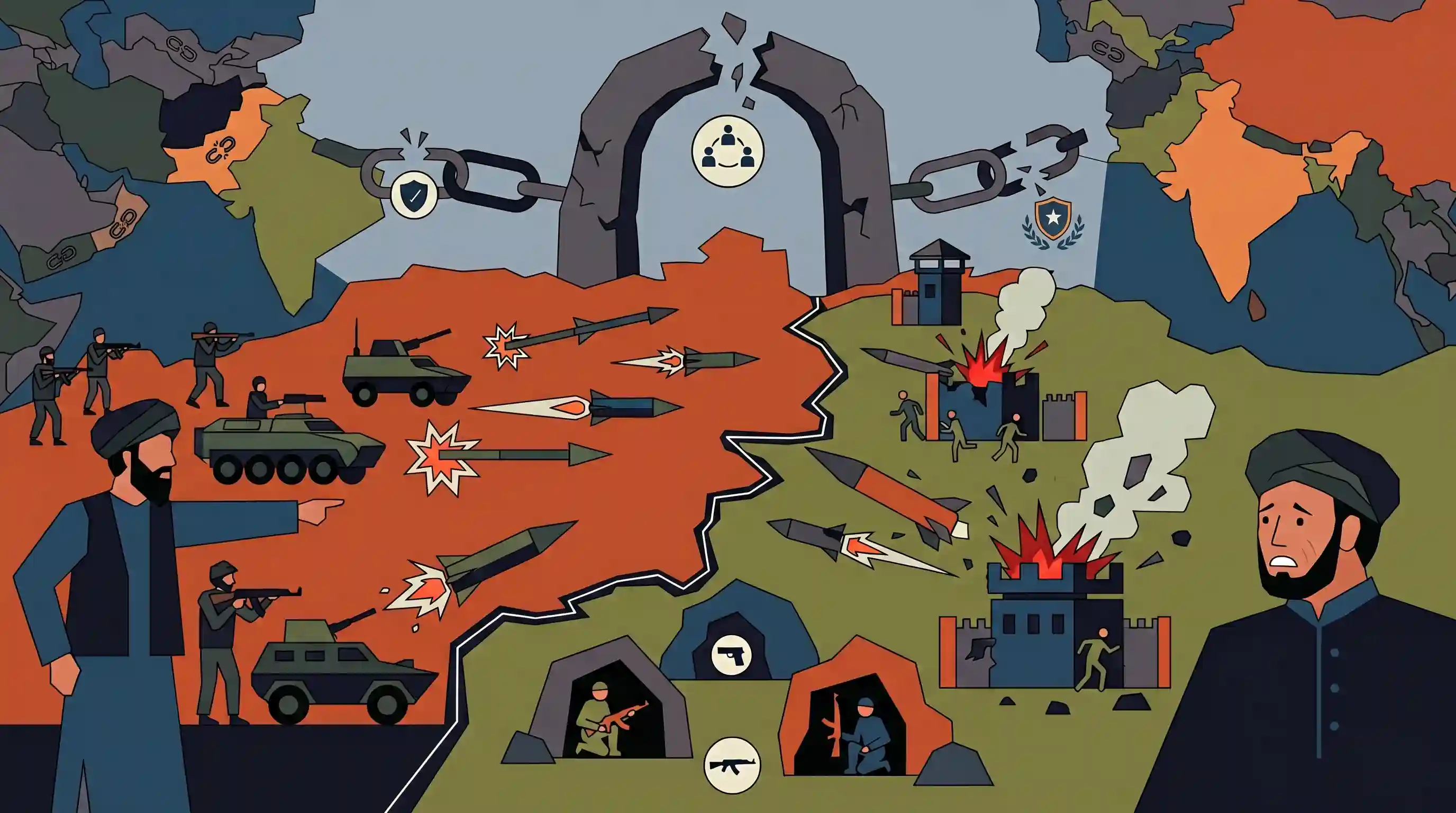
Escalating border conflict between Afghanistan and Pakistan
Source:Indian Express ↗
Why It Matters
The diplomatic and military breakdown between Pakistan and Afghanistan directly impacts regional stability. For UPSC aspirants, understanding this dynamic is crucial for questions related to India's neighborhood policy, the geopolitical fallout of the US withdrawal from Afghanistan, and the broader implications of transnational terrorism on border security.
Summary
The Taliban administration in Afghanistan has launched retaliatory military attacks on Pakistani border posts. This escalation follows intense border clashes and ongoing friction over the Durand Line, with Pakistan frequently accusing the Afghan Taliban of providing safe havens to the Tehrik-i-Taliban Pakistan (TTP). The retaliatory strikes underscore the deepening divide between Islamabad and Kabul, transforming what Pakistan once viewed as a 'strategic depth' opportunity into a major regional security vulnerability. The increasing militarization and instability along the Af-Pak border pose significant challenges to broader South Asian peace and counter-terrorism efforts.
Key Points
- The Taliban government in Afghanistan announced retaliatory strikes against Pakistani border outposts following recent border skirmishes.
- The underlying conflict stems from long-standing disputes over the Durand Line and Pakistani accusations that the Taliban is harboring Tehrik-i-Taliban Pakistan (TTP) militants.
- This escalation marks a severe deterioration in Af-Pak relations, defeating Islamabad's initial strategic calculations following the 2021 US withdrawal and Taliban takeover.
- Growing instability along the Afghanistan-Pakistan border creates a volatile security environment in South Asia with the potential to embolden transnational terrorist safe havens.
Important Terms
Taliban (Afghan Taliban)

A Sunni Islamist movement that regained power in Afghanistan in 2021, establishing the Islamic Emirate. It is currently the de facto governing authority in Kabul.
UPSC context
GS Paper 2: International Relations; tests understanding of regional stability, neighborhood policy, and impact on India's connectivity/security interests.
Tehrik-i-Taliban Pakistan (TTP)
An umbrella organization of militant groups formed in 2007 seeking to overthrow the Pakistani state and enforce Sharia. It operates primarily along the Afghanistan-Pakistan border.
UPSC context
GS Paper 3: Internal Security; focuses on non-state actors, cross-border terrorism, and their role in regional destabilization.
Durand Line
A 2,640-km border established in 1893 between British India and Afghanistan. It remains unrecognized by successive Afghan governments, including the Taliban, leading to frequent border clashes.
UPSC context
GS Paper 2: India and its Neighborhood; examines colonial legacies, territorial disputes, and the 'Great Game's' impact on modern borders.
Strategic Depth
A Pakistani military doctrine aiming to use Afghan territory as a secure 'strategic backyard' to prevent encirclement by India and provide space for military regrouping.
UPSC context
GS Paper 2: International Relations; tests knowledge of Pakistan's foreign policy and the evolving security dynamics of the Af-Pak region.
Af-Pak Region
A geopolitical term describing the shared border region of Afghanistan and Pakistan, characterized by porous boundaries, shared Pashtun ethnicity, and high levels of militancy.
UPSC context
GS Paper 3: Border Management; relevant for analyzing security challenges, refugee crises, and the management of sensitive international frontiers.
Prelims Trap
"Afghanistan officially recognizes the Durand Line as its permanent international boundary with Pakistan."
Afghanistan historically rejects the 1893 Durand Line, claiming Pashtun territories inside Pakistan. This non-recognition is a root cause of ongoing border skirmishes.
Static Concepts Connected
Which countries share a land border with Afghanistan?
- North: Turkmenistan, Uzbekistan, and Tajikistan.
- East and South: Pakistan, and India (officially, via the PoK region of Gilgit-Baltistan).
- West: Iran.
- Northeast: China (via the narrow Wakhan Corridor).
What is Pakistan's 'Strategic Depth' doctrine?
- Core Objective: A historical military strategy to install a compliant proxy regime in Kabul, providing Pakistan with a strategic rear-guard fallback against Indian military threats.
- Current Status: The doctrine has largely collapsed as the Afghan Taliban asserts strategic autonomy and harbors anti-Pakistan militants like the TTP.
Cross-Topic Patterns
Chabahar Port and INSTC connectivity
Af-Pak border closures and hostilities underline the critical need for India to bypass Pakistan using Iran's Chabahar Port and the INSTC for reaching Afghan and Central Asian markets.
Internal Security & Proxy Terrorism
Pakistan's heavy military entanglement on its western border with the TTP alters its resource allocation for proxy terrorism, potentially impacting the internal security matrix in Jammu & Kashmir.

Expect a 2026 Prelims map question on the Wakhan Corridor, or a Mains IR question on the collapse of Pakistan's 'Strategic Depth' policy.
Linked PYQs · 4
Linked PYQs · 4
- 2016MainsGS2
Increasing cross-border terrorist attacks in India and growing interference in the internal affairs of several member-states by Pakistan are not conducive for the future of SAARC (South Asian Association for Regional Cooperation)." Explain with suitable examples.
- 2020MainsGS3
Analyze internal security threats and transborder crimes along Myanmar, Bangladesh and Pakistan borders including Line of Control (LoC). Also discuss the role played by various security forces in this regard.
- 2022PrelimsGS1
Consider the following countries: 1. Azerbaijan 2. Kyrgyzstan 3. Tajikistan 4. Turkmenistan 5. Uzbekistan Which of the above have borders with Afghanistan ?
- 2024MainsGS2
‘Terrorism has become a significant threat to global peace and security.’ Evaluate the effectiveness of the United Nations Security Council's Counter Terrorism Committee (CTC) and its associated bodies in addressing and mitigating this threat at the international level.
