India Humanitarian Aid and Disaster Relief in Afghanistan
Source:Indian Express ↗
Why It Matters
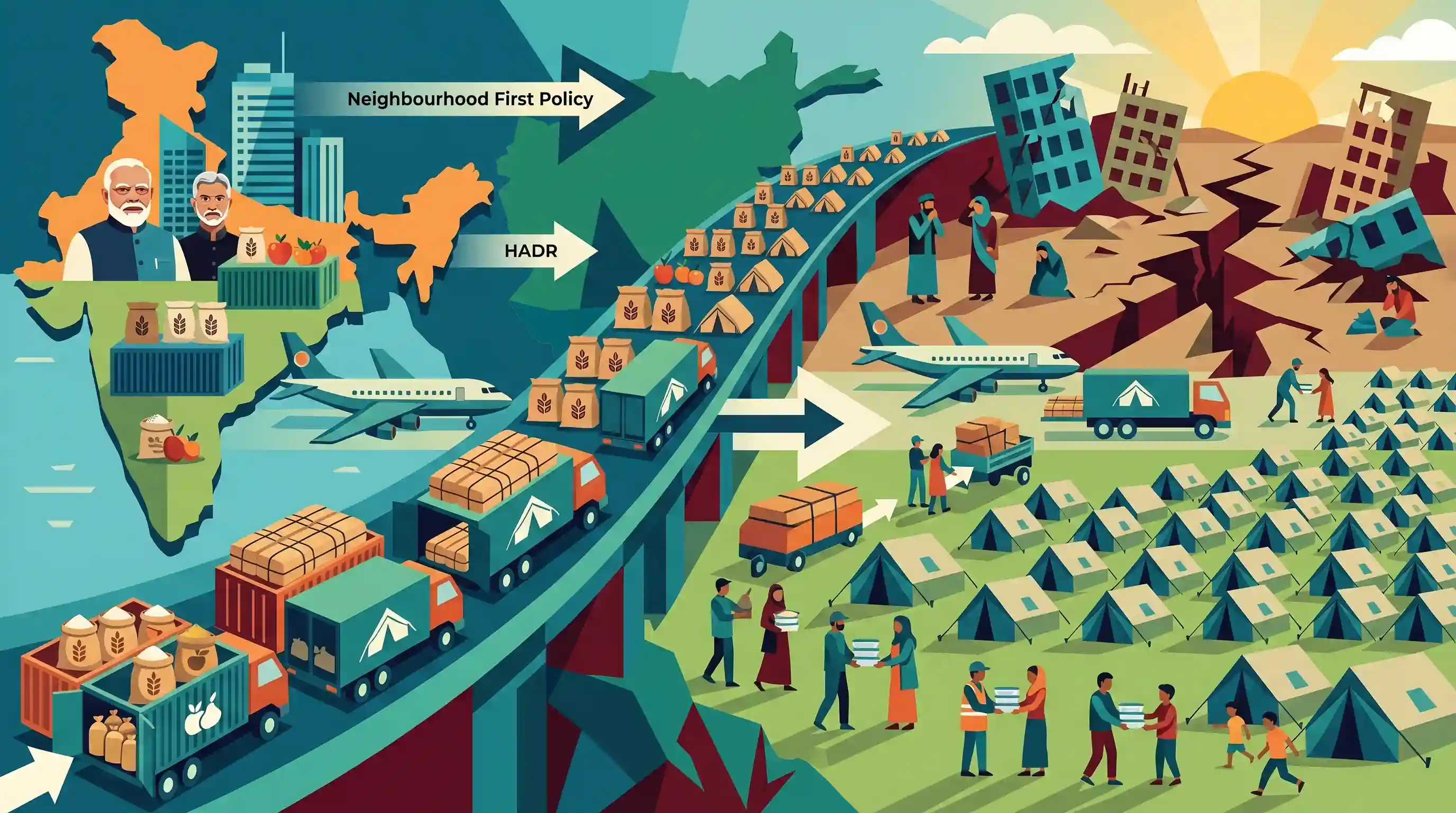
Demonstrates India's continued diplomatic engagement and soft power projection in Afghanistan through humanitarian assistance, reflecting its 'Neighbourhood First' policy. Relevant for GS-II (IR) questions on neighborhood relations and soft power, and GS-III (Disaster Management) on international HADR efforts.
Summary
Following a devastating 6.0-magnitude earthquake in Afghanistan that claimed over 800 lives, India immediately dispatched humanitarian aid to the affected regions. External Affairs Minister S Jaishankar and Prime Minister Narendra Modi expressed their condolences, ensuring support for the Afghan people. Relief materials, including 1,000 family tents and 15 tonnes of food, were rapidly mobilized from the Indian Mission in Kabul to the hardest-hit areas, highlighting India's proactive diplomatic engagement and continued humanitarian commitment to Afghanistan.
Key Points
- A 6.0-magnitude earthquake struck near Jalalabad in Nangarhar province, Afghanistan, causing over 800 deaths and widespread devastation.
- India responded swiftly by delivering 1,000 family tents and 15 tonnes of food from its mission in Kabul to the affected Kunar province.
- External Affairs Minister S Jaishankar spoke with Afghan Foreign Minister Mawlawi Amir Khan Muttaqi to convey condolences and offer continued support.
- Prime Minister Narendra Modi reiterated India's commitment to standing by Afghanistan during crises and providing all possible humanitarian aid.
Important Terms
Humanitarian Assistance and Disaster Relief (HADR)

Coordinated civil-military operations providing immediate relief, search and rescue, and essential services during natural disasters or crises to save lives and alleviate suffering.
UPSC context
GS Paper II (Foreign Policy) and GS Paper III (Disaster Management); tests India's role as a regional 'net security provider.'
Neighbourhood First Policy
A core component of India's foreign policy prioritizing stable, friendly, and mutually beneficial relations with immediate neighbors through connectivity, trade, and humanitarian aid.
UPSC context
GS Paper II (International Relations); essential for understanding regional stability and countering external influences in South Asia.
India-Afghanistan Relations
A strategic bilateral partnership historically focused on development and humanitarian aid; currently managed through 'pragmatic engagement' following the 2021 regime change.
UPSC context
GS Paper II (Bilateral Relations); involves strategic interests like the Chabahar Port, counter-terrorism, and regional connectivity.
Indian Mission in Kabul
India's diplomatic presence in Afghanistan, which transitioned to a 'Technical Mission' in June 2022 to oversee humanitarian aid and development projects post-Taliban takeover.
UPSC context
GS Paper II (Diplomacy); signifies India’s 'middle path' of assisting Afghan people without formal political recognition of the regime.
Disaster Management
The organization and management of resources and responsibilities for dealing with all aspects of emergencies, in particular preparedness, response, and recovery.
UPSC context
GS Paper III (Disaster and Disaster Management); focuses on institutional frameworks like NDMA and international agreements like the Sendai Framework.
Earthquakes
Sudden shaking of the ground caused by seismic waves, frequently occurring in the Hindu Kush region due to the collision of Indian and Eurasian plates.
UPSC context
GS Paper I (Geography) and GS Paper III (Disaster Management); tests knowledge of plate tectonics and seismic vulnerability.
Prelims Trap
India's bilateral humanitarian aid delivery to Kabul signifies its formal diplomatic recognition of the Taliban administration.
India operates a 'technical mission' in Kabul for pragmatic engagement and HADR. It has explicitly not granted formal de jure recognition to the Taliban government.
Static Concepts Connected
Why is the Hindu Kush region highly susceptible to destructive earthquakes?
- Tectonic intersection: The region sits at the complex collision zone of the Indian, Eurasian, and Arabian tectonic plates.
- Alpide belt: It is part of the highly active Alpide seismic belt, the world's second most seismically active region after the Circum-Pacific belt.
- Subduction dynamics: Deep-focus intermediate tremors are frequently caused by the subduction and detachment of a lithospheric slab deep beneath the Hindu Kush mountains.
How does HADR function within India's Neighbourhood First Policy?
- First Responder: It positions India as the 'First Responder' in South Asia and the Indian Ocean Region, providing rapid, non-reciprocal assistance during crises.
- Soft diplomacy: HADR builds direct goodwill with citizens (people-centric diplomacy), allowing India to bypass complex political frictions with regimes.
Cross-Topic Patterns
HADR as regime-agnostic soft power
India's aid to Taliban-run Afghanistan mirrors 'Operation Dost' in Syria, showing India deploys humanitarian assistance as people-centric diplomacy independent of formal regime recognition.
Humanitarian logistics and Chabahar Port
Delivering food and tents to landlocked Afghanistan highlights India's transit dependencies, linking back to the strategic necessity of Iran's Chabahar port to bypass Pakistani territory.

Expect a Prelims geography question mapping recent major earthquakes (Afghanistan, Turkey, Morocco) to their specific tectonic boundaries.
Linked PYQs · 3
Linked PYQs · 3
- 2022MainsGS2
India is an age-old friend of Sri Lanka.’ Discuss India's role in the recent crisis in Sri Lanka in the light of the preceding statement.
- 2020MainsGS3
Discuss the recent measures initiated in disaster management by the Government of India departing from the earlier reactive approach.
- 2024MainsGS3
What is disaster resilience? How is it determined? Describe various elements of a resilience framework. Also mention the global targets of Sendai Framework for Disaster Risk Reduction (2015–2030).
