Afghanistan Pakistan border clashes and closure of key crossings
Source:The Hindu ↗
Why It Matters
Tensions between Afghanistan and Pakistan over the TTP and border disputes directly impact regional stability in India's neighborhood. Understanding this dynamic is crucial for analyzing cross-border terrorism, safe havens, and their geopolitical implications for South Asia.
Summary
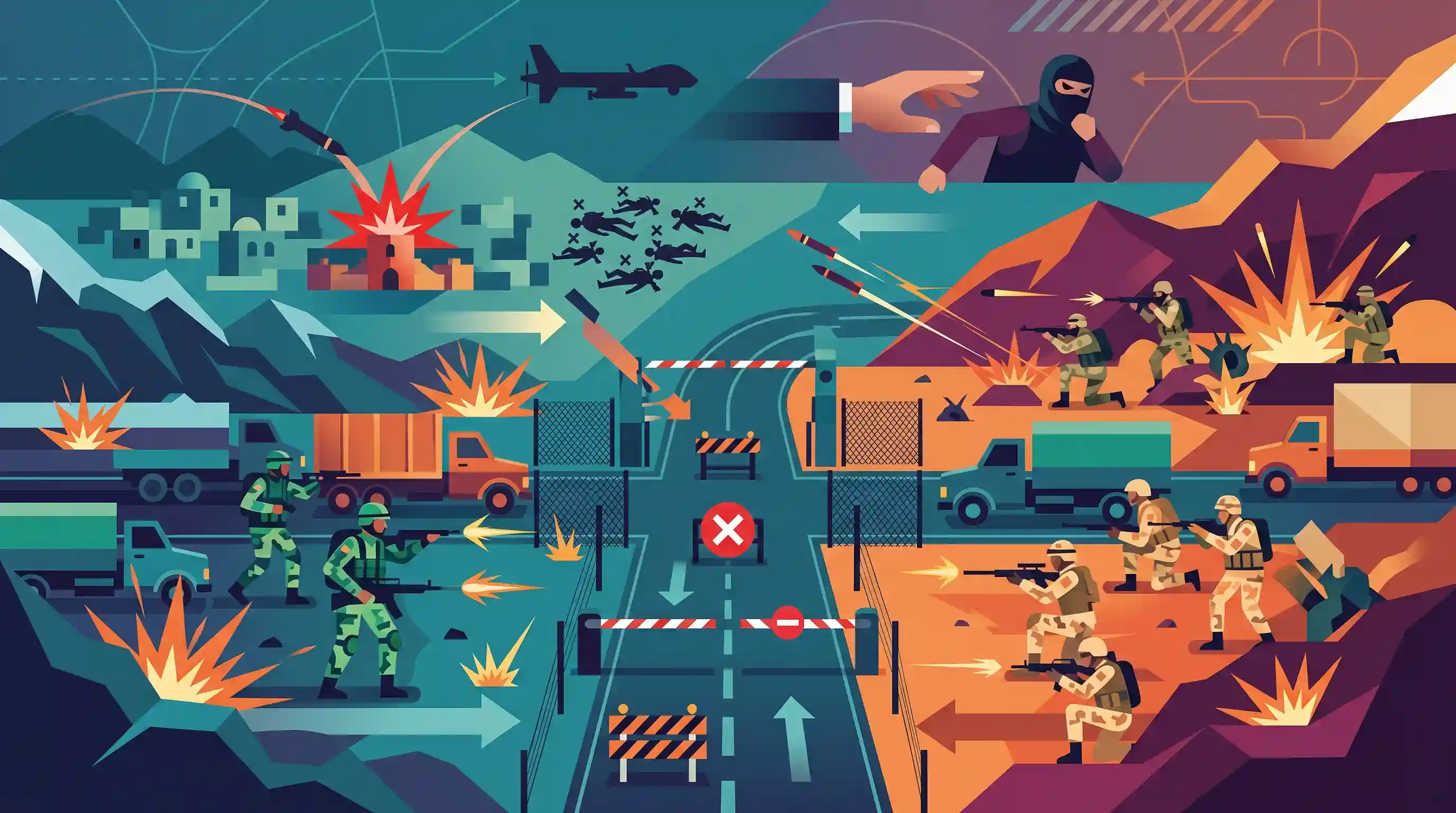
Heavy military clashes erupted between Afghan and Pakistani forces along their shared border, triggered by unacknowledged Pakistani airstrikes targeting a Tehreek-e-Taliban Pakistan (TTP) leader in Kabul. In retaliation, Afghan troops opened fire, claiming to have killed 58 Pakistani soldiers. The conflict led to the closure of key border crossings, including Torkham and Chaman, significantly impacting regional movement and trade. The incident underscores the escalating tensions between Islamabad and Kabul over accusations that the Taliban harbors TTP militants, highlighting the persistent challenges of cross-border terrorism and border management in the region.
Key Points
- Afghan and Pakistani forces engaged in heavy border clashes, with Kabul claiming to have killed 58 Pakistani soldiers in retaliation for earlier airstrikes.
- Pakistan launched unacknowledged airstrikes in Kabul targeting a leader of the Tehreek-e-Taliban Pakistan (TTP).
- Major border crossings between the two countries, including Torkham and Chaman, were closed following the violence.
- The conflict highlights escalating tensions over Islamabad's accusations that the Taliban administration provides safe havens for TTP militants, which Kabul denies.
Important Terms
Durand Line

A 2,640-km boundary between Afghanistan and Pakistan established in 1893. Afghanistan refuses to recognize it formally, as it bisects ethnic Pashtun and Baloch homelands, fueling persistent cross-border friction.
UPSC context
GS Paper II: International Relations. Crucial for understanding border disputes, colonial legacies, and India\'s extended neighborhood security.
Tehreek-e-Taliban Pakistan (TTP)
An umbrella militant organization formed in 2007 to overthrow the Pakistani state. It shares ideological ties with the Afghan Taliban but operates independently, frequently using Afghan safe havens for attacks.
UPSC context
GS Paper III: Security. Tests knowledge of non-state actors, cross-border terrorism, and regional stability in South Asia.
Torkham and Chaman
Strategic border crossings between Afghanistan and Pakistan. Torkham connects Nangarhar to Khyber Pakhtunkhwa; Chaman-Spin Boldak connects Kandahar to Balochistan. Both are vital for transit, trade, and humanitarian aid.
UPSC context
GS Paper I: Geography & GS Paper II: International Relations. Highlights critical trade corridors and chokepoints in regional connectivity.
Taliban
The Sunni Islamist movement that returned to power in Afghanistan in August 2021. It serves as the de facto governing authority, managing internal security and contentious border relations with neighbors.
UPSC context
GS Paper II: International Relations. Central to India\'s "Neighborhood First" policy and regional security dynamics.
Engagement without Recognition
India’s pragmatic policy of maintaining functional, sub-diplomatic ties with the Taliban (e.g., via a "Technical Mission") for humanitarian and strategic reasons without granting formal de jure diplomatic recognition.
UPSC context
GS Paper II: Foreign Policy. Tests understanding of "realpolitik" and diplomatic strategies in volatile regional environments.
Prelims Trap
The Durand Line is the mutually accepted, officially demarcated international border between Pakistan and Afghanistan.
Neither the Taliban nor previous Afghan governments recognize the 1893 Durand Line, viewing it as an arbitrary colonial imposition dividing Pashtun homelands.
Static Concepts Connected
What is the Durand Line and why does Afghanistan contest it?
- Colonial origins: Established in 1893 via an agreement between British India (Sir Mortimer Durand) and Afghan Amir Abdur Rahman Khan.
- Ethnic division: It artificially divides the Pashtun and Baloch tribal heartlands, causing perennial ethnic and political friction.
- Afghan rejection: Successive Afghan governments, including the Taliban, refuse to recognize it as a legitimate international boundary.
What is Pakistan's 'Strategic Depth' policy?
- Core objective: A military doctrine aiming to secure a pliant government in Kabul to act as a buffer and strategic retreat space against India.
- Proxy reliance: The strategy heavily relied on cultivating proxy non-state actors, such as the Afghan Taliban, to wield regional influence.
- Policy blowback: The current TTP insurgency operating from Taliban-ruled Afghanistan represents the severe backfiring and failure of this long-standing doctrine.
Cross-Topic Patterns
Border crossings in mapping
UPSC frequently tests strategic transit points. Torkham and Chaman should be mapped alongside other volatile regional crossings like India's Moreh (Myanmar) or Nathu La (China).
Preemptive strikes & sovereignty
Pakistan's unacknowledged airstrikes inside Kabul mirror global debates on violating state sovereignty to target non-state actors, recalling international law discussions post-India's 2016 surgical strikes.

Expect a Prelims mapping question on Torkham/Chaman crossings, or a Mains GS-II prompt on the collapse of Pak's 'Strategic Depth'.
Linked PYQs · 3
Linked PYQs · 3
- 2015MainsGS2
Terrorist activities and mutual distrust have clouded India-Pakistan relations. To what extent the use of soft power like sports and cultural exchanges could help generate goodwill between the two countries? Discuss with suitable examples.
- 2016MainsGS2
Increasing cross-border terrorist attacks in India and growing interference in the internal affairs of several member-states by Pakistan are not conducive for the future of SAARC (South Asian Association for Regional Cooperation)." Explain with suitable examples.
- 2021MainsGS3
Analyse the complexity and intensity of terrorism, its causes, linkages and obnoxious nexus. Also suggest measures required to be taken to eradicate the menace of terrorism.
