शीतकालीन कोहरे के निर्माण और वायु प्रदूषण गतिशीलता पर एरोसोल का प्रभाव
स्रोत:द हिंदू ↗
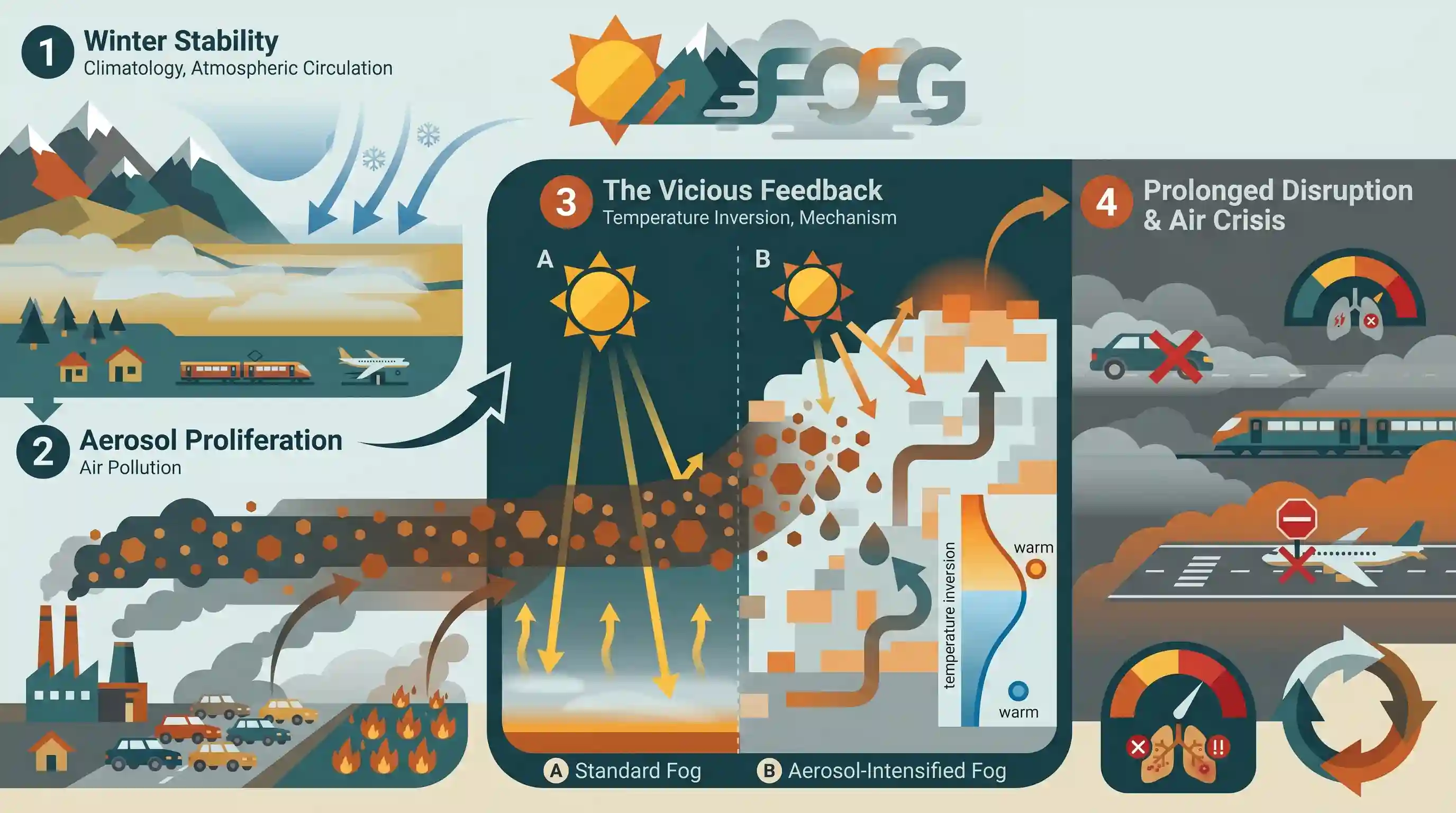
क्यों मायने रखता है
भारत-गंगा के मैदान (Indo-Gangetic Plain) में सर्दियों में बार-बार होने वाले कोहरे और स्मॉग के संकट की एक वैज्ञानिक व्याख्या (जिसमें वायुमंडलीय माइक्रोफिज़िक्स और रेडिएटिव फोर्सिंग शामिल है) प्रदान करता है। यह सीधे तौर पर मानवजनित प्रदूषण को कोहरे के निर्माण और तापीय व्युत्क्रमण (temperature inversion) जैसी भौतिक भौगोलिक घटनाओं से जोड़ता है।
सारांश
भारतीय उष्णकटिबंधीय मौसम विज्ञान संस्थान (IIT-M) का एक अध्ययन इस बात पर प्रकाश डालता है कि वायुमंडलीय एरोसोल की उच्च सांद्रता किस प्रकार उत्तर भारत में शीतकालीन कोहरे को घना करती है और उसकी अवधि को बढ़ाती है। संघनन नाभिक (condensation nuclei) के रूप में कार्य करने और सौर विकिरण को अवरुद्ध करने के कारण, ये एरोसोल तापीय प्रतिलोमन (temperature inversions) की स्थिति उत्पन्न करते हैं जो कोहरे को ऊपर उठाकर निचले स्तर के बादलों के रूप में बनाए रखते हैं, जिससे परिवहन व्यवस्था गंभीर रूप से बाधित होती है और क्षेत्र का वायु गुणवत्ता संकट और अधिक बढ़ जाता है।
मुख्य बिंदु
- वायुमंडल में एरोसोल क्लाउड कंडेनसेशन न्यूक्लिआई (CCN) के रूप में कार्य करते हैं, जिससे पानी की छोटी और अधिक संख्या में बूंदें बनती हैं जो उत्तर भारत में सर्दियों के कोहरे को और घना कर देती हैं।
- Elevated aerosol layers scatter and absorb solar radiation, cooling the Earth's surface and strengthening temperature inversions. This dynamic lifts the fog into persistent low-level clouds.
- The Indo-Gangetic Plain is uniquely vulnerable to this phenomenon due to its topography, stable winter meteorological conditions, and high anthropogenic aerosol emissions (such as biomass burning and vehicular pollution).
- The prolonged and thickened fog severely disrupts aviation, railway, and road transport, while concurrently worsening respiratory health by trapping toxic pollutants near the surface.
महत्वपूर्ण शब्द
Indian Institute of Tropical Meteorology (IITM)

An autonomous research organization under the Ministry of Earth Sciences (MoES), Pune, specializing in tropical meteorology, monsoon dynamics, and atmospheric science research in the Indian subcontinent.
UPSC context
GS Paper III (Science & Technology); focuses on national scientific institutions and their roles in climate and weather monitoring.
Aerosols
वायुमंडल में निलंबित सूक्ष्म ठोस या तरल कण (जैसे- कालिख, धूल, सल्फेट) जो सूर्य के प्रकाश को प्रकीर्णित या अवशोषित करके और बादल या कोहरे के निर्माण में सहायता प्रदान कर मौसम को प्रभावित करते हैं।
UPSC context
GS पेपर I (भूगोल) और GS III (पर्यावरण); वायु प्रदूषण, ग्लोबल डिमिंग और क्षेत्रीय मौसम पैटर्न को समझने के लिए महत्वपूर्ण।
Temperature Inversion
A meteorological phenomenon where a layer of warm air settles above cooler air, reversing the normal lapse rate and trapping pollutants and moisture near the ground.
UPSC context
GS Paper I (Climatology); central to explaining winter smog persistence and fog dynamics in the Indo-Gangetic Plain.
Cloud Condensation Nuclei (CCN)
Small atmospheric particles (often aerosols) that provide the necessary surface for water vapor to condense into droplets, forming clouds or fog.
UPSC context
GS Paper I (Physical Geography); essential for understanding precipitation processes and the impact of pollution on cloud physics.
सिंधु-गंगा का मैदान (IGP)
A vast, low-lying region in North India particularly vulnerable to intense winter fog and air quality crises due to topography, high aerosol loading, and atmospheric stability.
UPSC context
GS पेपर I (क्षेत्रीय भूगोल) और GS III (पर्यावरण); अपनी अनूठी पर्यावरणीय चुनौतियों और मौसमी प्रदूषण के लिए अक्सर परीक्षा में पूछा जाता है।
Radiative Cooling
वह प्रक्रिया जिसके द्वारा पृथ्वी की सतह और वायुमंडल दीर्घतरंग विकिरण (longwave radiation) उत्सर्जित करके ऊष्मा खो देते हैं, जिससे शीतलन (cooling) होता है जो जमीनी स्तर पर कोहरे के निर्माण में सहायक होता है।
UPSC context
GS Paper I (Geography); key to understanding the Earth's energy budget and the formation of radiation fog.
प्रारंभिक ट्रैप
High aerosol concentrations create larger water droplets that become heavy and precipitate, dissipating the winter fog.
Aerosols act as condensation nuclei to produce smaller, more numerous droplets. These stay suspended and scatter light, thickening the fog, rather than precipitating out.
संबंधित अवधारणाएँ
तापमान व्युत्क्रमण (Temperature Inversion) क्या है और इसके लिए आदर्श स्थितियाँ क्या हैं?
- परिभाषा: The reversal of the normal environmental lapse rate, where temperature increases with altitude in the lower troposphere.
- आदर्श परिस्थितियाँ: Long winter nights, clear skies, calm winds, and a dry air mass near the surface to allow rapid radiational cooling of the ground.
- प्रभाव: It creates a stable atmospheric layer that traps pollutants and moisture close to the ground, drastically increasing smog and fog persistence.
How does Radiation Fog differ from Advection Fog?
- Radiation Fog: Forms over land on calm, clear nights when the ground cools rapidly via radiation, cooling the air immediately above it to its dew point (common in North India).
- Advection Fog: इसका निर्माण तब होता है जब एक गर्म, नम वायु द्रव्यमान (air mass) किसी ठंडी सतह के ऊपर क्षैतिज रूप से गति (advects) करता है, जिससे ऊष्मा का नीचे की ओर स्थानांतरण होता है और वायु संघनन (condensation) तक ठंडी हो जाती है (तटीय क्षेत्रों में सामान्य)।
अंतर-विषय पैटर्न
IGP स्थलाकृति और वैली इफ़ेक्ट
हिमालय प्रचलित पवनों के विसरण को बाधित करते हैं, जिससे 'वैली इफेक्ट' उत्पन्न होता है। यह स्थलाकृतिक जाल शीतकालीन तापीय व्युत्क्रमण और एरोसोल लोडिंग के साथ मिलकर वार्षिक स्मॉग संकट को बनाए रखता है।
Biomass Burning as CCN Source
Crop residue burning in NW India directly contributes primary aerosols (black carbon) that act as Cloud Condensation Nuclei, feeding the feedback loop that thickens regional winter fog.

Expect a Prelims 2026 multi-statement question linking aerosol-induced temperature inversions to the specific topography of the IGP.
संबद्ध PYQ · 4
संबद्ध PYQ · 4
- 2013MainsGS1
What do you understand by the phenomenon of 'temperature inversion' in meteorology? How does it affect weather and the habitants of the place?
- 2022MainsGS3
Discuss in detail the photochemical smog emphasizing its formation, effects and mitigation. Explain the 1999 Gothenburg Protocol.
- 2022PrelimsGS1
In the context of WHO Air Quality Guidelines, consider the following statements: 1. The 24-hour mean of PM2.5 should not exceed 15 µg/m³ and annual mean of PM2.5 should not exceed 5 µg/m³. 2. In a year, the highest levels of ozone pollution occur during the periods of inclement weather. 3. PM10 can penetrate the lung barrier and enter the bloodstream. 4. Excessive ozone in the air can trigger asthma. Which of the statements given above are correct?
- 2025PrelimsGS1
Artificial way of causing rainfall to reduce air pollution makes use of
