Aerosols Impact on Winter Fog Formation and Air Pollution Dynamics
Source:The Hindu ↗
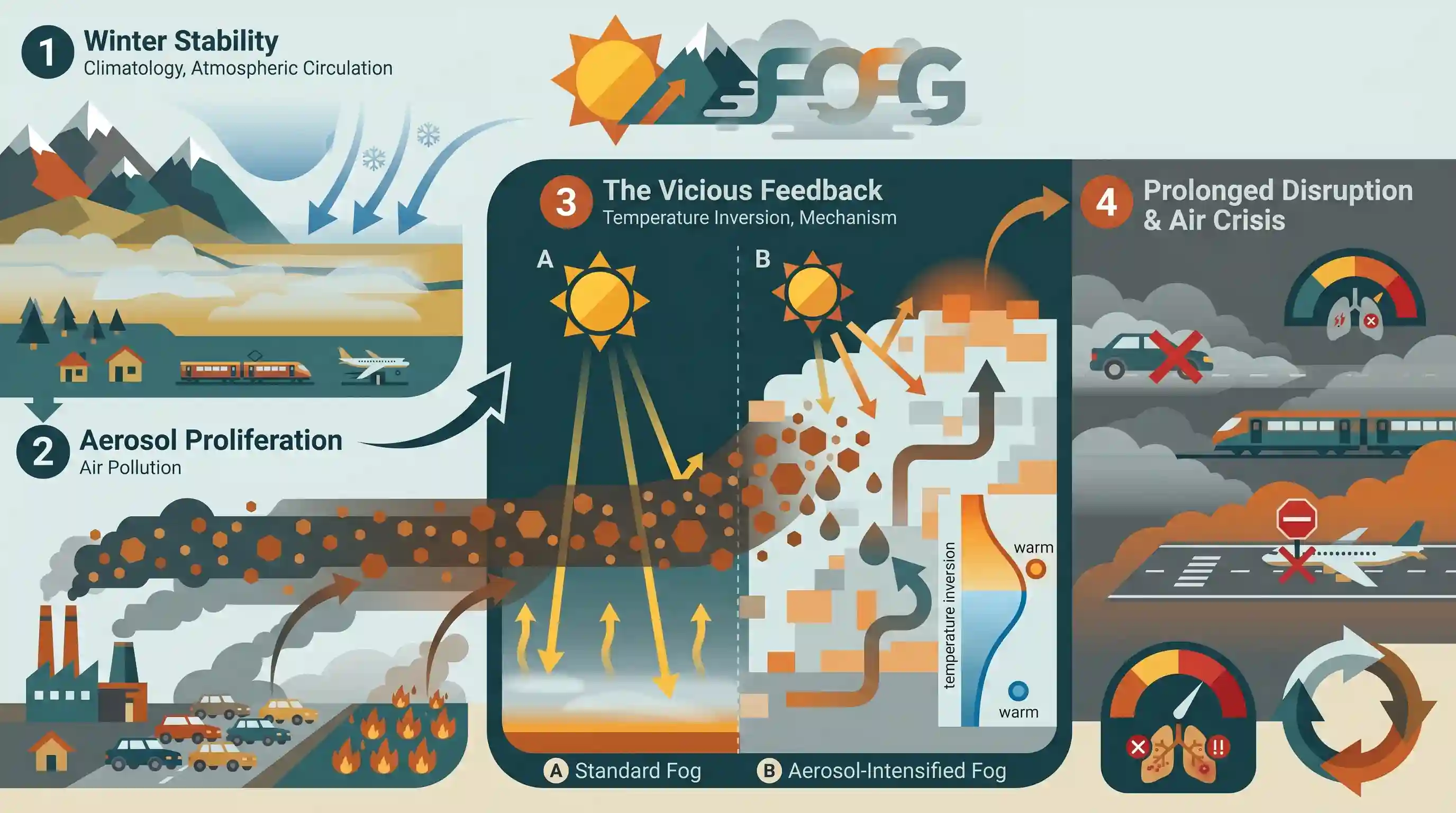
Why It Matters
Provides a scientific explanation (involving atmospheric microphysics and radiative forcing) for the recurrent winter fog and smog crisis in the Indo-Gangetic Plain. It directly connects anthropogenic pollution with physical geographical phenomena like fog formation and temperature inversion.
Summary
A study by the Indian Institute of Tropical Meteorology (IIT-M) highlights how high concentrations of atmospheric aerosols thicken and prolong winter fog over North India. By acting as condensation nuclei and blocking solar radiation, these aerosols induce temperature inversions that lift and sustain the fog as low-level clouds, severely disrupting transport and exacerbating the region's air quality crisis.
Key Points
- Aerosols in the atmosphere act as Cloud Condensation Nuclei (CCN), creating smaller and more numerous water droplets that thicken winter fog over North India.
- Elevated aerosol layers scatter and absorb solar radiation, cooling the Earth's surface and strengthening temperature inversions. This dynamic lifts the fog into persistent low-level clouds.
- The Indo-Gangetic Plain is uniquely vulnerable to this phenomenon due to its topography, stable winter meteorological conditions, and high anthropogenic aerosol emissions (such as biomass burning and vehicular pollution).
- The prolonged and thickened fog severely disrupts aviation, railway, and road transport, while concurrently worsening respiratory health by trapping toxic pollutants near the surface.
Important Terms
Indian Institute of Tropical Meteorology (IITM)

An autonomous research organization under the Ministry of Earth Sciences (MoES), Pune, specializing in tropical meteorology, monsoon dynamics, and atmospheric science research in the Indian subcontinent.
UPSC context
GS Paper III (Science & Technology); focuses on national scientific institutions and their roles in climate and weather monitoring.
Aerosols
Microscopic solid or liquid particles suspended in the atmosphere (e.g., soot, dust, sulfates) that influence weather by scattering/absorbing sunlight and facilitating cloud or fog formation.
UPSC context
GS Paper I (Geography) and GS III (Environment); crucial for understanding air pollution, global dimming, and regional weather patterns.
Temperature Inversion
A meteorological phenomenon where a layer of warm air settles above cooler air, reversing the normal lapse rate and trapping pollutants and moisture near the ground.
UPSC context
GS Paper I (Climatology); central to explaining winter smog persistence and fog dynamics in the Indo-Gangetic Plain.
Cloud Condensation Nuclei (CCN)
Small atmospheric particles (often aerosols) that provide the necessary surface for water vapor to condense into droplets, forming clouds or fog.
UPSC context
GS Paper I (Physical Geography); essential for understanding precipitation processes and the impact of pollution on cloud physics.
Indo-Gangetic Plain (IGP)
A vast, low-lying region in North India particularly vulnerable to intense winter fog and air quality crises due to topography, high aerosol loading, and atmospheric stability.
UPSC context
GS Paper I (Regional Geography) and GS III (Environment); frequently tested for its unique environmental challenges and seasonal pollution.
Radiative Cooling
The process by which the Earth’s surface and atmosphere lose heat by emitting longwave radiation, leading to cooling that facilitates ground-level fog formation.
UPSC context
GS Paper I (Geography); key to understanding the Earth's energy budget and the formation of radiation fog.
Prelims Trap
High aerosol concentrations create larger water droplets that become heavy and precipitate, dissipating the winter fog.
Aerosols act as condensation nuclei to produce smaller, more numerous droplets. These stay suspended and scatter light, thickening the fog, rather than precipitating out.
Static Concepts Connected
What is Temperature Inversion and what are its ideal conditions?
- Definition: The reversal of the normal environmental lapse rate, where temperature increases with altitude in the lower troposphere.
- Ideal Conditions: Long winter nights, clear skies, calm winds, and a dry air mass near the surface to allow rapid radiational cooling of the ground.
- Impact: It creates a stable atmospheric layer that traps pollutants and moisture close to the ground, drastically increasing smog and fog persistence.
How does Radiation Fog differ from Advection Fog?
- Radiation Fog: Forms over land on calm, clear nights when the ground cools rapidly via radiation, cooling the air immediately above it to its dew point (common in North India).
- Advection Fog: Forms when a warm, moist air mass moves horizontally (advects) over a cooler surface, transferring heat downward and cooling the air to condensation (common in coastal areas).
Cross-Topic Patterns
IGP Topography & the Valley Effect
The Himalayas block the dispersion of prevailing winds, creating a 'valley effect'. This topographical trap combines with winter temperature inversions and aerosol loading to sustain annual smog crises.
Biomass Burning as CCN Source
Crop residue burning in NW India directly contributes primary aerosols (black carbon) that act as Cloud Condensation Nuclei, feeding the feedback loop that thickens regional winter fog.

Expect a Prelims 2026 multi-statement question linking aerosol-induced temperature inversions to the specific topography of the IGP.
Linked PYQs · 4
Linked PYQs · 4
- 2013MainsGS1
What do you understand by the phenomenon of 'temperature inversion' in meteorology? How does it affect weather and the habitants of the place?
- 2022MainsGS3
Discuss in detail the photochemical smog emphasizing its formation, effects and mitigation. Explain the 1999 Gothenburg Protocol.
- 2022PrelimsGS1
In the context of WHO Air Quality Guidelines, consider the following statements: 1. The 24-hour mean of PM2.5 should not exceed 15 µg/m³ and annual mean of PM2.5 should not exceed 5 µg/m³. 2. In a year, the highest levels of ozone pollution occur during the periods of inclement weather. 3. PM10 can penetrate the lung barrier and enter the bloodstream. 4. Excessive ozone in the air can trigger asthma. Which of the statements given above are correct?
- 2025PrelimsGS1
Artificial way of causing rainfall to reduce air pollution makes use of
