National Highway Toll Barriers and Constitutional Federalism Issues
Source:himachalscape ↗
Why It Matters
This case highlights crucial constitutional principles regarding federalism, the distribution of legislative powers under the Seventh Schedule, and the mechanism of Union control over states via Articles 256 and 257.
Summary
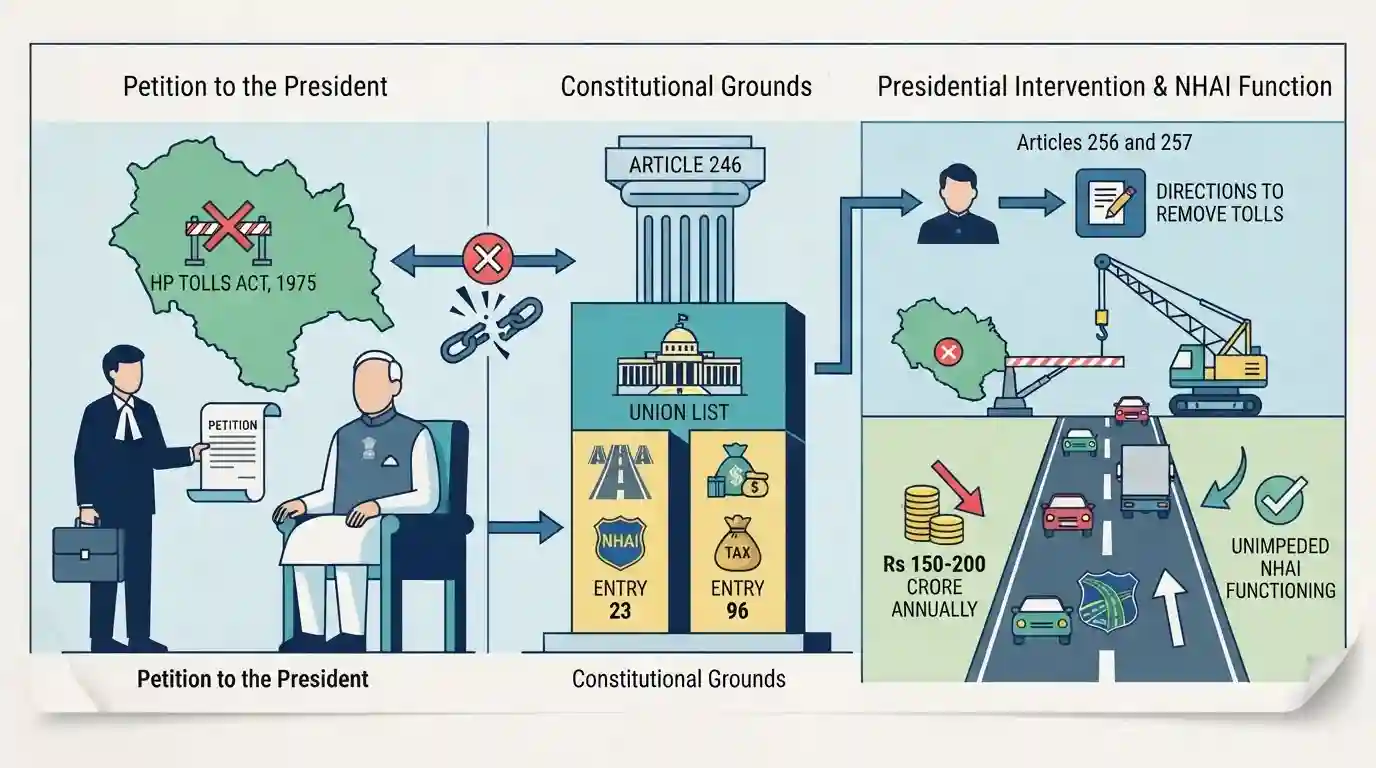
An advocate has submitted a petition to the President of India challenging the Himachal Pradesh government's authority to establish toll barriers on National Highways. The petition argues that tolls on National Highways fall exclusively under the Union's domain under Article 246 (Entries 23 and 96 of the Union List), and that the state's actions under the Himachal Pradesh Tolls Act, 1975 violate constitutional boundaries. Seeking presidential intervention under Articles 256 and 257, the petition asks for directions to remove these toll barriers, which currently yield Rs 150-200 crore annually for the state but impede the functioning of the National Highways Authority of India (NHAI).
Key Points
- Advocate Uttansh Monga petitioned the President of India under Articles 256 and 257, seeking the removal of toll barriers set up by the Himachal Pradesh Government on National Highways.
- The petitioner argues that levying tolls on National Highways lies strictly within the Union's domain, making HP's collection a violation of legislative competence under Article 246 (Entries 23 and 96 of the Union List) and Article 254 (repugnancy).
- Under the Himachal Pradesh Tolls Act, 1975 and Toll Policy for 2026-27, the state classifies National Highways as 'Road Infrastructure', yielding around Rs 150-200 crore annually.
- The petition highlights that the barriers act as physical impediments to the administration, operation, and regulation of highways by the NHAI.
- The petition urges the President to direct the HP State Government to comply with federal laws, prevent interference with Union functions, and immediately dismantle the toll barriers.
Important Terms
Article 246

A constitutional mechanism dividing legislative subjects. Article 246 gives Parliament exclusive power over the Union List, states exclusive power over the State List, and both concurrent power over the Concurrent List, establishing India's quasi-federal structure.
UPSC context
GS Paper 2 (Polity). Central to Centre-State relations, the Seventh Schedule, and federalism debates.
Articles 256 and 257
Constitutional provisions granting the Union power to direct states. Article 256 requires states to comply with Union laws, while Article 257 ensures state executive actions do not impede the Union's executive power.
UPSC context
GS Paper 2 (Polity). Tests the unitary bias in India's federal structure and Centre-State administrative relations.
National Highways Authority of India (NHAI)
A statutory body under the Ministry of Road Transport and Highways, established in 1988. It develops, maintains, and manages India's national highway network, including toll collection and implementing projects like Bharatmala.
UPSC context
GS Paper 3 (Infrastructure). Tests knowledge of statutory bodies, transport infrastructure, and road network management.
Himachal Pradesh Tolls Act, 1975
A state law authorizing the Himachal Pradesh government to levy and collect tolls on mechanical vehicles passing over road infrastructure and establish toll barriers within the state.
UPSC context
GS Paper 2 (Polity). Illustrates state legislative actions that can conflict with Union powers, triggering federal disputes.
Prelims Trap
Under Entry 59 of the State List, State governments have the exclusive power to levy tolls on all highways passing through their territory.
While "Tolls" is indeed a State List subject (Entry 59), this power is restricted to state-owned infrastructure. National Highways fall strictly under the Union List (Entry 23).
Static Concepts Connected
How does the Constitution enforce Union administrative directions on States?
- Article 256: Mandates states to exercise executive power to ensure compliance with laws made by Parliament.
- Article 257(2): Empowers the Union to issue directions to states for constructing and maintaining communications of national or military importance (like National Highways).
- Article 365: If a state fails to comply with Union directions, the President can declare a constitutional breakdown, opening the door for President's Rule (Article 356).
How are powers regarding roads and tolls distributed in the 7th Schedule?
- Entry 23 (Union List): Gives the Union exclusive legislative competence over highways explicitly declared by Parliament to be National Highways.
- Entry 13 (State List): Gives states control over communications, roads, bridges, and ferries, but this is explicitly subject to the provisions of List I.
- Entry 59 (State List): Grants states the power to levy tolls, though this cannot be legally extended to assets under the Union's exclusive domain.
Cross-Topic Patterns
Fiscal federalism & 7th Schedule friction
Cash-strapped states often stretch legislative boundaries for revenue, such as HP classifying National Highways as state 'Road Infrastructure'. This highlights ongoing Centre-State fiscal federalism disputes.
The Article 257-365-356 Pipeline
UPSC heavily tests administrative relations. Non-compliance with central directions regarding national highways (Article 257) triggers Article 365, serving as a constitutional prerequisite for invoking President's Rule (Article 356).

Expect a tricky Prelims statement pairing the State List's Entry 59 (Tolls) with the Union's power to issue directives under Article 257.
Linked PYQs · 2
Linked PYQs · 2
- 2024HPAS_PRELIMSGS1
Consider the following statements : (1) Constitution amendment bill can be introduced in any house of the parliament. (2) Centre and States have equal power to amend the constitution. (3) Amendment in the seventh schedule requires the ratification by the legislatures of not less than half of the states. (4) Basic structure of the constitution can also be amended. Choose the correct answer from the options given below :
- 2011HPAS_PRELIMSGS1
Which one of the following is no longer a source of income of urban local bodies in Punjab, Haryana and Himachal Pradesh ?
