AI Governance Framework and Child Specific Safety Guardrails
Source:The Hindu ↗
Why It Matters
This topic is highly relevant for GS-2 and GS-3 questions regarding the regulation of emerging technologies, the socio-economic impacts of digital tools on vulnerable sections (especially children), and the broader ethical/governance challenges surrounding Artificial Intelligence.
Summary
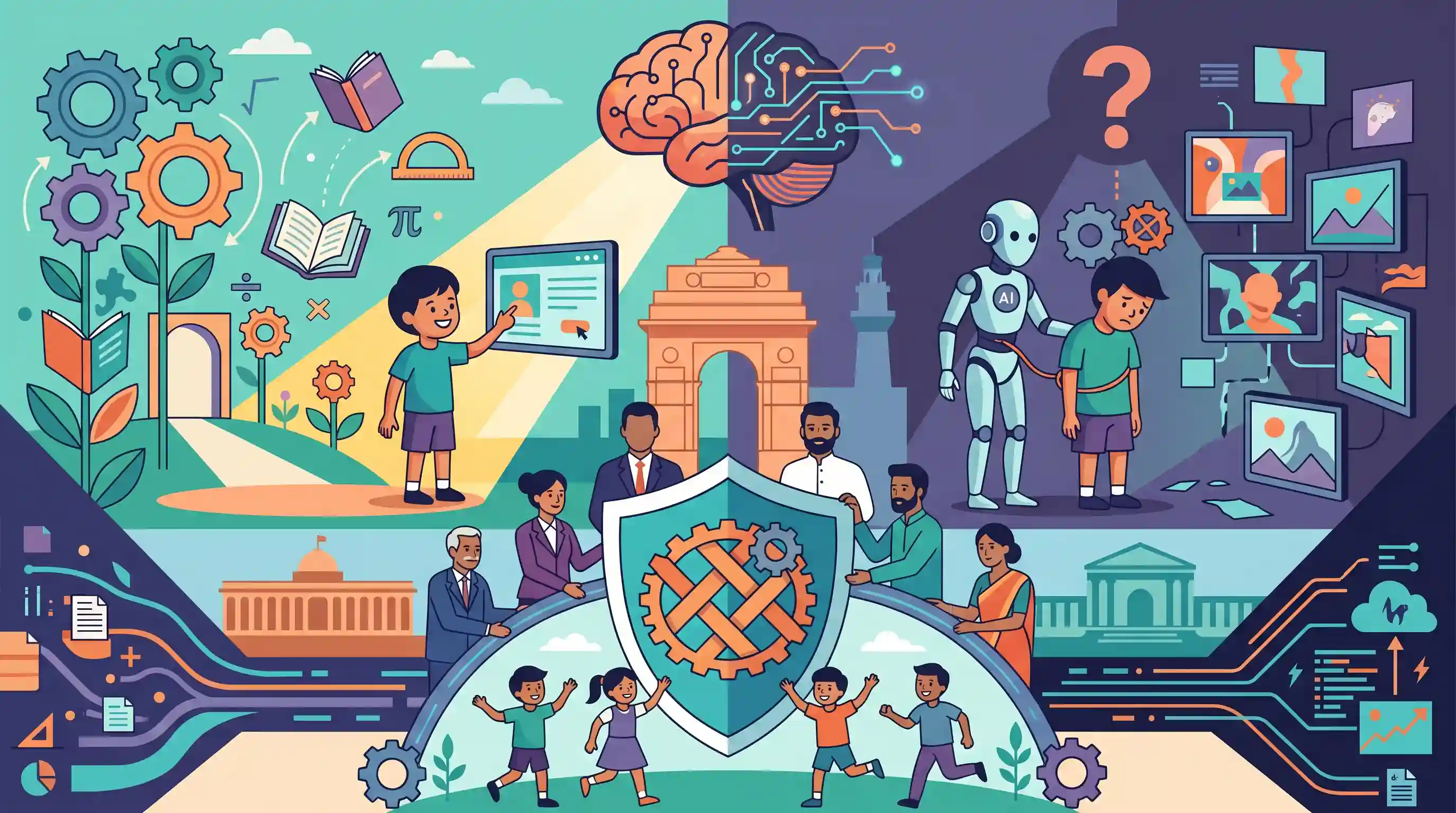
At the AI Impact Summit in New Delhi, India\'s Principal Scientific Adviser Ajay Kumar Sood highlighted the necessity of a robust AI governance framework, particularly focusing on child-specific safeguards. Acknowledging AI as a double-edged sword, he noted that while it can revolutionize education through personalized pedagogy, an over-reliance on AI tools poses risks to children's critical thinking and independent problem-solving abilities. The address underscored the need for more empirical evidence on how synthetic media and AI companions affect children's long-term mental health and cognitive development, urging policymakers to ensure that future generations do not become victims of today's technology.
Key Points
- The Principal Scientific Adviser emphasized at the AI Impact Summit that artificial intelligence is a double-edged sword requiring a balanced governance framework.
- There is an urgent need to embed child-specific safeguards and guardrails into AI governance due to the rising exposure of children to AI companions and synthetic media.
- While AI offers advantages in education such as personalized pedagogy and timely feedback, over-reliance on these tools can weaken critical thinking and independent problem-solving skills.
- Further empirical evidence is required to understand the long-term impacts of AI-driven platforms on a child\'s cognitive development, mental health, and overall education.
Important Terms
Principal Scientific Adviser (PSA)

The chief advisor to the Government of India on scientific policy and innovations of strategic socio-economic importance, holding a rank equivalent to a Cabinet Secretary.
UPSC context
GS Paper II & III: Critical for understanding high-level scientific decision-making and the formulation of national S&T policies.
AI Governance Framework
A set of policies, laws, and ethical guidelines designed to manage AI development, balancing rapid innovation with safety, transparency, and accountability through a risk-based approach.
UPSC context
GS Paper II & III: Key for questions on technology regulation, ethics in AI, and digital sovereignty.
Synthetic Media
Any digital content—including images, videos, audio, or text—that has been partially or fully generated or manipulated using artificial intelligence and machine learning.
UPSC context
GS Paper III: Essential for discussing deepfakes, cybersecurity, and the challenges of misinformation in the digital age.
Personalized Pedagogy
An educational approach using AI to tailor teaching methods, learning materials, and feedback to the individual needs, pace, and abilities of each student.
UPSC context
GS Paper II: Relevant to 'Issues relating to Education' and the implementation of the National Education Policy (NEP) 2020.
AI Companions
AI-powered systems, such as chatbots or robots, designed to simulate emotional companionship and provide support through human-like interaction and natural language processing.
UPSC context
GS Paper II & IV: Pertinent to social issues like mental health, child welfare, and the ethics of human-machine interaction.
Prelims Trap
The Office of the Principal Scientific Adviser is a statutory body under the Ministry of Science and Technology.
The PSA office is a non-statutory body created in 1999 by a Cabinet decision. It functions under the Cabinet Secretariat, not the S&T Ministry.
Static Concepts Connected
What is the mandate and structure of the Office of the PSA?
- Establishment: Created in 1999 via Cabinet decision (non-statutory) to provide pragmatic, objective advice to the Prime Minister and Cabinet on S&T matters.
- PM-STIAC Role: The PSA chairs the Prime Minister’s Science, Technology, and Innovation Advisory Council (PM-STIAC), which drives national missions like the National Quantum Mission.
- Nodal Authority: Functions under the Cabinet Secretariat and coordinates inter-ministerial S&T implementations.
How is 'Synthetic Media' (Deepfakes) currently regulated in India?
- IT Rules 2021: Under the Information Technology Rules, 2021, intermediaries must remove morphed or impersonated content within 24-36 hours upon receiving a user complaint.
- Bharatiya Nyaya Sanhita: BNS provisions address cheating by personation and forgery, which authorities apply to cases of deepfake financial frauds and identity theft.
- DPDP Act 2023: Mandates strict consent architectures for processing personal data, providing a layer of protection against AI scraping, especially regarding children's data.
Cross-Topic Patterns
AI Governance + Child Rights under DPDP Act
The intersection of GS3 (AI tech) and GS2 (vulnerable sections) is rising. Expect questions linking deepfakes and AI companions to child privacy rights under the recent DPDP Act.
IndiaAI Mission + Global South Diplomacy
India leverages its digital public infrastructure (DPI) and human-centric AI frameworks as a soft-power tool to lead the Global South agenda at multilateral forums like the G20 and GPAI.

Expect a 2026 Mains GS3/Essay question evaluating the trade-off between AI-driven personalized education and cognitive skill erosion.
Linked PYQs · 4
Linked PYQs · 4
- 2025MainsGS2
The National Commission for Protection of Child Rights has to address the challenges faced by children in the digital era. Examine the existing policies and suggest measures the Commission can initiate to tackle the issue.
- 2023MainsGS1
Child cuddling is now being replaced by mobile phones. Discuss its impact on the socialization of children.
- 2020MainsGS1
How have digital initiatives in India contributed to the functioning of the education system in the country? Elaborate your answer.
- 2023MainsGS3
Introduce the concept of Artificial Intelligence (AI). How does Al help clinical diagnosis? Do you perceive any threat to privacy of the individual in the use of Al in healthcare?
