Wildlife authorities release tiger in Papikonda national park
Source:The Hindu ↗
Why It Matters
The article highlights the functional connectivity of wildlife corridors between Central India and the Eastern Ghats, a crucial geographic concept for UPSC. It also demonstrates practical applications of conservation technologies (VHF/GPS satellite collars) and emphasizes ecosystem restoration practices like prey base augmentation.
Summary
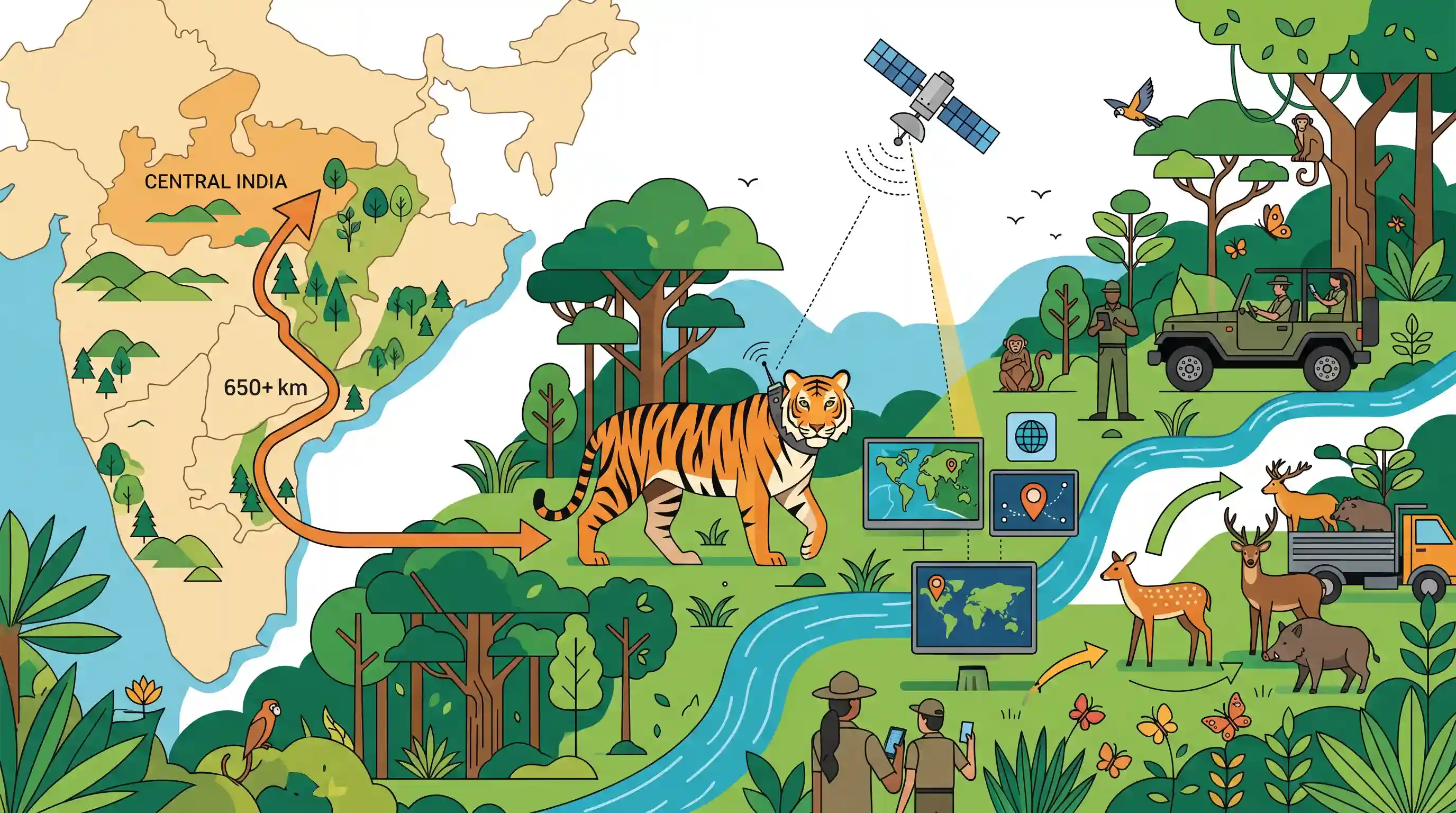
Under 'Operation Stripes', an adult male tiger named 'Explorer' was released into the Papikonda National Park in Andhra Pradesh. The tiger had migrated naturally over 650 km from Central India to the Eastern Ghats through functional wildlife corridors. Forest authorities fitted the animal with a GPS/VHF satellite collar to monitor its habitat integration and territorial establishment within the Godavari landscape, while concurrently taking measures to boost the local herbivore population to support the predator.
Key Points
- An adult male tiger named 'Explorer' was successfully released into the Papikonda National Park in Andhra Pradesh.
- The release falls under 'Operation Stripes', a wildlife rehabilitation initiative to establish apex predator populations in the Godavari landscape.
- The tiger naturally traversed over 650 km using the functional wildlife corridor connecting Central India to the Eastern Ghats.
- To monitor its movements and territory establishment, the tiger was fitted with a satellite collar equipped with GPS and VHF caller facilities.
- Forest officials are simultaneously working on augmenting the herbivore prey base within the national park to ensure the tiger's long-term survival.
Important Terms
Operation Stripes

An Andhra Pradesh wildlife management initiative for tiger conservation, habitat restoration, and predator reintroduction, exemplified by the 2026 release of the tiger 'Explorer' into Papikonda National Park.
UPSC context
GS III: Environment/Conservation; specifically state-led predator reintroduction and habitat management strategies.
Papikonda National Park
A protected area in Andhra Pradesh's Eastern Ghats along the Godavari River; a critical ecological corridor and Important Bird and Biodiversity Area (IBA).
UPSC context
GS I: Geography & GS III: Environment; tests knowledge of river-linked protected areas and biodiversity hotspots.
Wildlife Corridors
Natural pathways connecting fragmented habitats, allowing wildlife movement for breeding, genetic diversity, and climate adaptation, such as the 650km path from Central India to Eastern Ghats.
UPSC context
GS III: Conservation/Biodiversity; critical for questions on habitat fragmentation and landscape-level conservation.
National Tiger Conservation Authority (NTCA)
A statutory body under the Ministry of Environment, Forest and Climate Change providing oversight, technical support, and legal frameworks for tiger conservation in India.
UPSC context
GS II: Statutory Bodies; GS III: Environment; key institution for Project Tiger implementation.
Satellite Collaring
Conservation technology using GPS and VHF telemetry to track animal movement, habitat use, and territory establishment in real-time, often used in translocation projects.
UPSC context
GS III: Science & Technology in Conservation; application of space technology for wildlife monitoring.
Tadoba-Andhari Tiger Reserve (TATR)
Maharashtra's oldest and largest tiger reserve; a vital source population for tiger dispersal across the Central Indian and Eastern Ghats landscapes.
UPSC context
GS I: Geography; tests mapping of major tiger reserves and their roles in the tiger landscape.
Umbrella Species
A species whose conservation indirectly protects numerous other species within its ecosystem; tigers serve as umbrella species for forest and water catchment preservation.
UPSC context
GS III: Environment/Ecology; fundamental concept in multi-species conservation strategies.
Prelims Trap
"Papikonda National Park is an NTCA-designated Tiger Reserve intersected by the Krishna River."
Papikonda is a National Park situated in the Eastern Ghats and intersected by the Godavari River (not Krishna). Furthermore, it is not an officially notified Tiger Reserve under Project Tiger.
Static Concepts Connected
What are the geographical and ecological features of Papikonda National Park?
- Geography: Located in the Papi Hills of the Eastern Ghats in Andhra Pradesh, deeply intersected by the Godavari River.
- Forest type: Dominated by Southern Tropical Dry Deciduous and Moist Deciduous forests.
- Ecological significance: Recognized globally as an Important Bird and Biodiversity Area (IBA) by BirdLife International.
What is the difference between VHF and GPS collars in wildlife telemetry?
- VHF telemetry: Uses Very High Frequency radio signals; requires researchers to be in close proximity with a directional antenna to track the animal.
- GPS telemetry: Records exact geographical coordinates and transmits data via satellites, allowing remote, real-time tracking of long-distance migrations.
- Conservation utility: Helps map functional wildlife corridors, predict human-wildlife conflict zones, and monitor rehabilitated animals without recapture.
Cross-Topic Patterns
Linear infrastructure vs. Wildlife corridors
The tiger's 650 km migration highlights the ecological threat of linear infrastructure (highways, canals) in Central India, frequently tested in GS-3 under Environmental Impact Assessments (EIA) and mitigation structures.
Prey base and Carrying Capacity
Augmenting herbivores links to the static ecological concept of 'carrying capacity'. Insufficient prey density limits predator populations and directly escalates human-wildlife conflict via livestock depredation.

Expect a 2026 Prelims question pairing protected areas in the Eastern Ghats (Papikonda, Sri Venkateswara) with their intersecting rivers.
Linked PYQs · 5
Linked PYQs · 5
- 2017PrelimsGS1
The term 'M-STRIPES' is sometimes seen in the news in the context of
- 2021PrelimsGS1
The term 'ACE2' is talked about in the context of
- 2024PrelimsGS1
Consider the following activities : 1. Identification of narcotics on passengers at airports or in aircraft 2. Monitoring of precipitation 3. Tracking the migration of animals In how many of the above activities can the radars be used?
- 2017PrelimsGS1
From the ecological point of view, which one of the following assumes importance in being a good link between the Eastern Ghats and the Western Ghats?
- 2020PrelimsGS1
Among the following Tiger Reserves, which one has the largest area under "Critical Tiger Habitat"?
