Policy Frameworks for Wastewater Recycling and Circular Water Economy
Source:The Hindu ↗
কেন এটি গুরুত্বপূর্ণ
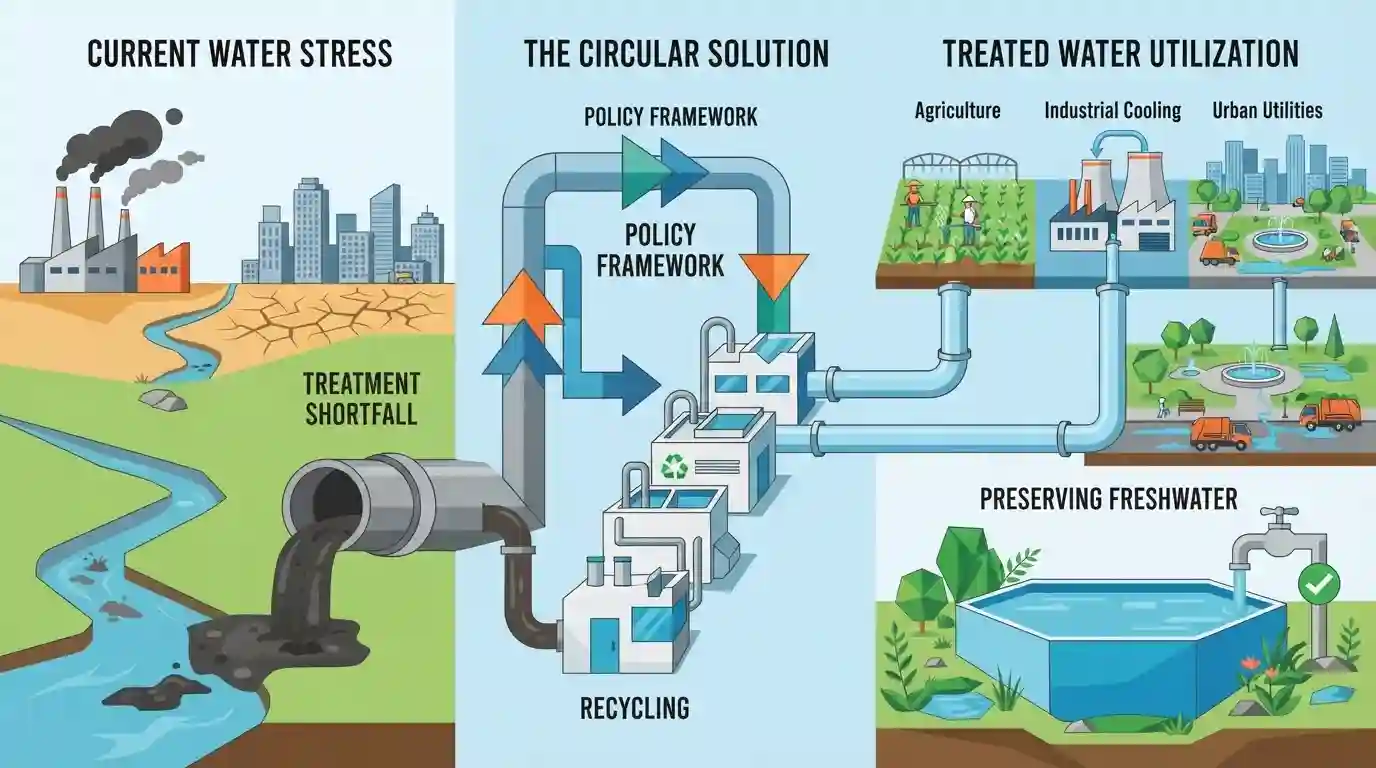
As India grapples with acute water stress, groundwater depletion, and river pollution, shifting toward wastewater recycling and a circular water economy is critical for sustainable development and national water security.
সারসংক্ষেপ
The article emphasizes the urgent need for India to adopt robust policy frameworks and infrastructure for the reuse of treated wastewater. Highlighting the shortfall in sewage treatment and widespread water stress, it argues for transitioning toward a circular water economy by mandating treated water utilization in agriculture, industrial cooling, and urban utilities to preserve depleting freshwater resources.
মূল বিষয়
- India faces severe water scarcity, making the management and reuse of treated wastewater an urgent imperative rather than an option.
- Most sewage treatment plants (STPs) underperform, and a large fraction of wastewater remains untreated, polluting rivers and groundwater aquifers.
- A comprehensive national policy framework is required to mandate treated wastewater reuse in non-potable sectors like agriculture, industry, thermal power plants, and urban landscaping.
- Economic incentives, pricing mechanisms, and decentralized treatment infrastructure are essential to shift from linear water consumption models to a circular water economy.
গুরুত্বপূর্ণ শব্দ
National Water Policy

A comprehensive policy framework formulated by the Ministry of Jal Shakti to govern the planning, development, and conservation of water resources, emphasizing the reuse and recycling of treated wastewater in urban and industrial planning.
UPSC context
Important for UPSC CSE GS Paper I (Geography) and GS Paper III (Environment and Water Resource Management).
Namami Gange
An integrated flagship conservation mission of the Union Government aimed at abating pollution and rejuvenating the National River Ganga, which increasingly promotes treating sewage as a resource for non-potable reuse.
UPSC context
Relevant for UPSC GS Paper III under environment conservation, river pollution, and sustainable development initiatives.
Central Pollution Control Board (CPCB)
A statutory apex organization under the Ministry of Environment, Forest and Climate Change tasked with maintaining water and air quality standards, monitoring sewage treatment, and regulating industrial effluent discharge.
UPSC context
Crucial for UPSC GS Paper II (Statutory Bodies) and GS Paper III (Environmental Pollution and Regulation).
Niti Aayog
The premier public policy think tank of the Government of India that provides strategic policy inputs, cooperative federalism frameworks, and evaluation metrics for sustainable resource management and water security indices.
UPSC context
Important for UPSC GS Paper II (Governance and Institutional Bodies) and GS Paper III (Economic Development and Planning).
প্রিলিমস ফাঁদ
mandating treated wastewater reuse across all states uniformly
Aspirants often assume India's National Water Policy legally mandates and enforces penal actions for wastewater reuse across all states, whereas water is a State subject under Entry 17 of the State List.
সংযুক্ত স্থির ধারণা
What are the key institutional mechanisms and legal frameworks for water pollution control in India?
- CPCB Role: Statutory body established in 1974 under the Water (Prevention and Control of Pollution) Act to coordinate state boards and set standards.
- Regulatory Powers: Enforces consent to establish and consent to operate mechanisms for industries discharging effluents into water bodies.
- National Water Policy: Comprehensive framework addressing water allocation priorities, emphasizing water as a scarce economic good, and promoting recycling.
আন্তঃবিষয় প্যাটার্ন
Circular Economy + Urban Local Governance
Urban local bodies shifting from pure service providers to commercial water-utility vendors creates new dimensions for municipal governance under the 74th Constitutional Amendment.
Water Security + Energy Transition Nexus
Substituting freshwater with treated wastewater in thermal power plants directly impacts industrial compliance costs and eases agricultural-urban water conflicts.

Expect a statement-based prelims question combining freshwater availability statistics with circular water economy models like the Nagpur Model.
সংযুক্ত PYQ · 3
সংযুক্ত PYQ · 3
- 2024MainsGS3
Industrial pollution of river water is a significant environmental issue in India. Discuss the various mitigation measures to deal with this problem and also the government's initiatives in this regard.
- 2013MainsGS3
Enumerate the National Water Policy of India. Taking river Ganges as an example, discuss the strategies which may be adopted for river water pollution control and management. What are the legal provisions of management and handling of hazardous wastes in India?
- 2024PrelimsGS1
"Membrane Bioreactors" are often discussed in the context of:
