Andhra Pradesh mandates AI and blockchain for e-governance portals
Source:new-indian-express ↗
Why It Matters
The article highlights practical state-level applications of emerging technologies in governance (Data Lake, Blockchain) and crucial climate adaptation strategies (river interlinking and real-time crop analytics) that frequently feature in APPSC Prelims regarding AP geography, economy, and state initiatives.
Summary
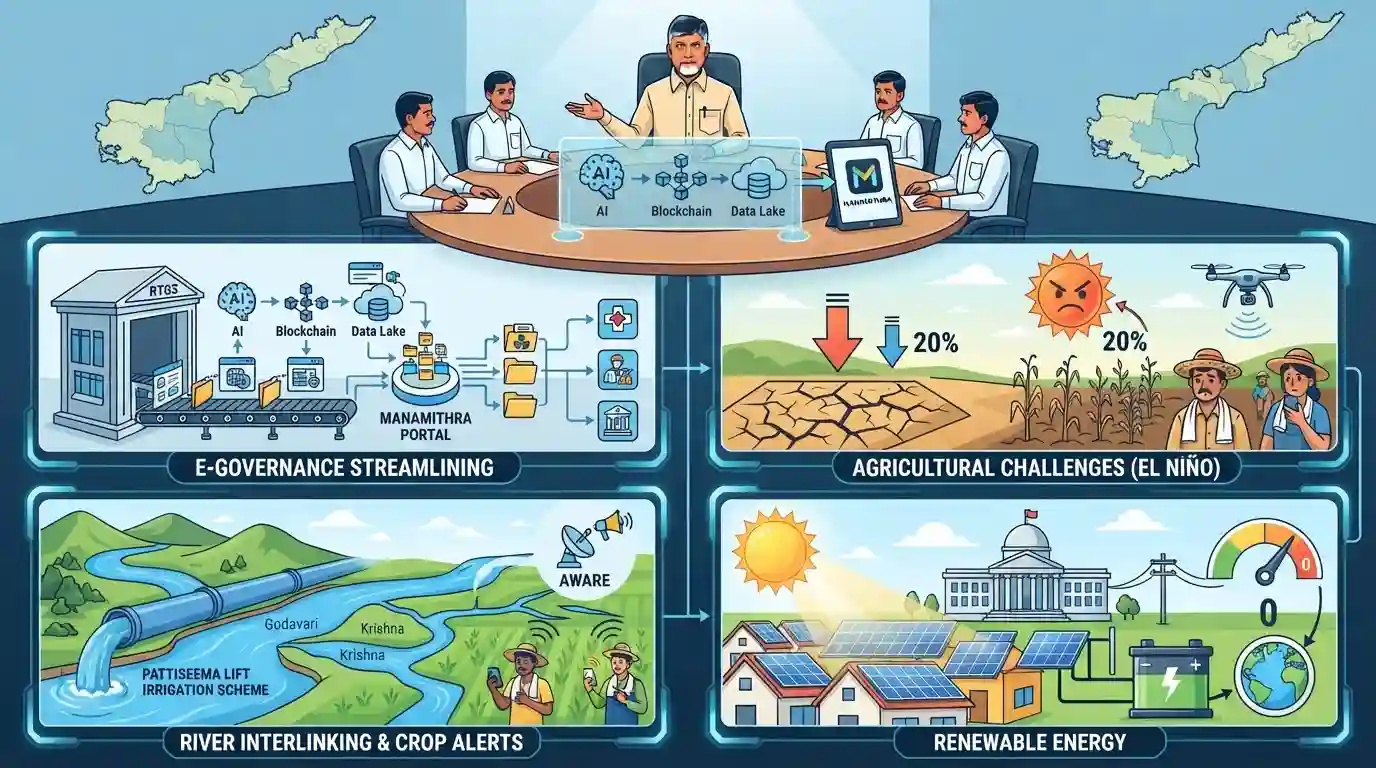
Andhra Pradesh Chief Minister N. Chandrababu Naidu conducted a comprehensive review meeting with the Real-Time Governance Society (RTGS), mandating the adoption of advanced technologies like AI, Blockchain, and Data Lake to streamline the Manamithra e-governance portal. The review also addressed significant agricultural challenges, noting a 20% drop in expected crop yields due to El Niño. To counter this, the government is utilizing the Pattiseema Lift Irrigation Scheme to divert Godavari water to the Krishna Delta and using the AWARE platform for real-time crop alerts. Additional highlights included successful public health interventions that sharply reduced dengue cases and a renewed focus on rooftop solar power to reach state carbon neutrality goals.
Key Points
- AP government is integrating AI, Blockchain, and Data Lake technologies into the Manamithra WhatsApp portal to enable seamless, paperless e-governance and eliminate manual certificate uploads.
- A projected 20% decline in crop yields due to El Niño is being mitigated by routing Godavari river water to the Krishna Delta via the Pattiseema Lift Irrigation Scheme.
- The AWARE platform, integrated with APTS Analytics, is actively issuing real-time crop alerts to farmers and monitoring agricultural conditions.
- The state reported a significant reduction in dengue cases due to targeted vector control and outlined future strategies for rooftop solar expansion to achieve carbon neutrality.
Important Terms
Real-Time Governance Society (RTGS)

An e-governance framework in Andhra Pradesh that integrates IoT, weather systems, and citizen feedback into a unified platform to enable proactive, data-driven decision-making and rapid public service delivery.
UPSC context
Crucial for APPSC Group-I Paper-III (Governance) and Paper-V (Science & Tech) to illustrate state-level advanced e-governance applications.
AWARE Platform
The Advanced Warning Advisory for Resilient Ecosystem (AWARE) is an RTGS-operated system utilizing satellite and historical data for real-time early warnings regarding weather, agricultural risks, and public health outbreaks.
UPSC context
Highly relevant for APPSC Paper-IV (Disaster Management) and Paper-V (ICT), showcasing space tech applications in state administration.
Pattiseema Lift Irrigation Scheme
A major river-interlinking project in Andhra Pradesh that pumps surplus Godavari water into the Krishna River basin, acting as a lifeline for Krishna Delta farmers during rainfall deficits.
UPSC context
Vital for APPSC Paper-II (AP Geography) and Paper-V (AP Economy), specifically illustrating river interlinking and drought mitigation.
Manamithra Portal
A flagship citizen-centric e-governance portal in AP, recently upgraded with AI and Blockchain, designed to seamlessly deliver hundreds of public services and improve administrative transparency.
UPSC context
Important for APPSC Paper-III (Governance) as a prime example of digital public service delivery and citizen empowerment.
State Data Lake
A centralized digital repository in AP that consolidates massive datasets from over 40 government departments, facilitating real-time analytics, AI integration, and evidence-based policymaking within the RTGS framework.
UPSC context
Relevant for APPSC Paper-V (Science & Technology) concerning big data management and technological integration in state governance.
Prelims Trap
"Pattiseema Lift Irrigation diverts surplus water from the Krishna River to the Godavari basin."
It is the exact reverse. Pattiseema lifts surplus water from the Godavari River and diverts it to the Krishna basin to stabilize the delta.
Static Concepts Connected
What is the geographical significance of the Pattiseema Lift Irrigation Scheme?
- Core Objective: It is India's first operational river-linking project, designed to transfer surplus Godavari water to the Krishna basin.
- Key Infrastructure: Lifts water from the Godavari into the Polavaram Right Main Canal, which then flows down to the Prakasam Barrage.
- Primary Beneficiary: Stabilizes the agricultural ayacut in the Krishna Delta, heavily mitigating the impacts of erratic monsoons and regional water scarcity.
How does El Niño affect Indian agriculture and monsoon patterns?
- Ocean Warming: Involves the periodic, abnormal warming of surface waters in the central and eastern equatorial Pacific Ocean.
- Monsoon Deficit: Disrupts atmospheric circulation, typically weakening the Southwest Monsoon and causing rainfall deficits or severe droughts across the Indian subcontinent.
- Agro-economic Impact: Leads to delayed sowing and lower crop yields, forcing state governments to activate real-time alerts and diversion irrigation.
Cross-Topic Patterns
E-governance + Blockchain integration
AP's RTGS integrating Blockchain and Data Lakes for the Manamithra portal bridges the static APPSC syllabus topics of IT in public administration, data security, and emerging technologies.
Climate anomalies + Irrigation strategies
Mitigating El Niño's crop yield drop via the Pattiseema Godavari-Krishna link perfectly demonstrates state-level climate adaptation utilizing mega-irrigation infrastructure.

Expect a multi-statement question combining Pattiseema's river-linking geography with El Niño's specific impacts on AP's crop yields.
Linked PYQs · 3
Linked PYQs · 3
- 2019APPSC_PRELIMSGS1
What is the name of the project launched with the objective of computerization of Urban, Local bodies ?
- 2023APPSC_PRELIMSGS1
Apex Council of Godavari and Krishna river water resources and their management consists of
- 2019APPSC_PRELIMSGS1
El-Nino is a complex weather system that appears once every three to seven years. Consider the following statements in this regard : A. The appearance of warm currents off the Coast of Peru in the Eastern Pacific. B. The word El-Nino means 'Christ Child' because the current appears around Christmas in December. C. El-Nino was one of the reasons for the deficit rainfall in India (2014). Which of the statements given above is/are correct ?
