Juvenile Delinquency Trends and Violent Offence Statistics
Source:The Hindu ↗
Why It Matters
The changing patterns in juvenile delinquency—specifically the rise in violent crimes amidst digital exposure (cyberbullying, online misogyny)—are directly relevant to GS-1 (Society and Socialization) and GS-2 (Issues relating to the development and management of Social Sector/Services relating to Children). It provides vital data for mains answers concerning youth demographics, crime, and the effectiveness of the juvenile justice system.
Summary
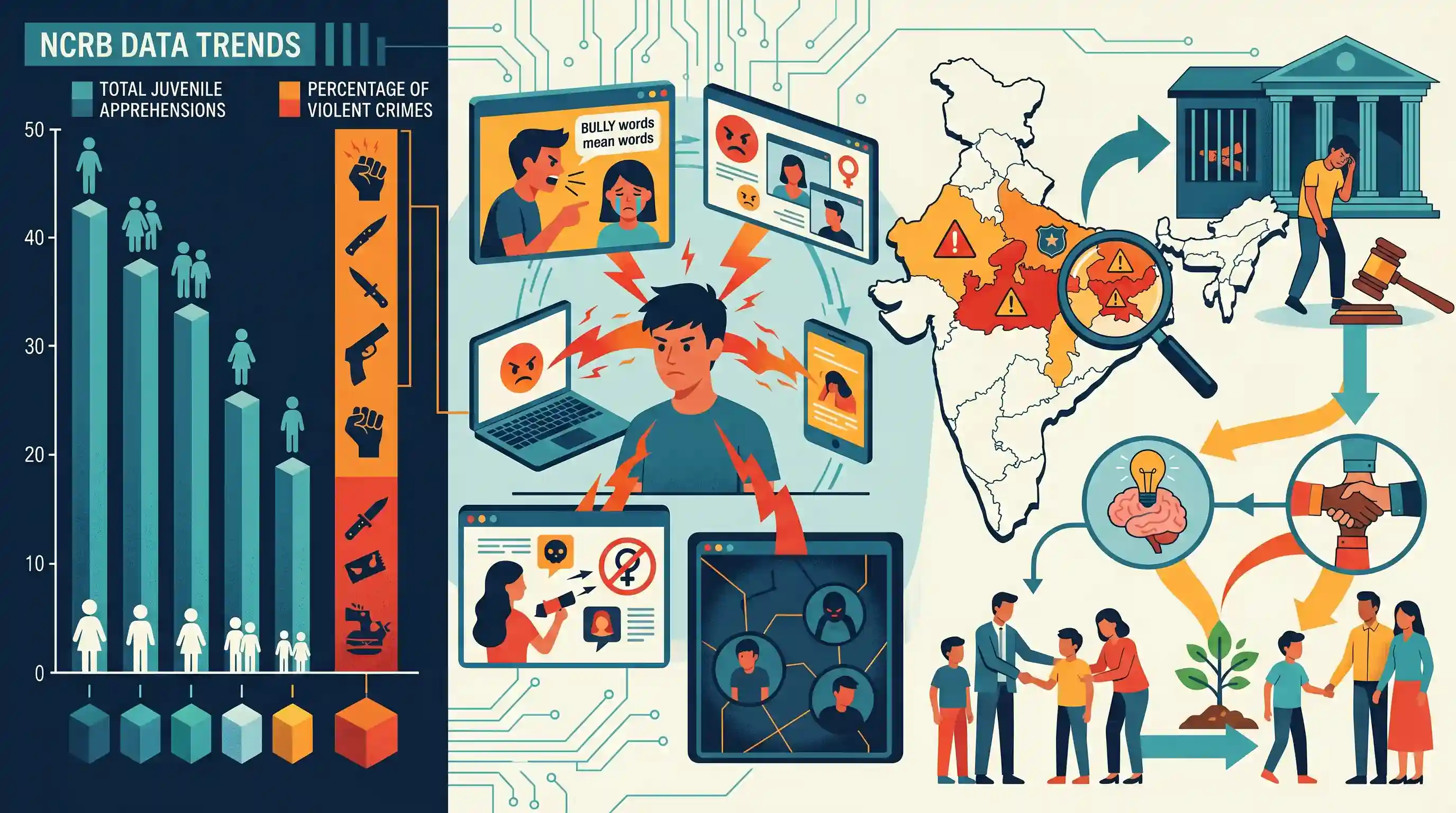
Recent data from the National Crime Records Bureau (NCRB) reveals a concerning trend in juvenile delinquency in India: while the absolute number of juveniles in conflict with the law has declined over the past few years, the proportion of those apprehended for violent crimes has surged significantly, nearing 50% in 2022. This mirrors a global phenomenon where issues like cyberbullying, online misogyny, and the involuntary celibate (incel) subculture are increasingly influencing adolescent behavior. Central and eastern Indian states, particularly Madhya Pradesh and Jharkhand, have emerged as primary hotspots for these violent offenses. The shifting nature of juvenile crime poses significant challenges for the juvenile justice system, highlighting the need for comprehensive interventions that address the socio-psychological impacts of the digital era on children's socialization and rehabilitation.
Key Points
- Despite a decline in overall juvenile apprehensions in India (from 37,402 in 2017 to 33,261 in 2022), the share of those accused of violent crimes sharply increased from 32.5% in 2016 to 49.5% in 2022.
- Madhya Pradesh recorded the highest number of violent juvenile crimes, accounting for 20% of such cases between 2017 and 2022, followed by Maharashtra and Rajasthan.
- Jharkhand reported the highest proportion of violent offenses among all juvenile crimes, with 67% of cases falling under the violent category.
- Central and eastern Indian States have emerged as major hotspots for violent juvenile crimes, whereas Odisha remains an exception with only 10% of juvenile crimes being violent.
- The data underscores broader sociological concerns, such as the impact of cyberbullying, online misogyny, and the 'incel' subculture on adolescent behavioral shifts.
Important Terms
National Crime Records Bureau (NCRB)

An Indian government agency under the Ministry of Home Affairs (est. 1986) that collects and analyzes crime data. It publishes the annual "Crime in India" report, serving as the official repository for criminal statistics.
UPSC context
GS Paper 2/3: Tests knowledge of governance, security, and data-driven analysis of crime trends and police reforms.
Juvenile Justice (Care and Protection of Children) Act, 2015
Primary legislation governing the care, protection, and rehabilitation of children in India. It introduced provisions for trying 16-18-year-olds as adults for heinous crimes and established Juvenile Justice Boards and Child Welfare Committees.
UPSC context
GS Paper 2: Essential for topics on vulnerable sections and legislative measures for child welfare and justice.
Child in Conflict with the Law (JCL)
Defined under Section 2(13) of the JJ Act, it refers to any person under 18 years alleged or found to have committed an offense. The law prioritizes their reformation and social reintegration over punitive measures.
UPSC context
GS Paper 2: Relevant for social justice and human rights regarding the legal status and rehabilitation of minors.
Heinous Offence (Juvenile Context)
Under the JJ Act, an offense attracting a minimum punishment of seven years imprisonment. Such crimes trigger a preliminary assessment by the Juvenile Justice Board to determine if a minor should be tried as an adult.
UPSC context
GS Paper 2: Important for analysis of criminal justice reforms and the legal framework for trying minors.
Involuntary Celibate (Incel)
An online subculture of individuals (primarily young men) who feel unable to find romantic partners. The movement is often associated with misogyny, resentment toward women, and extremist or violent ideologies.
UPSC context
GS Paper 1/3: Relevant for contemporary social issues, online radicalization, and threats to social harmony and women’s safety.
Cyberbullying
Harassment, threats, or humiliation directed at individuals using digital platforms. In India, such actions are governed by the IT Act and the JJ Act when involving minors, impacting mental health and social safety.
UPSC context
GS Paper 3: Relevant to cybersecurity and the socio-psychological impact of digital technology on society and youth.
Prelims Trap
NCRB data shows the absolute number of juvenile apprehensions in India has continuously increased over the past five years.
Aspirants confuse the rising share of violent juvenile crimes with total numbers. Total juvenile apprehensions have actually declined; only the violent proportion surged.
Static Concepts Connected
When can a juvenile be tried as an adult under the JJ Act, 2015?
- Age Criteria: Juveniles aged 16 to 18 years can be tried as adults only if they are accused of committing 'heinous offenses'.
- Heinous Offenses: Defined as crimes that carry a minimum punishment of 7 years or more under the Indian Penal Code (IPC) or other relevant laws.
- JJB Assessment: The Juvenile Justice Board (JJB) must conduct a mandatory preliminary assessment of the child's mental and physical capacity before transferring the case to a Children's Court.
What is the mandate and nodal ministry of the NCRB?
- Nodal Ministry: Functions under the Ministry of Home Affairs (MHA); established in 1986 based on the recommendations of the National Police Commission and the MHA's Task Force.
- Key Publications: Annually publishes comprehensive data through flagship reports like 'Crime in India', 'Accidental Deaths & Suicides in India', and 'Prison Statistics India'.
- CCTNS Implementation: Acts as the nodal executing agency for managing and implementing the Crime and Criminal Tracking Network & Systems (CCTNS).
Cross-Topic Patterns
Algorithmic echo chambers & youth radicalization
The 'incel' and 'black pill' subcultures reflect algorithm-driven radicalization, linking social media regulation directly to internal security challenges and youth demography.
Demographic dividend vs. demographic disaster
Rising violent juvenile crimes in youth-heavy states like Madhya Pradesh and Jharkhand highlight how unchannelized adolescent energy, exacerbated by digital toxicity, threatens India's demographic dividend.

Expect a 2026 multi-statement question combining JJ Act 2015’s 'heinous crime' assessment with NCRB's juvenile violence trends.
Linked PYQs · 2
Linked PYQs · 2
- 2023MainsGS1
Child cuddling is now being replaced by mobile phones. Discuss its impact on the socialization of children.
- 2025MainsGS2
The National Commission for Protection of Child Rights has to address the challenges faced by children in the digital era. Examine the existing policies and suggest measures the Commission can initiate to tackle the issue.
