Jwalamukhi Administration Bans Weapons During Shravan Ashtami Fair
Source:uniindia ↗
Why It Matters
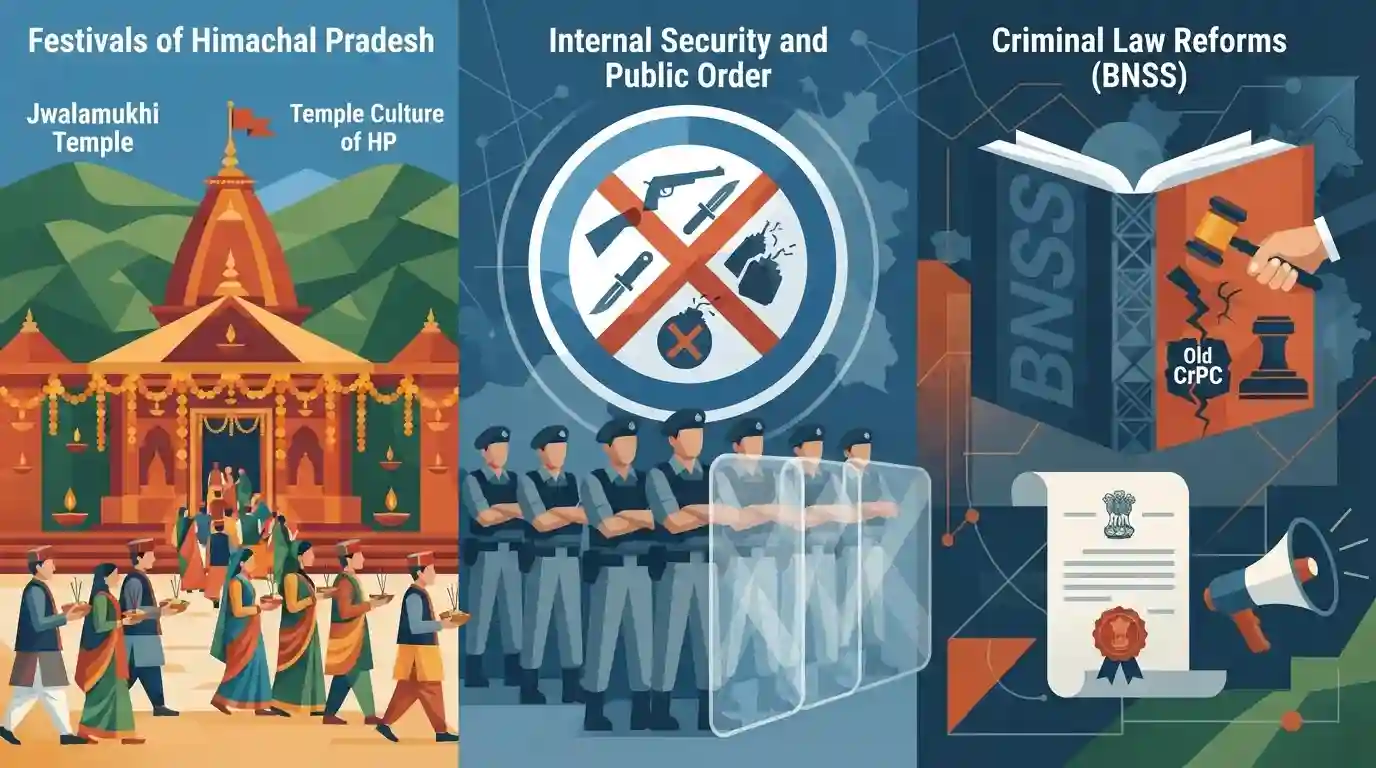
The Shravan Ashtami Fair in Jwalamukhi is a prominent cultural and religious event in Himachal Pradesh, making it relevant for GS1 cultural topics. Additionally, the application of Section 163(1) of the BNSS illustrates how the new criminal codes are being practically utilized by local administration to ensure public order during mass gatherings.
Summary
The Jwalamukhi administration has banned the carrying and use of weapons, ammunition, and explosives within the municipal council limits during the upcoming Shravan Ashtami Fair. The restrictive orders were issued by SDM Sanjeev Sharma by invoking Section 163(1) of the newly implemented Bharatiya Nagarik Suraksha Sanhita (BNSS), which serves a similar function to the former Section 144 of the CrPC for maintaining public order.
Key Points
- The Jwalamukhi administration has imposed a complete ban on carrying and using weapons, ammunition, and explosives.
- The ban applies within the limits of the Jwalamukhi Municipal Council during the Shravan Ashtami Fair.
- The restrictive orders were issued under Section 163(1) of the Bharatiya Nagarik Suraksha Sanhita (BNSS).
Important Terms
Bharatiya Nagarik Suraksha Sanhita (BNSS)

The procedural law enacted in 2023 to replace the colonial-era Code of Criminal Procedure (CrPC), modernizing India's criminal justice system through digital processes and victim-centric measures.
UPSC context
GS Paper II (Polity) and GS Paper III (Internal Security); tests reforms in India's criminal justice system.
Section 163 of BNSS
A preventive legal provision in the BNSS, replacing Section 144 of the CrPC, that empowers Executive Magistrates to issue temporary prohibitory orders to maintain public tranquility.
UPSC context
GS Paper II (Polity) and GS Paper III (Internal Security); tests administrative power and public order management.
Shravan Ashtami Fair
A major annual religious pilgrimage and festival celebrated in Himachal Pradesh, particularly at key Shakti Peethas, during the auspicious Hindu month of Shravan.
UPSC context
GS Paper I (Art and Culture); tests knowledge of regional festivals and pilgrimage sites in India.
Jwalamukhi Temple
A sacred Hindu temple and Shakti Peetha in Kangra, Himachal Pradesh, where the deity is worshipped as natural, eternal blue flames emerging from rock fissures without an idol.
UPSC context
GS Paper I (Art and Culture); tests knowledge of temple architecture, religious history, and pilgrimage sites.
Prelims Trap
The Jwalamukhi Temple features a central stone idol of the deity alongside the sacred natural flames.
Jwalamukhi Temple is architecturally and culturally unique because it has absolutely no anthropomorphic idol. The flame itself is worshipped as the manifestation of the goddess.
Static Concepts Connected
What is the statutory framework of Section 163 of the BNSS (formerly CrPC Section 144)?
- Issuing Authority: Empowers an Executive Magistrate to issue written orders to abstain from certain acts to prevent obstruction, annoyance, or danger to human life.
- Duration Limits: An order remains in force for maximum 2 months, but the State Government can extend it for up to an additional 6 months.
- Constitutional Basis: Acts as a statutory mechanism to enforce 'reasonable restrictions' under Articles 19(2) and 19(3) in the interest of public order.
What are the distinct characteristics of the Jwalamukhi Temple's architecture and worship?
- No Idol Worship: Lacks any traditional stone or metal idol; the deity is worshipped in the form of natural gas flames emerging from rock fissures.
- Architectural Style: The temple is constructed in a unique dome style with Indo-Sikh architectural elements, including a golden dome gifted by Emperor Akbar and Maharaja Ranjit Singh.
- Mythological Status: Revered as one of the 51 Shakti Peethas, historically believed to be the site where the tongue of Goddess Sati fell.
Cross-Topic Patterns
BNSS Section 163 & Public Order Law
Analyzes how transitioning colonial-era CrPC 144 to BNSS 163 affects administrative discretion and the preventive arrest/prohibitory framework during mass public gatherings.
Sacred Geography + Tectonic Seepages
Examines the overlap of India's active geological features (hydrocarbon/methane gas seepages) with ancient cultural traditions, forming the basis of 'sacred geography' sites like Jwalamukhi.

The shift from CrPC Sec 144 to BNSS Sec 163 will likely be tested via multi-statement questions on Executive Magistrates' emergency powers.
Linked PYQs · 1
Linked PYQs · 1
- 2020HPAS_PRELIMSGS1
Consider the given four statements and choose the correct answer from the given options. Which of the following are not true about folk dances, fair and festivals of H.P.? 1. 'Kharait' and 'Ujagjama' are the famous sword dances. 2. 'Bhunda', 'Shant' and 'Bhoj' are given the importance of 'Kumbha' by the hill people. 3. 'Minjar' fair starts on the second Sunday of sawan. 4. 'Chhamb' is the sacred masked dance performed only by Lamas.
