Bihar agricultural power supply and renewable energy transition
Source:uniindia ↗
Why It Matters
Ensuring energy security for farmers while transitioning towards clean energy resources is a primary governance objective. This aligns with Bihar's environmental target of reducing carbon emissions and promoting green infrastructure through policies like Green Hydrogen and solarization schemes (KUSUM, Surya Ghar).
Summary
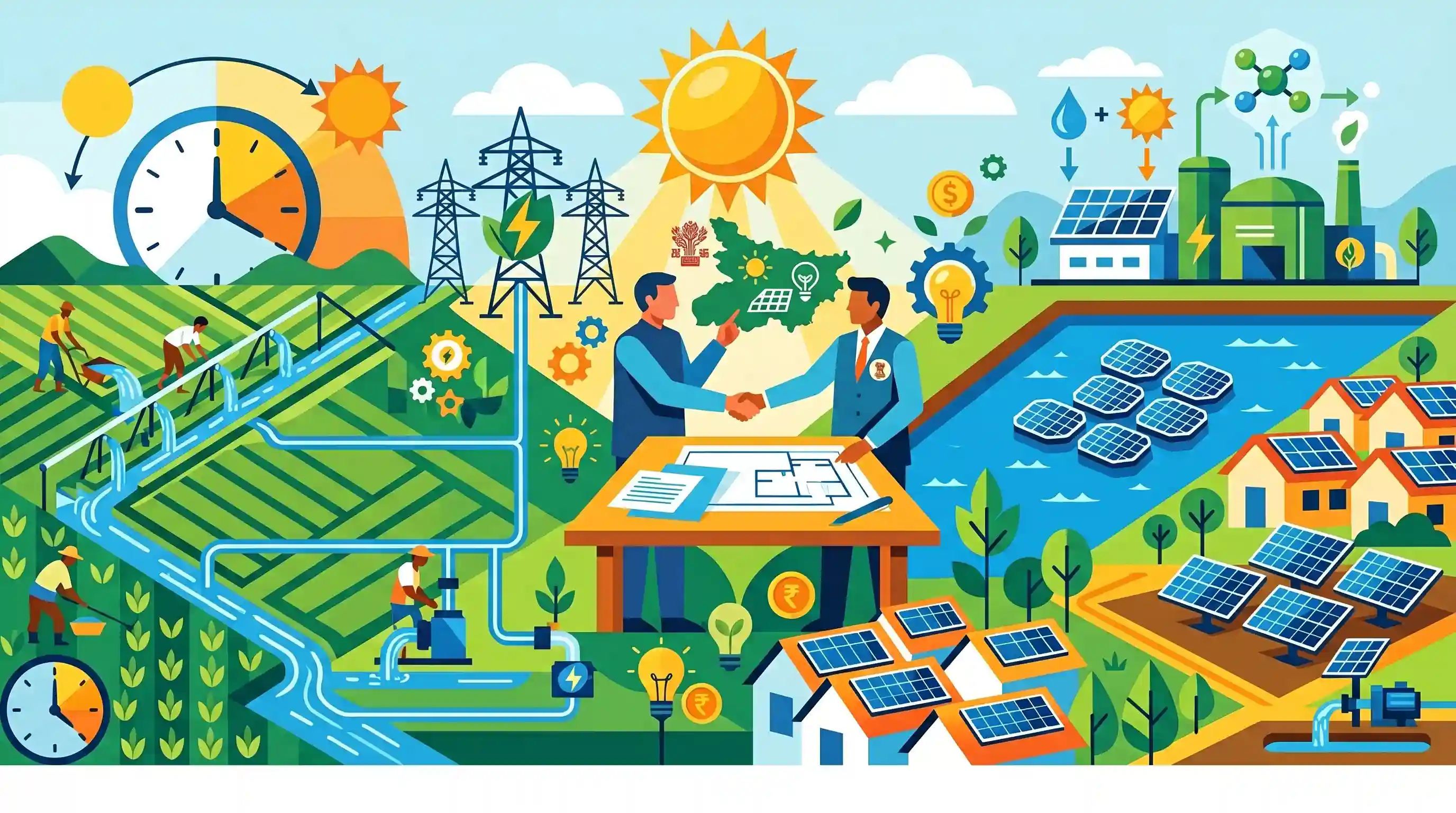
The Bihar state administration has directed the power sector to ensure a 12-hour daily uninterrupted electricity supply (6 AM to 6 PM) to farmers via dedicated agriculture feeders. During a high-level review meeting with Union Minister Pralhad Joshi, plans to accelerate Bihar's clean energy shift were discussed, including implementing PM-KUSUM, PM Surya Ghar Muft Bijli Yojana, evaluating reservoirs for floating solar plants, and drafting a state Green Hydrogen Policy.
Key Points
- The Bihar administration directed authorities to ensure uninterrupted 12-hour electricity supply to farmers (from 6:00 AM to 6:00 PM) through dedicated agriculture feeders, keeping in view the rainfall and irrigation requirements.
- A high-level meeting was held with Union Minister for New and Renewable Energy Pralhad Joshi to review and accelerate Bihar's renewable energy transition and energy security.
- Directions were issued to expedite the implementation of the PM Surya Ghar Muft Bijli Yojana and meet district-specific rooftop solar targets.
- Accelerating the PM-KUSUM Scheme was highlighted as a priority to solarize irrigation facilities, reduce agricultural input costs, and promote clean energy.
- Bihar is exploring floating solar power project potentials through scientific studies of reservoirs and other water bodies.
- The state is planning to formulate a dedicated Green Hydrogen Policy to prepare for emerging clean energy technologies and attract private investments.
Important Terms
PM Surya Ghar Muft Bijli Yojana

A central government scheme launched in February 2024 to provide up to 300 units of free monthly electricity to one crore Indian households through financial subsidies for rooftop solar panel installations.
UPSC context
GS Paper II (Welfare Schemes) & GS Paper III (Energy/Infrastructure); tests awareness of solar governance and clean energy targets.
PM-KUSUM Scheme
Pradhan Mantri Kisan Urja Suraksha evam Utthaan Mahabhiyan is a central scheme promoting solar energy in agriculture by subsidising solar pumps, decentralised grid-connected plants, and solarising agricultural feeders.
UPSC context
GS Paper III (Agriculture & Infrastructure); tests knowledge of decentralised renewable energy and policies supporting farmer incomes.
Green Hydrogen Policy
A central policy framework promoting clean fuel production by offering incentives like transmission fee waivers to achieve a target of 5 million tonnes of green hydrogen annually by 2030.
UPSC context
GS Paper III (Infrastructure & Climate Change); tests understanding of decarbonisation in hard-to-abate sectors and clean energy policies.
Bihar Energy Department
The nodal state government department overseeing electricity generation, transmission, and distribution in Bihar, coordinating policies for agricultural feeder separation and state-level clean energy deployment.
UPSC context
GS Paper II (State Governance) & GS Paper III (Infrastructure); tests comprehension of federal power sector reforms and rural electrification.
Union Ministry of New and Renewable Energy (MNRE)
The nodal ministry of the Government of India responsible for the research, development, promotion, and national implementation of grid-connected and off-grid renewable energy sources.
UPSC context
GS Paper II (Union Ministries) & GS Paper III (Energy/Infrastructure); tests knowledge of central agencies driving India's net-zero transition.
Prelims Trap
PM-KUSUM only targets off-grid standalone pumps and does not support grid-connected pumps or feeder-level solarization.
Component C explicitly solarizes grid-connected agricultural pumps and supports feeder-level solarization, helping states transition dedicated agricultural feeders to solar power.
Static Concepts Connected
What are the three core components of the PM-KUSUM Scheme?
- Component A: Aims to set up 10,000 MW of decentralized, grid-connected ground-mounted solar or other renewable energy power plants on barren land.
- Component B: Focuses on the installation of 14 lakh standalone solar-powered agriculture pumps to transition off-grid farmers away from diesel.
- Component C: Covers solarization of 35 lakh grid-connected agriculture pumps, including feeder-level solarization to ease the subsidy burden on state utilities.
What are the advantages and challenges of Floating Solar Photovoltaic (FSPV) systems?
- Efficiency Gains: Water bodies cool the solar panels, which reduces thermal losses and increases overall electricity generation efficiency compared to land-based installations.
- Water Conservation: By shading the water surface, FSPVs significantly reduce evaporation losses in reservoirs and limit harmful algal blooms.
- Key Challenges: High initial capital expenditure, potential ecological impacts on aquatic ecosystems, and structural challenges under fluctuating water levels.
Cross-Topic Patterns
Agrivoltaics & Land-Use Efficiency
Integrating solar panels with farming/aquaculture (like Bihar's dual-use model) addresses land constraints for renewables while securing dual food-energy incomes for rural communities.
DISCOM Health & Feeder Separation
Separating agricultural feeders and solarizing them under PM-KUSUM Component C reduces the massive fiscal subsidy burden on state DISCOMs while ensuring reliable daytime supply.

PM-KUSUM Component C and agrivoltaics/aquavoltaics dual-use models will likely be framed as solutions to rural DISCOM distress in 2026.
Linked PYQs · 4
Linked PYQs · 4
- 2023BPSC_PRELIMSGS1
India’s first floating solar power plant has been built at which place in Bihar?
- 2023BPSC_PRELIMSGS1
The first ‘floating solar power plant’ has been built at which place in Bihar?
- 2020BPSC_PRELIMSGS1
The objective of PM-KUSUM Scheme is
- 2023BPSC_PRELIMSGS1
Bihar Government has planned to make Bihar State ‘pollution-free’ by reducing carbon emissions by which year?
