Subnational Afforestation Drives and Carbon Finance Integration
Source:The Hindu ↗
Why It Matters
This article exemplifies the localization of global climate action. It demonstrates how sub-national governments can integrate massive afforestation drives, scientific forestry education, and market-based solutions (like carbon credits) with renewable energy policies (solar cities, PM Surya Ghar) and clean energy access (PM Ujjwala Yojana) to build climate resilience and safeguard agricultural economies from monsoon shifts.
Summary
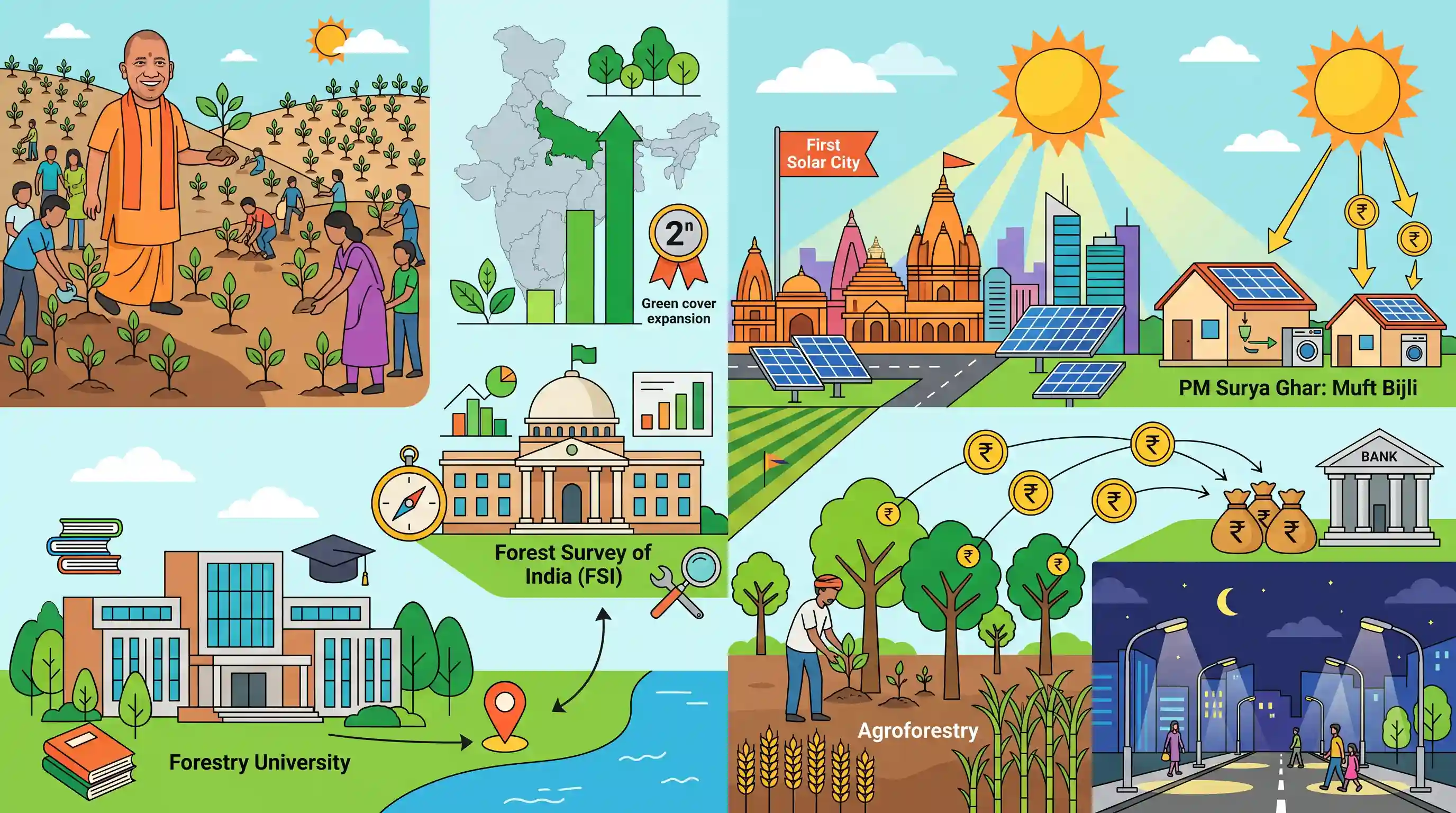
Uttar Pradesh Chief Minister Yogi Adityanath launched a mega afforestation drive to plant 35 crore saplings in a single day under the 'Ek Pedh Maa Ke Naam' campaign. The event highlighted UP's progress in forest cover expansion—ranking second nationally in green cover growth according to the Forest Survey of India. The Chief Minister emphasized the deep economic and agricultural impacts of climate change, such as delayed monsoons cutting agricultural output by up to 30%. He outlined holistic mitigation efforts, including the Carbon Credit Finance Scheme for farmers, a new Forestry University in Gorakhpur, the transformation of Ayodhya into a solar city, and central schemes like PM Surya Ghar: Muft Bijli Yojana and PM Ujjwala Yojana.
Key Points
- Uttar Pradesh Chief Minister Yogi Adityanath launched a massive environmental drive under the 'Ek Pedh Maa Ke Naam' campaign, targeting the planting of 35 crore saplings in a single day, adding to the 5 crore planted on World Environment Day (June 5).
- According to the Forest Survey of India (FSI), Uttar Pradesh ranks second in the country in terms of increasing green cover. The state's afforestation drives have reportedly absorbed 6.37 crore tonnes of carbon dioxide and released 4.63 tonnes of oxygen over the past decade.
- A Carbon Credit Finance Scheme is being implemented to financially incentivize farmers who plant trees on their land, aligning carbon sequestration with rural livelihood support.
- A specialized Forestry University is being constructed in Gorakhpur to cultivate scientific expertise in forest conservation, management, and agroforestry.
- The Chief Minister raised alarm over shifting climatic patterns, noting that a month-long delay in the monsoon has pushed crop sowing from mid-June to mid-July, threatening to reduce overall agricultural yield by 25% to 30%.
- The state has integrated urban development with renewable energy, transforming Ayodhya into UP's first 'solar city' (street lights and public buildings run on solar energy) and replacing traditional halogen lights with energy-efficient LED streetlights, saving ₹100 crore in energy bills.
Important Terms
Forest Survey of India

A premier national organization established in 1981 under the Ministry of Environment, Forest and Climate Change, conducting biennial assessments of India’s forest resources.
UPSC context
GS Paper III (Environment). Tests knowledge of forest conservation, land-use trends, and national carbon sinks.
Carbon Credit Finance Scheme
Uttar Pradesh's pioneering initiative that links farmers with global carbon markets by providing advance payments for carbon sequestered through agroforestry plantations on farm boundaries.
UPSC context
GS Paper III (Agriculture/Climate Change). Tests understanding of market-based mitigation, rural incomes, and sustainable farming policies.
PM Surya Ghar: Muft Bijli Yojana
A flagship central sector scheme launched in 2024 to install rooftop solar panels for one crore households, providing up to 300 free electricity units monthly.
UPSC context
GS Paper III (Infrastructure & Energy). Tests knowledge of clean energy transitions, household-level solar adoption, and India's Net-Zero goals.
PM Ujjwala Yojana
A flagship social welfare scheme launched in 2016 by the Ministry of Petroleum and Natural Gas to provide deposit-free LPG connections to underprivileged women.
UPSC context
GS Paper II (Welfare Schemes). Tests understanding of indoor air pollution, public health initiatives, and women's empowerment.
International Solar Alliance
An Indian-French joint initiative launched at COP21 in 2015, headquartered in Gurugram, acting as a treaty-based global platform to scale up solar energy deployment.
UPSC context
GS Paper II & III (International Relations & Energy). Tests knowledge of global climate governance and solar energy frameworks.
Ek Ped Maa Ke Naam
A nationwide afforestation campaign launched on World Environment Day 2024 by PM Modi, encouraging citizens to plant trees in tribute to their mothers.
UPSC context
GS Paper III (Environment). Tests understanding of community forestry, voluntary carbon sinks, and environmental awareness campaigns.
Prelims Trap
The newly established Gorakhpur Forestry University is India's first specialized university dedicated entirely to forestry.
Telangana established India's first dedicated Forestry University (FCRI Mulugu) in 2022. The Gorakhpur institution is North India's first and the country's second overall.
Static Concepts Connected
What is the distinction between 'Forest Cover' and 'Tree Cover' in India State of Forest Reports?
- Forest Cover definition: Refers to all lands more than one hectare in area with a tree canopy density of more than 10%, regardless of ownership.
- Tree Cover definition: Includes tree patches outside recorded forest areas that are less than one hectare, estimated using sample-based field inventories.
- Assessment cycle: Both are mapped biennially by the Forest Survey of India (FSI) using remote sensing data combined with ground verification.
What are the core parameters of a 'Solar City' under India's MNRE guidelines?
- Demand-reduction goal: Aims to reduce the projected conventional energy demand of a city by at least 10% through renewable installations.
- Local body mandate: Integrates solar rooftops, solar streetlights, and waste-to-energy projects directly into municipal town-planning regulations.
Cross-Topic Patterns
Agroforestry as Carbon Offset Assets
Linking rural livelihood schemes with voluntary carbon markets enables marginal farmers to monetize tree-planting on farmland, directly connecting GS-3 Agriculture with Climate Finance.
Municipal Solar Transition and Decentralization
Developing model Solar Cities like Ayodhya demonstrates how municipal bodies can leverage the National Solar Mission to reduce urban fiscal stress caused by conventional energy bills.

Mains 2026 may ask how integrating carbon credit schemes with local agroforestry can mitigate climate-induced agricultural yield losses.
Linked PYQs · 4
Linked PYQs · 4
- 2019PrelimsGS1
Consider the following States: 1. Chhattisgarh 2. Madhya Pradesh 3. Maharashtra 4. Odisha With reference to the States mentioned above, in terms of percentage of forest cover to the total area of State, which one of the following is the correct ascending order?
- 2020MainsGS3
Describe the benefits of deriving electric energy from sunlight in contrast to the conventional energy generation. What are the initiatives offered by our Government for this purpose?
- 2014MainsGS3
Should the pursuit of carbon credits and clean development mechanisms set up under UNFCCC be maintained even though there has been a massive slide in the value of a carbon credit? Discuss with respect to India's energy needs for economic growth.
- 2020PrelimsGS1
Which one of the following statements best describes the term 'Social Cost of Carbon'? It is a measure, in monetary value, of the
