Adhir Ranjan Chowdhury Resurgence in West Bengal Congress Politics
Source:Indian Express ↗
Why It Matters
Understanding the interplay between national and regional political parties is crucial for GS Paper 2 (Polity and Governance). The contradiction of alliances at the national level versus rivalries at the state level reflects the evolving and complex nature of India's multi-party democracy and federal structure.
Summary
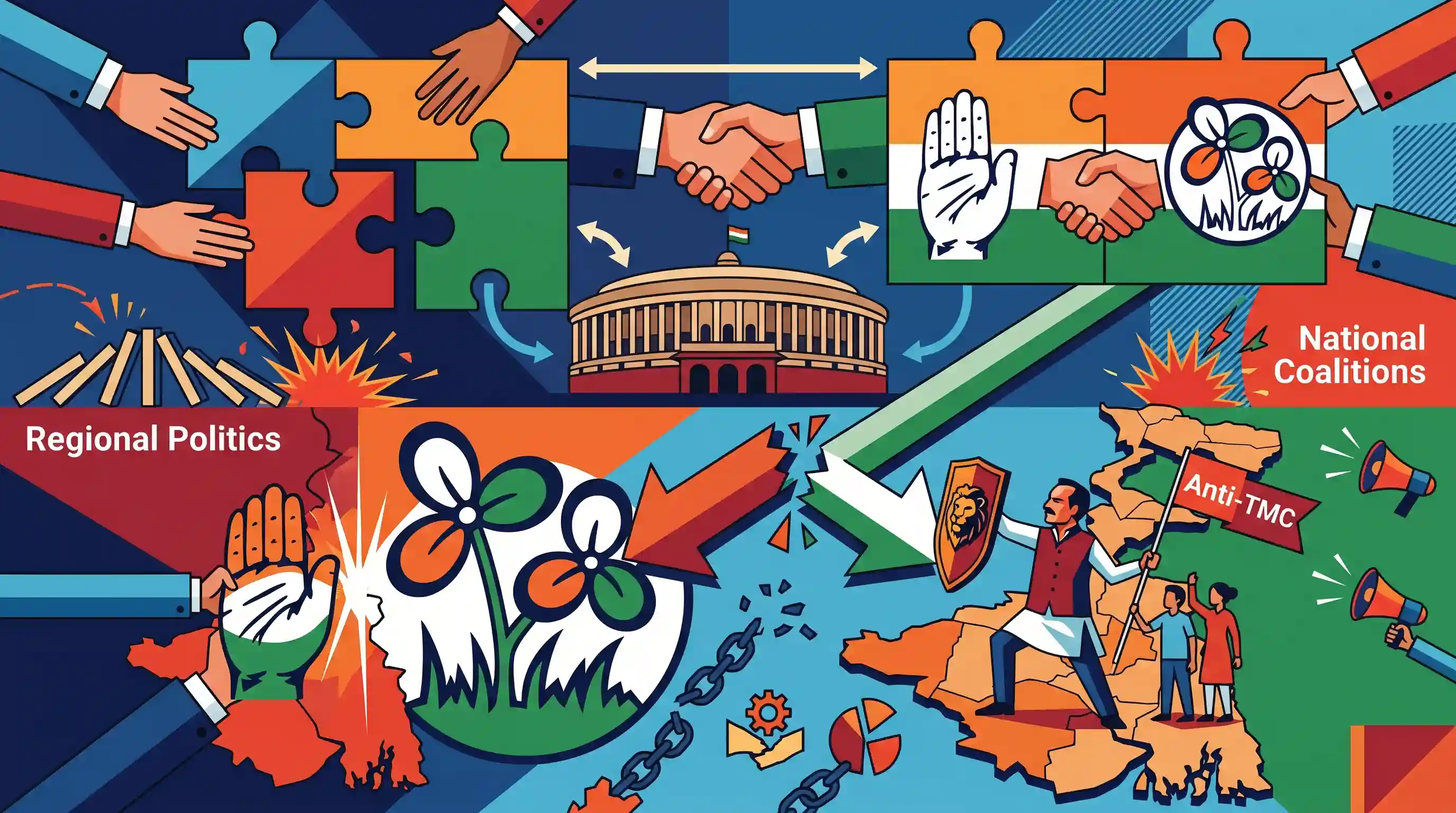
The article discusses the political resurgence of Adhir Ranjan Chowdhury within the West Bengal Congress and its broader implications. His comeback underlines the complex dynamics of regional politics, particularly the paradox of the Congress party allying with the Trinamool Congress (TMC) at the national level while maintaining a staunchly anti-TMC stance in West Bengal. This situation exemplifies the contradictions inherent in India's current coalition politics, where national party strategies often clash with the survival instincts and ideological positioning of their state-level units.
Key Points
- Adhir Ranjan Chowdhury's potential political comeback signifies shifting internal dynamics within the West Bengal unit of the Congress party.
- The development exposes the ongoing contradictions of coalition politics, where the Congress and TMC are partners at the national level (INDIA bloc) but remain fierce rivals at the state level.
- Highlights the challenges national parties face in balancing central leadership strategies with regional unit compulsions and anti-incumbency narratives.
- Reflects broader trends of factionalism and the crucial role of strong regional leadership for national parties to maintain relevance in state electoral politics.
Important Terms
INDIA bloc

A multi-party opposition alliance (Indian National Developmental Inclusive Alliance) formed in 2023 to challenge the ruling NDA. It emphasizes decentralization, empowering regional leaders, and protecting constitutional values through collective electoral strategy.
UPSC context
GS Paper II: Political parties and electoral dynamics. Relevant for analyzing modern alliance-building and opposition unity.
Coalition Politics
A governance model where multiple political parties cooperate to form a majority, typically governed by a Common Minimum Programme. It reflects India's social diversity and ensures regional representation in national decision-making.
UPSC context
GS Paper II: Functioning of political parties and challenges to stable governance in a multi-party system.
Indian National Congress
India's oldest political party, founded in 1885. It led the independence movement and dominated post-1947 politics. Currently, it navigates complex "state-vs-national" strategies within broader coalitions like the INDIA bloc.
UPSC context
GS Paper I (Modern History) and GS Paper II (Indian Polity: Political Parties).
Trinamool Congress (TMC)
A West Bengal-based party founded in 1998 by Mamata Banerjee. Formerly a national party, it currently holds State Party status while remaining a significant regional power and a key player in national coalitions.
UPSC context
GS Paper II: Regional political parties and their role in the federal structure.
Regionalism
A political ideology or sentiment focusing on regional identity, culture, or interests. In India, it often drives the rise of regional parties, balancing local autonomy with national integration.
UPSC context
GS Paper I: Social issues. GS Paper II: Challenges to the federal structure and national unity.
Federalism
A system of governance dividing powers between a central government and states. India’s version is often called "quasi-federal" or "federal in structure but unitary in spirit," accommodating diverse regional aspirations.
UPSC context
GS Paper II: Issues and challenges pertaining to the federal structure and devolution of powers.
Static Concepts Connected
What are the ECI criteria for a party to be recognized as a "National Party"?
- Seat Requirement: Win at least 2% of total Lok Sabha seats from a minimum of three different states.
- Vote Share: Secure 6% of valid votes polled in four or more states (in Lok Sabha or Assembly elections) AND win 4 Lok Sabha seats.
- State Party Status: Be recognized as a State Party in at least four states.
How does Indian law regulate the internal democracy of registered political parties?
- Section 29A (RPA 1951): Mandates registration of parties and requires them to bear allegiance to the Constitution, but doesn't strictly enforce internal democratic elections.
- ECI Limitations: The Supreme Court ruled the Election Commission cannot deregister a political party solely for failing to hold internal elections.
Cross-Topic Patterns
Intra-party Federalism & Coalitions
The disconnect between central alliance strategies (INDIA bloc) and state-level survival (Bengal Congress vs TMC) underscores the growing demand for intra-party federalism in Indian politics.
Regionalisation of National Parties
To counter entrenched state-level parties, national outfits are increasingly forced to adopt 'regionalisation', relying on local strongmen rather than central high-command agendas to harness anti-incumbency.

GS-II Mains 2026 will likely feature a 15-marker analyzing the 'dual-narrative trap' of coalition politics and intra-party federalism.
Linked PYQs · 2
Linked PYQs · 2
- 2022MainsGS2
“While the national political parties in India favour centralisation, the regional parties are in favour of State autonomy.” Comment.
- 2016MainsGS2
The Indian party system is passing through a phase of transition which looks to be full of contradictions and paradoxes." Discuss.
