Fertilizer Availability and Kharif Season Management in Uttar Pradesh
Source:uniindia ↗
Why It Matters
Fertilizer availability is critical for the success of the Kharif season (monsoon crops), which dictates agricultural productivity in UP. Understanding the types of major fertilizers (Urea, DAP, NPK) and the timing of Kharif crops is essential for UPPSC questions on agriculture and regional geography.
Summary
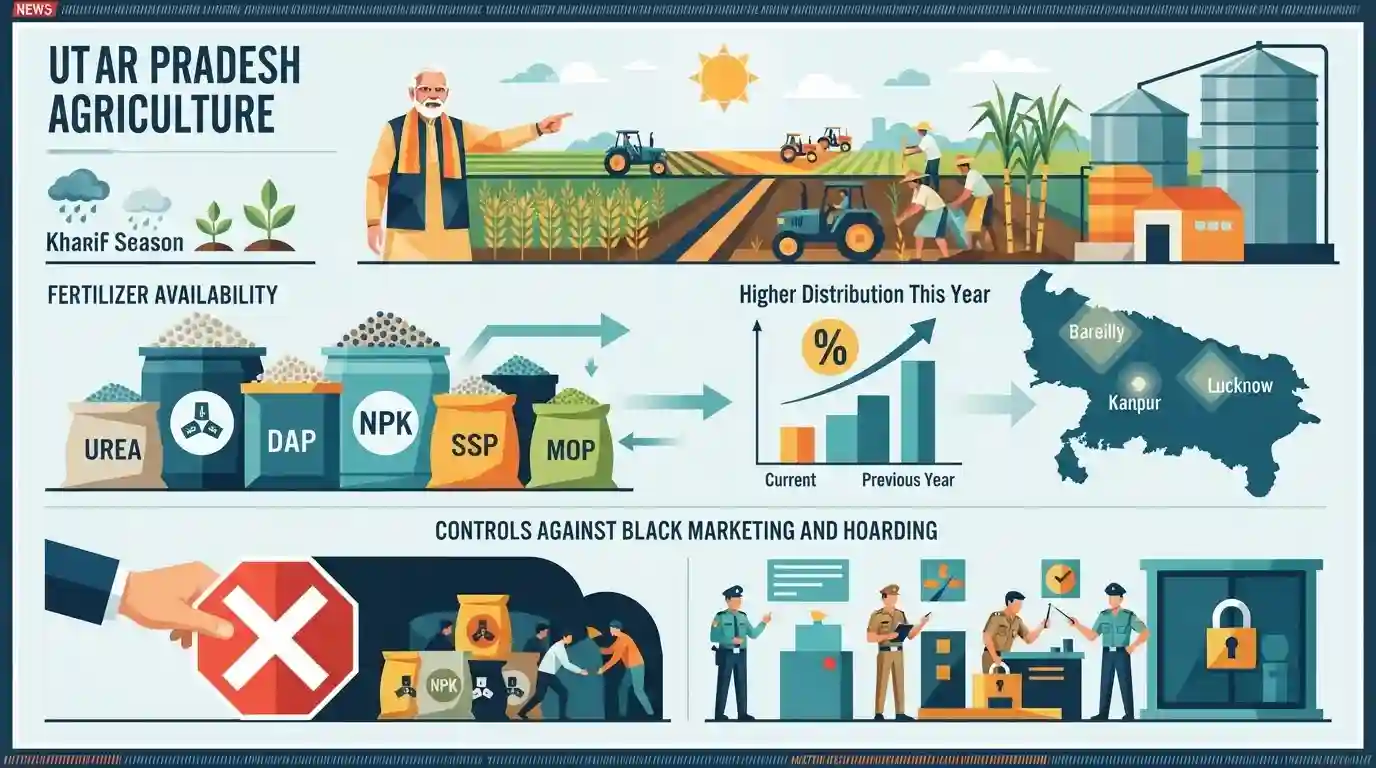
Uttar Pradesh Chief Minister Yogi Adityanath has assured farmers that there is no shortage of fertilizers for the Kharif season and warned against rumors of scarcity. He confirmed the state holds adequate stocks of urea, DAP, NPK, SSP, and MOP, and directed officials to take stern action against black marketing and hoarding to ensure uninterrupted supply to the agricultural sector. The state has already distributed more fertilizer this year compared to the corresponding period last year, primarily leading in the Kanpur, Lucknow, and Bareilly divisions.
Key Points
- Uttar Pradesh Chief Minister Yogi Adityanath assured farmers of adequate fertilizer stocks for the ongoing Kharif crop season.
- The state has sufficient reserves of key fertilizers, including Urea, DAP, NPK, SSP (Single Super Phosphate), and MOP (Muriate of Potash).
- He directed strict action against black marketing and hoarding of fertilizers.
- Fertilizer distribution in the state has been higher compared to the previous year, with Kanpur, Lucknow, Bareilly, Prayagraj, and Varanasi divisions receiving the maximum urea distribution.
Important Terms
Urea fertilizer

A widespread, nitrogen-rich organic chemical compound (46% nitrogen) used extensively as a fertilizer to promote crop growth. Its high nitrogen content and low production cost make it India's most heavily consumed fertilizer.
UPSC context
GS Paper 3 (Agriculture). Tests knowledge of fertilizer subsidies (outside NBS), soil degradation from overuse, and initiatives like Neem-coated and Nano Urea.
Di-ammonium Phosphate (DAP)
The world's most widely used phosphorus fertilizer, highly soluble, containing both phosphorus and nitrogen. Essential for root establishment during crop sowing. Second most consumed fertilizer in India after Urea.
UPSC context
GS Paper 3 (Agriculture). Crucial for questions on farm subsidies, import dependence, and the Nutrient Based Subsidy (NBS) scheme.
NPK fertilizer
Complex fertilizers comprising the three primary macronutrients for plant growth: Nitrogen (N), Phosphorus (P), and Potassium (K). They provide balanced soil nutrition and are subsidized under the Nutrient Based Subsidy regime.
UPSC context
GS Paper 3 (Agriculture). Relevant to soil health imbalance, the ideal 4:2:1 usage ratio, and fertilizer pricing mechanisms.
Kharif season
The summer crop season in India, typically starting with the onset of the southwest monsoon in June and lasting until October. Major crops include rice, maize, cotton, and soybean.
UPSC context
GS Paper 1 (Geography) & GS Paper 3 (Agriculture). Tests cropping patterns, monsoon dependency, Minimum Support Prices (MSP), and food security.
Prelims Trap
All major chemical fertilizers in India, including Urea, DAP, and MOP, are subsidized under the Nutrient Based Subsidy (NBS) scheme.
Urea is excluded from the NBS scheme. It remains under statutory price control with a fixed MRP, whereas Phosphatic and Potassic (P&K) fertilizers are covered under the NBS scheme.
Static Concepts Connected
How does the subsidy mechanism differ between Urea and Non-Urea (P&K) fertilizers in India?
- Urea Pricing: Under direct statutory price control; the government fixes the MRP and reimburses the production-to-retail price gap to manufacturers.
- P&K Fertilizers: Governed by the Nutrient Based Subsidy (NBS) Scheme (since 2010), where a fixed nutrient-specific subsidy is paid, and manufacturers fix market-reflective MRPs.
- Nodal Ministry: Administered by the Department of Fertilizers under the Ministry of Chemicals and Fertilizers.
What is the legislative framework regulating fertilizer distribution and hoarding in India?
- ECA Classification: Fertilizers are designated as 'essential commodities' under Schedule I of the Essential Commodities Act (ECA), 1955.
- Fertiliser Control Order: Issued under the ECA to regulate prices, trade, quality standards, and mandatory registration of fertilizer dealers.
- State Enforcement: State administrations hold the delegated power to enforce the FCO and crack down on illegal hoarding, diversion, or black marketing.
Cross-Topic Patterns
Fertilizer subsidies and fiscal consolidation
Fluctuations in global natural gas and rock phosphate prices directly inflate India's subsidy bill, complicating fiscal deficit targets and driving shifts toward nano-fertilizers.
Imbalanced NPK usage and eutrophication
Subsidized urea skews the ideal 4:2:1 NPK ratio, causing severe nitrate leaching into groundwater and eutrophication in local water bodies.

Differential pricing of Urea vs NBS, combined with chemical absorption mechanisms of nitrogen by plants, is highly likely for Prelims 2026.
Linked PYQs · 5
Linked PYQs · 5
- 2017UPPSC_PRELIMSGS1
Urea is
- 2016UPPSC_PRELIMSGS1
Indiscriminate use of fertilizers have led to
- 2009UPPSC_PRELIMSGS1
'Nitrogen use efficiency' in crop production may be enhanced by
- 2009UPPSC_PRELIMSGS1
In U.P. the Kharif crop is sown during
- 2024UPPSC_PRELIMSGS1
Consider the following statements with reference to cotton crops : 1. Cotton is mostly a Kharif crop. 2. Cotton crop requires moderate amounts of rainfall varying between 50 - 75 cm annually. Which of the above statements is/are correct ?
