Statistical Anomalies and Reforms in Public Examinations
Source:Indian Express ↗
Why It Matters
Recent controversies surrounding major national exams have brought the spotlight onto the statistical methodologies used for evaluating millions of candidates. The NSC's intervention underscores the intersection of data science, statistics, and public administration, making it a critical governance issue for ensuring fairness, transparency, and meritocracy in public recruitment and higher education admissions.
Summary
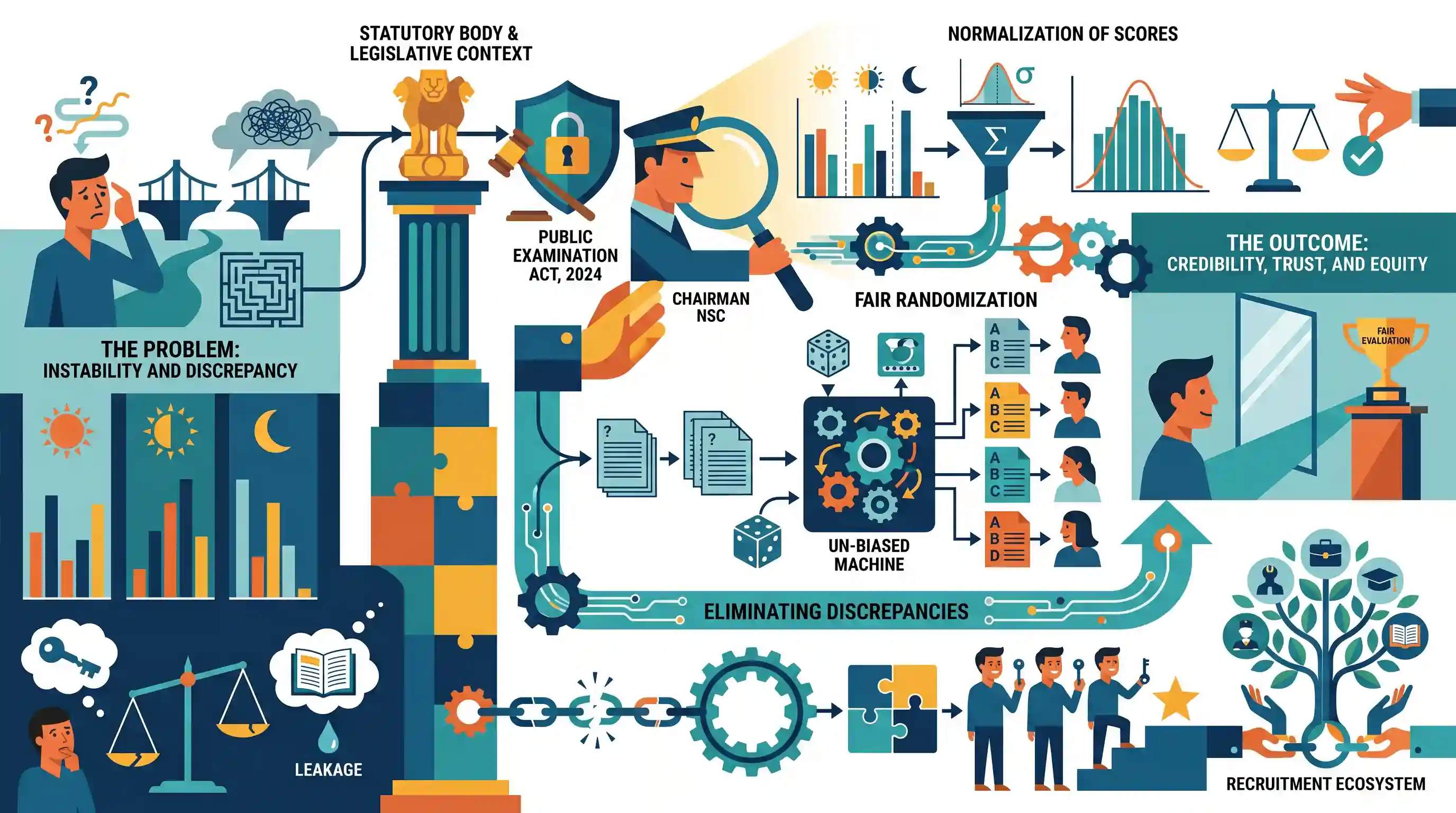
The Chairman of the National Statistical Commission (NSC) has highlighted the urgent need to address statistical issues in large-scale entrance and recruitment examinations conducted by government agencies. The intervention focuses on employing robust statistical methodologies for the normalization of scores across multiple exam shifts, ensuring fair randomization, and eliminating discrepancies that undermine the credibility of public exams. Proper statistical oversight can help maintain transparency, ensure equitable evaluation, and restore candidates' trust in the examination process. This is particularly crucial in the context of recent controversies surrounding national-level exams and aligns with broader legislative efforts, such as the Public Examination (Prevention of Unfair Means) Act, 2024, to safeguard the integrity of the recruitment ecosystem.
Key Points
- The National Statistical Commission (NSC) Chairman has urged the government to resolve statistical anomalies and methodological flaws in large-scale entrance and recruitment examinations.
- Key statistical challenges include the normalisation of marks across multiple shifts, ensuring equitable randomisation of candidates and question papers, and preventing systemic biases.
- Addressing these issues is critical to maintaining the transparency, fairness, and credibility of public examinations.
- Incorporating robust statistical frameworks can help prevent discrepancies and restore the trust of candidates in the recruitment and examination ecosystem.
Important Terms
National Statistical Commission (NSC)

An autonomous body established in 2005 to oversee the Indian statistical system, ensuring high-quality standards and evolving policies for data collection and analysis.
UPSC context
GS Paper II: Statutory/Regulatory Bodies; important for understanding data governance, institutional oversight, and the push for statutory empowerment.
Public Examination (Prevention of Unfair Means) Act, 2024
Legislation effective from 2024 aimed at deterring paper leaks and malpractices in national exams through stringent, non-bailable penalties for individuals and organized syndicates.
UPSC context
GS Paper II: Governance/Laws; relevant for reforms in the recruitment ecosystem and legal safeguards for merit-based selection.
National Testing Agency (NTA)
An autonomous premier testing agency under the Ministry of Education, established in 2017 to conduct standardized entrance examinations for higher educational institutions in India.
UPSC context
GS Paper II: Education/Governance; critical for understanding centralized testing mechanisms and institutional accountability in national entrance tests.
Normalization (Statistical)
A statistical adjustment method used to equalize scores across different exam shifts or subjects, accounting for variations in difficulty to ensure fair evaluation.
UPSC context
GS Paper II: Transparency & Accountability; relevant for discussing equitable evaluation processes and administrative fairness in high-stakes examinations.
Prelims Trap
The National Statistical Commission is a statutory body regulating data standards.
The NSC was established by an executive resolution in 2005 based on the C. Rangarajan Commission. It is currently an autonomous, non-statutory body.
Static Concepts Connected
What is the origin and composition of the National Statistical Commission (NSC)?
- Origin: Established via an executive resolution in 2005 on the C. Rangarajan Commission's recommendation; it operates as an autonomous, non-statutory body.
- Composition: A part-time Chairperson, four part-time members, the NITI Aayog CEO (ex-officio), and the Chief Statistician of India acting as Secretary.
What are the key provisions of the Public Examination Act, 2024?
- Jurisdiction: Applies to central agencies (UPSC, SSC, NTA) but explicitly excludes university and state education board examinations.
- Nature of offense: All offenses are classified as cognizable, non-bailable, and non-compoundable to ensure strict deterrence against organized cheating.
- Penalties: Mandates severe penalties for organized groups and service providers, including up to 10 years imprisonment and fines reaching ₹1 crore.
Cross-Topic Patterns
Algorithmic fairness & Article 14
Flawed statistical normalization in exams can be challenged under Article 14 for arbitrariness, linking administrative tech methodologies to fundamental rights jurisprudence.
Federalism in exam regulation
Because Education is a Concurrent List subject, the 2024 Public Exam Act avoids overreach by targeting only central testing bodies, leaving state board exams to state legislatures.

Expect a paired-statement Prelims question testing the executive status of the NSC alongside the non-bailable nature of the Public Exam Act.
Linked PYQs · 2
Linked PYQs · 2
- 2024MainsGS2
What are the aims and objects of recently passed and enforced, The Public Examination (Prevention of Unfair Means) Act, 2024? Whether University/State Education Board examinations, too, are covered under the Act ?
- 2024MainsGS2
The Doctrine of Democratic Governance makes it necessary that the public perception of the integrity and commitment of civil servants becomes absolutely positive. Discuss.
