Bihar Caste Survey Data and Socio-Economic Deprivation of Dalits
Source:The Hindu ↗
Why It Matters
This article provides crucial quantitative data (from the Bihar Caste Survey 2023) to substantiate answers regarding the marginalization of vulnerable sections. It bridges GS2 (social justice and affirmative action) with GS3 (land ownership/reforms) and GS1 (caste realities), highlighting the persistent gap between constitutional safeguards and on-ground socio-economic outcomes for Dalits.
Summary
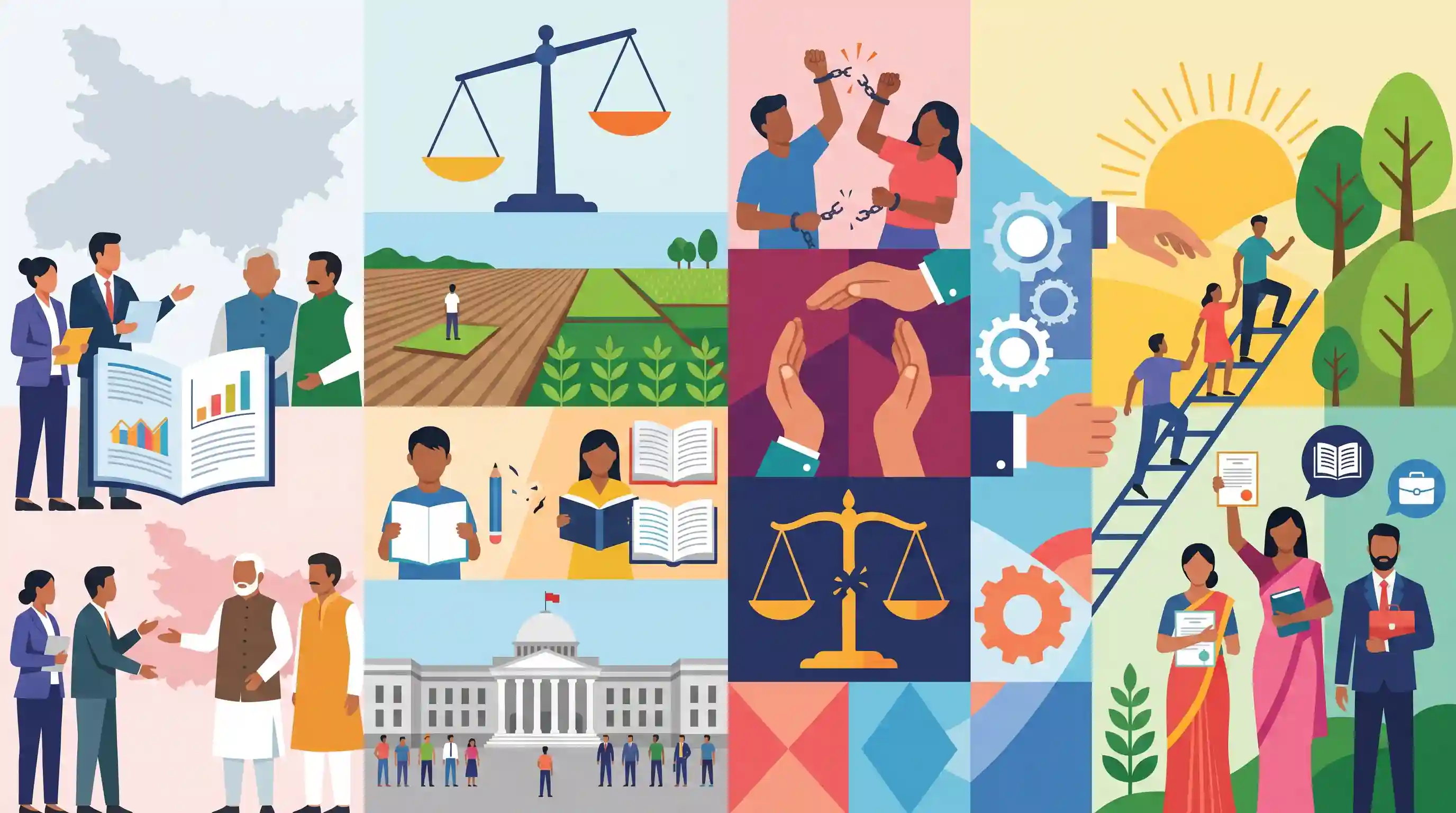
The National Confederation of Dalit and Adivasi Organisations (NACDAOR) has urged political parties in Bihar to prioritize Scheduled Caste (SC) issues, releasing a comprehensive report titled 'Bihar: Dalit Kya Chahte Hain'. Citing the Bihar Caste Survey 2023, the report exposes stark socio-economic disparities. Although SCs comprise 19.65% of the state's population, they suffer from 84% landlessness, low literacy rates (55.9%), and negligible representation in government employment (1.3%). Furthermore, the confederation highlighted severe safety and human rights concerns, pointing to over 85,000 atrocities committed against Dalits in the state between 2010 and 2022. The data underscores the urgent need for targeted political and policy interventions to address structural inequalities.
Key Points
- The NACDAOR released the report 'Bihar: Dalit Kya Chahte Hain', demanding political parties explicitly address Scheduled Caste (SC) issues in their assembly election manifestos.
- SCs constitute a significant demographic block, making up 19.65% of Bihar's population according to the 2023 Caste Survey.
- The community faces severe economic marginalization, with 84% being landless, an average monthly income of just ₹6,480, and a mere 1.3% holding government jobs.
- Social justice indicators remain poor, marked by a literacy rate of 55.9% (below the national SC average) and over 85,000 recorded cases of atrocities between 2010 and 2022.
Important Terms
Bihar Caste Survey 2023

A state-led socio-economic enumeration revealing that OBCs/EBCs constitute 63% and SCs 19.65% of Bihar's population, used to refine welfare targeting and reservation policies.
UPSC context
GS2 Governance; tests understanding of data-driven policy-making, federalism, and debates on the 50% reservation ceiling.
National Confederation of Dalit and Adivasi Organisations (NACDAOR)
An apex national umbrella platform of organizations advocating for the socio-economic and political rights of Dalit and Adivasi communities through policy advocacy and mobilization.
UPSC context
GS2 Civil Society; tests the role of NGOs and pressure groups in advocating for vulnerable sections.
Scheduled Castes (SC)
A constitutional category under Article 341 identifying communities historically subjected to social exclusion and untouchability, entitled to safeguards like reservations and legal protection.
UPSC context
GS2 Indian Constitution; tests knowledge of Articles 15, 16, 17, and protective discrimination for social justice.
SC/ST (Prevention of Atrocities) Act, 1989
A specialized law aimed at preventing crimes and discrimination against SC/ST members by non-SC/ST individuals, providing for special courts and victim rehabilitation.
UPSC context
GS2 Social Justice; tests knowledge of legal mechanisms and institutional protections for marginalized groups.
Land Reforms
Structural measures involving the abolition of intermediaries, land ceilings, and redistribution of surplus land to landless peasants to ensure agrarian equity and social justice.
UPSC context
GS3 Economy/Agriculture; tests understanding of structural changes to address rural poverty and historical landholding inequalities.
Social Empowerment
The process of enabling marginalized groups to achieve equal status, dignity, and participation in decision-making through education, rights, and resource inclusion.
UPSC context
GS1 Society; tests concepts of inclusive development and strategies for uplifting historically disadvantaged sections.
Prelims Trap
State-led caste surveys like Bihar's are conducted under the central Census Act of 1948.
Only the Union government can conduct a 'Census' under Entry 69 (Union List). States legally conduct 'surveys' via executive orders for policy formulation.
Static Concepts Connected
What are the key Constitutional safeguards for the economic and educational empowerment of SCs?
- Art 15(4) & 16(4): Enables the State to make special provisions and reservations in educational institutions and public employment for backward classes, including SCs.
- Article 46 (DPSP): Directs the State to promote with special care the educational and economic interests of SCs/STs and protect them from social injustice.
- Article 338: Establishes the National Commission for Scheduled Castes to monitor, investigate, and report on the implementation of constitutional safeguards for SCs.
Why did post-independence land reforms largely fail to benefit Dalit communities?
- Ceiling Evasion: Landlords used benami transfers and loopholes in land ceiling acts to retain surplus land, severely limiting actual redistribution to landless Dalits.
- Tenancy Loopholes: Tenancy laws often lacked written records, leading to mass evictions of sharecroppers (many from SC communities) under the guise of resuming land for 'personal cultivation'.
- Poor Implementation: A lack of political will and bureaucratic apathy hindered the effective distribution of surplus government and Bhoodan lands to marginalized communities.
Cross-Topic Patterns
Sub-categorization of SCs
Empirical data from state caste surveys directly fuels the ongoing Supreme Court debate and political demands for sub-classifying SC quotas to reach the most marginalized.
Agrarian Distress & Left-Wing Extremism
Endemic landlessness among Dalits (84% in Bihar) provides the socio-economic tinder for historical agrarian unrest and Left-Wing Extremism (Naxalism) in eastern India.

Expect a 2026 GS2 Mains question linking state caste surveys to the Supreme Court's ruling on sub-classification of SC quotas.
Linked PYQs · 5
Linked PYQs · 5
- 2018MainsGS1
Caste system is assuming new identities and associational forms. Hence, caste system cannot be eradicated in India." Comment.
- 2025MainsGS2
Inequality in the ownership pattern of resources is one of the major causes of poverty. Discuss in the context of 'paradox of poverty'.
- 2019MainsGS2
Performance of welfare schemes that are implemented for vulnerable sections is not so effective due to absence of their awareness and active involvement at all stages of policy process. Discuss.
- 2021MainsGS3
How did land reforms in some parts of the country help to improve the socio-economic conditions of marginal and small farmers?
- 2023MainsGS2
“Development and welfare schemes for the vulnerable, by its nature, are discriminatory in approach.” Do you agree? Give reasons for your answer.
