ADB Cuts India FY26 Growth Forecast Due to US Tariffs
Source:The Hindu ↗
Why It Matters
This development is crucial for UPSC aspirants as it provides a live case study of how external geopolitical and trade policy shifts (like US protectionism) directly impact India's macroeconomic stability and export sector. It also underscores the importance of domestic consumption as an economic buffer and highlights the role of international financial institutions (like ADB) in assessing regional economic health.
Summary
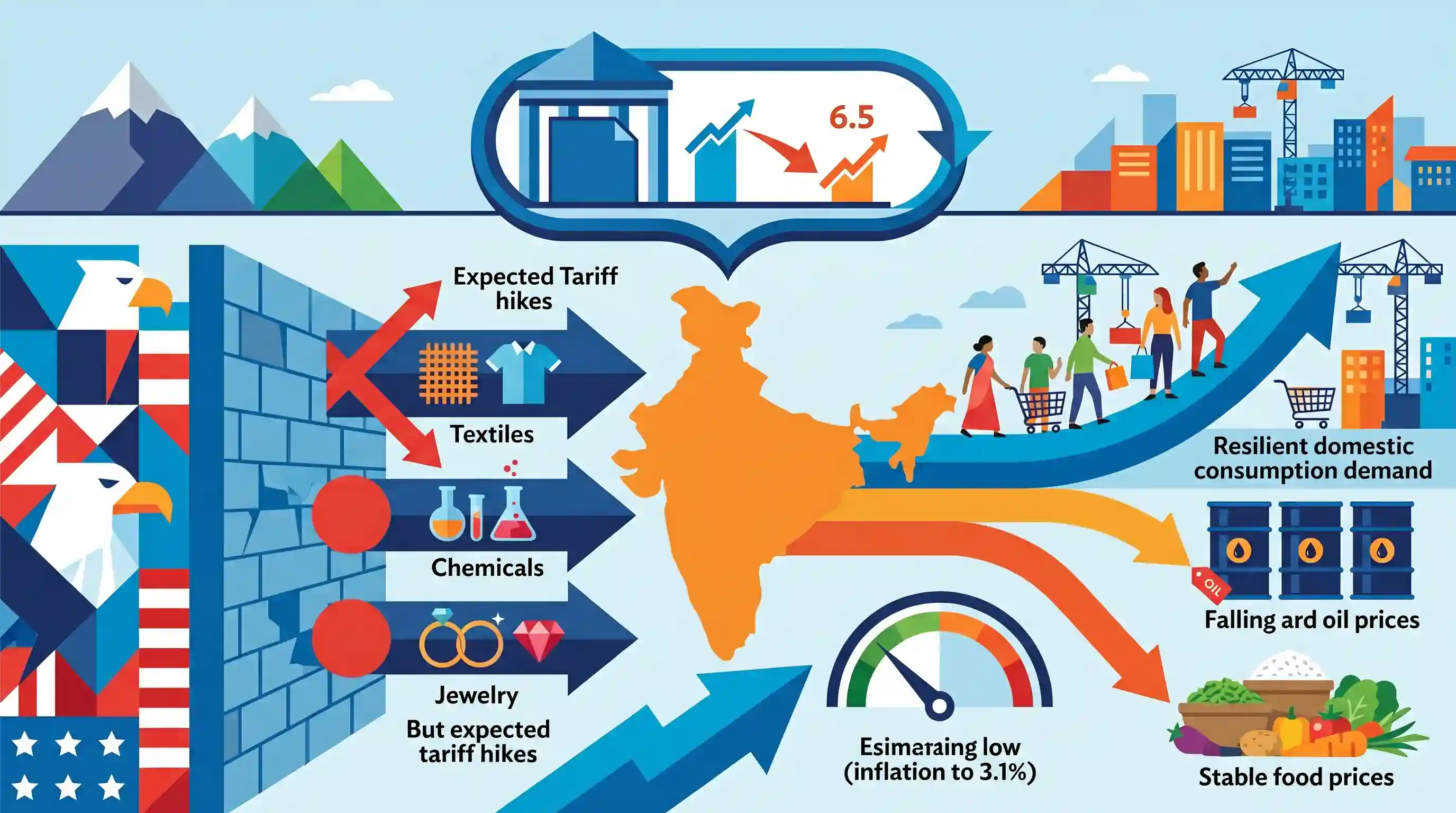
The Asian Development Bank (ADB), in its 'Asian Development Outlook', has trimmed India's growth forecast for the fiscal year 2025-26 to 6.5% from an earlier projection of 6.7%. This revision is driven by the looming threat of increased protectionism, specifically expected US tariff hikes that could adversely affect 60% of India's exports to the United States, spanning critical sectors like textiles, chemicals, and jewelry. However, the macroeconomic picture is balanced by positive trends in inflation, which ADB expects to drop to 3.1% in FY26 on the back of lower international oil prices and stable domestic food prices, alongside resilient domestic consumption demand.
Key Points
- The Asian Development Bank (ADB) reduced India's GDP growth forecast for FY26 to 6.5% from its previous estimate of 6.7%.
- The downward revision is primarily attributed to anticipated US tariff hikes, which are expected to impact approximately 60% of Indian exports to the US.
- Key export sectors vulnerable to these tariffs include textiles, ready-made garments, jewelry, shrimp, and chemicals.
- Conversely, the ADB lowered its inflation forecast for India to 3.1% for FY26, citing softer global oil prices and moderated food prices, though it anticipates a rise to 4.2% in FY27.
- Despite external trade headwinds, domestic consumption demand is expected to remain robust and support overall economic growth.
Important Terms
Asian Development Bank (ADB)

A regional multilateral development bank established in 1966, headquartered in Manila. It provides loans, technical assistance, and grants to promote social and economic development across Asia-Pacific.
UPSC context
GS Paper 2 & 3. Tests international institutions, India's role as founding member, and developmental financing.
Asian Development Outlook (ADO)
The annual flagship economic report published by the ADB. It provides comprehensive analysis, growth projections, and inflation forecasts for developing economies in Asia.
UPSC context
GS Paper 3 (Economy). Important for Prelims (Reports and Indices) and Mains (Growth trends).
Protectionism
Economic policy of restricting imports through tariffs, quotas, or subsidies to shield domestic industries and workers from foreign competition.
UPSC context
GS Paper 3 & 2. Tests impacts of global trade policies on Indian export competitiveness and IR.
Tariff
A tax or duty imposed by a government on imported goods to increase their domestic price, often used to discourage imports and protect local manufacturers.
UPSC context
GS Paper 3 (Economy). Relevant for trade wars, export-led growth, and WTO's Most-Favoured Nation (MFN) principle.
Consumer Price Index (CPI)
A macroeconomic indicator measuring the average change in retail prices of a basket of goods and services, used as the primary gauge for inflation in India.
UPSC context
GS Paper 3 (Economy). Key for monetary policy, RBI's inflation mandate, and cost-of-living analysis.
GDP Growth Forecast
An estimate of a country's economic expansion rate. Projections from bodies like the ADB or IMF serve as benchmarks for global investor sentiment and policy planning.
UPSC context
GS Paper 3 (Growth). Frequent Prelims topic regarding comparative economic data across international organizations.
Prelims Trap
The Asian Development Outlook is a flagship report published by the IMF or World Bank.
Aspirants often confuse this with the IMF's 'World Economic Outlook' or World Bank's 'Global Economic Prospects'. It is solely published by the ADB.
Static Concepts Connected
How is voting power and membership structured in the Asian Development Bank (ADB)?
- Capital-based voting: Voting power is distributed based on member capital subscriptions, unlike a one-country-one-vote system.
- Top shareholders: Japan and the US hold the largest and equal voting shares, followed by China and India.
- Membership makeup: ADB admits non-regional members (like the US), but regional members hold the majority of capital.
How do external tariff hikes impact India's macroeconomic stability?
- CAD Widening: Reduced export competitiveness lowers forex earnings, exerting pressure on the Current Account Deficit (CAD).
- Employment Shock: Tariffs on labor-intensive exports (textiles, jewelry) directly threaten job creation and depress semi-urban wages.
- Currency Depreciation: A widening trade deficit puts downward pressure on the Rupee, making inelastic imports (oil) costlier.
Cross-Topic Patterns
Protectionism hitting labor-intensive MSMEs
US tariff hikes directly target sectors like textiles and jewelry, linking international trade disputes to domestic unemployment and MSME stress in India.
Crude oil as an inflation buffer
Softer global energy prices are easing India's headline inflation, cushioning the economy from external shocks despite rising global trade barriers.

Expect a 2026 Prelims question matching global economic reports to publishers (ADB, IMF, WB) mixed with ADB's voting share structure.
Linked PYQs · 5
Linked PYQs · 5
- 2014PrelimsGS1
Which of the following organizations brings out the publication known as 'World Economic Outlook'?
- 2015PrelimsGS1
Which one of the following issues the 'Global Economic Prospects' report periodically?
- 2018MainsGS3
How would the recent phenomena of protectionism and currency manipulations in world trade affect macroeconomic stability of India?
- 2025MainsGS3
What are the challenges before the Indian economy when the world is moving away from free trade and multilateralism to protectionism and bilateralism? How can these challenges be met?
- 2020PrelimsGS1
Consider the following statements: 1. The weightage of food in Consumer Price Index (CPI) is higher than that in Wholesale Price Index (WPI). 2. The WPI does not capture changes in the prices of services, which CPI does. 3. Reserve Bank of India has now adopted WPI as its key measure of inflation and to decide on changing the key policy rates. Which of the statements given above is/are correct?
