IMD Climate Change Adaptation and Weather Forecasting Models
Source:The Hindu ↗
Why It Matters
The intersection of climate change and food security is a persistent GS3 theme. Understanding the limitations of current weather forecasting (40-50% accuracy) and the push for multi-forecast models offers critical insights for answers regarding agricultural resilience, disaster preparedness, and technology application in farming.
Summary
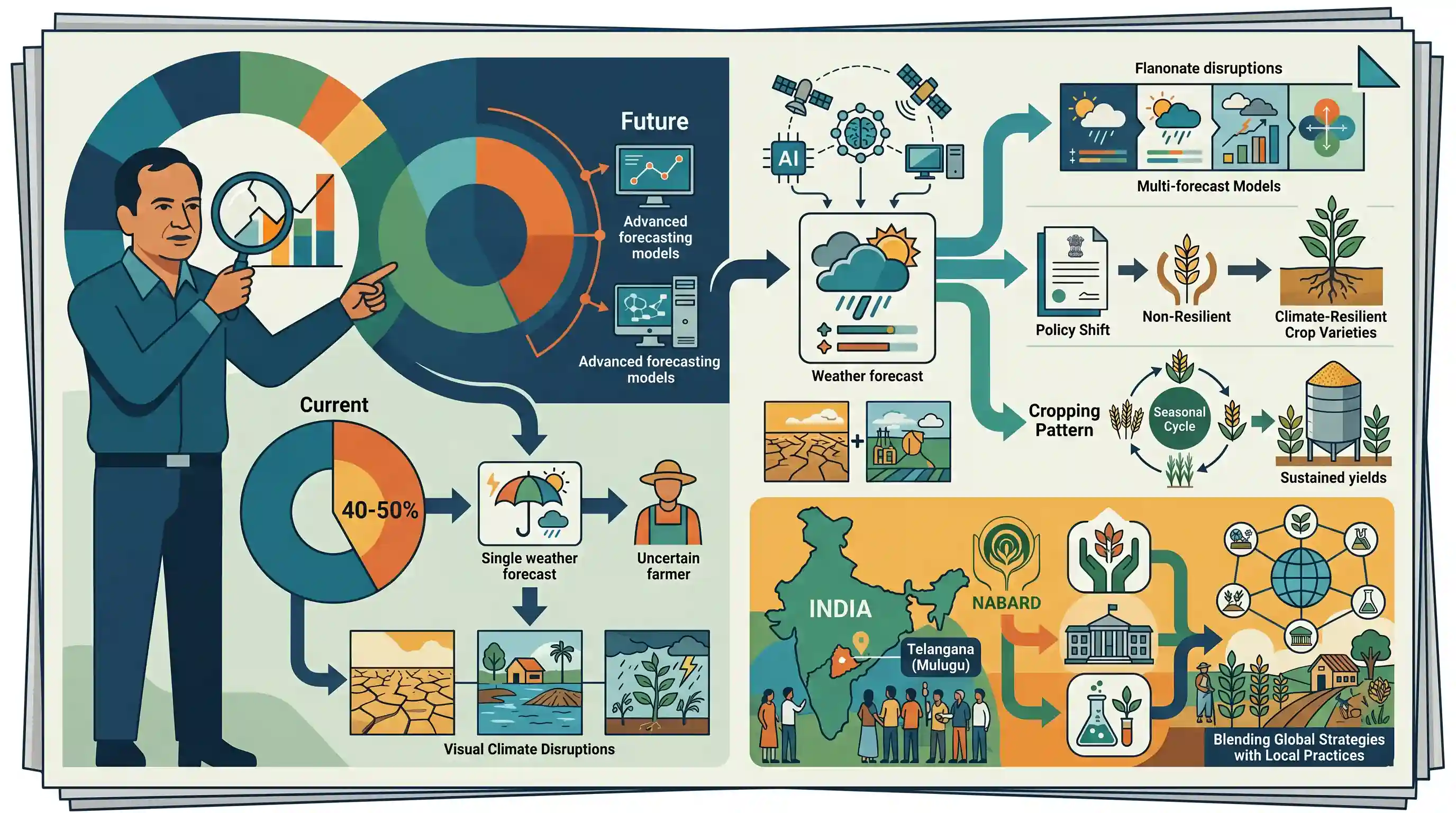
At a national conference on the impact of climate change on horticulture in Mulugu, Telangana, IMD Director General Mrityunjaya Mahapatra emphasized the critical need for adopting innovative mitigation strategies in agriculture. Highlighting that current weather forecasts are only 40-50% accurate, he advocated for multi-forecast models and policy shifts toward cultivating climate-resilient crop varieties. Organizers including NABARD and agricultural universities echoed the necessity of blending global strategies with local agricultural practices to sustain crop yields amidst visible climate disruptions.
Key Points
- IMD Director General Mrityunjaya Mahapatra highlighted the urgent need to adopt mitigation and adaptation strategies against climate change impacts on agriculture and horticulture.
- He acknowledged that current weather forecasts hold around 40-50% accuracy, emphasizing the need for multi-forecast models to improve meteorological precision.
- Experts at the conference recommended adopting climate-resilient crop varieties capable of sustaining high yields despite environmental disruptions.
- A call was made to align appropriate agricultural policies with changing cultivation patterns, blending global action with local production methods.
- A textbook titled 'Introductory Agricultural Meteorology' was released during the national conference in Mulugu, Telangana.
Important Terms
India Meteorological Department (IMD)

India's principal government agency for meteorological observations, weather forecasting, and seismology. Established in 1875, it functions under the Ministry of Earth Sciences to provide critical data for agriculture and disaster management.
UPSC context
GS Paper 1 (Geography) and GS 3 (Disaster Management/Agriculture); critical for monsoon predictions and food security.
NABARD
An apex development bank established in 1982 to provide credit and promote sustainable rural development. It supervises cooperative banks and RRBs, focusing on agricultural productivity and rural infrastructure.
UPSC context
GS Paper 3 (Agriculture/Economy); essential for understanding rural credit systems and institutional support for farmers.
Ministry of Earth Sciences (MoES)
The nodal ministry responsible for Earth System Science in India. It oversees IMD and focuses on climate change assessments, ocean resources, and predicting natural hazards to ensure sustainable development.
UPSC context
GS Paper 3 (Science & Tech/Environment); central to India's climate policy and disaster mitigation framework.
Borlaug Institute of South Asia (BISA)
An international non-profit research institute established as a joint initiative between CIMMYT and ICAR. It focuses on food security, environmental rehabilitation, and scaling out climate-smart agricultural solutions in South Asia.
UPSC context
GS Paper 3 (Agriculture); relevant for international collaborations in food security and the 'Second Green Revolution'.
Rajendra Prasad Central Agricultural University (RPCAU)
A central agricultural university and Institute of National Importance located in Bihar. Originally established in 1905, it leads research in climate-resilient crop varieties and water management in the eastern region.
UPSC context
GS Paper 3 (Agriculture); notable for institutional history and regional contributions to agricultural research and education.
Sri Konda Laxman Telangana Horticultural University (SKLTSHU)
A state horticultural university in Telangana dedicated to specialized education, research, and extension services. It focuses on developing sustainable horticultural practices and climate-resilient crop varieties for varied agro-climatic zones.
UPSC context
GS Paper 3 (Agriculture); emphasizes the shift toward high-value horticulture and local climate adaptation strategies.
Prelims Trap
IMD has achieved over 90% accuracy in hyper-local weather forecasting.
Despite supercomputing upgrades, the IMD DG explicitly stated current micro-level and agricultural forecast accuracy is around 40-50%, necessitating multi-forecast ensemble models.
Static Concepts Connected
What forecasting models does the IMD use for weather prediction?
- Dynamical Models: Uses ocean-atmosphere coupled models run on supercomputers (like Pratyush and Mihir) to simulate physical atmospheric processes, replacing older statistical methods for monsoons.
- Ensemble Prediction (EPS): Generates multiple forecast scenarios (multi-forecast models) by slightly altering initial conditions to capture uncertainties and provide probabilistic outcomes.
- Statistical Models: Historically used for long-range monsoon forecasts, relying on historical meteorological data correlations (like El Nino, snow cover).
What are the core components of Climate-Resilient Agriculture (CRA)?
- Stress-Tolerant Varieties: Breeding short-duration, drought-resistant, thermal-tolerant, and submergence-tolerant seed varieties to withstand extreme weather shocks.
- Agrometeorology Services: Deploying hyper-local weather advisories (e.g., Meghdoot app, Gramin Krishi Mausam Sewa) to help farmers optimize sowing and harvesting.
- Resource Conservation Tech: Utilizing micro-irrigation, zero-tillage, and crop diversification to maximize resource efficiency amid erratic rainfall patterns.
Cross-Topic Patterns
Weather forecasting + Sendai Framework
Low accuracy in micro-level forecasts complicates disaster preparedness, a key metric for India's commitments under the Sendai Framework's targets for multi-hazard early warning systems.
Agro-climatic zones + shifting horticulture
Rising temperatures are forcing a shift in traditional horticulture zones, demanding policy support for transitioning crops to new geographies, such as moving apple belts higher in the Himalayas.

A multi-statement Prelims question linking IMD's Ensemble Prediction System (EPS) with NICRA's climate-resilient crop strategies is highly probable.
Linked PYQs · 4
Linked PYQs · 4
- 2014MainsGS3
Drought has been recognized as a disaster in view of its spatial expanse, temporal duration, slow onset and lasting effects on vulnerable sections. With a focus on the September 2010 guidelines from the National Disaster Management Authority (NDMA), discuss the mechanisms for preparedness to deal with likely El Niño and La Niña fallouts in India.
- 2017MainsGS3
What are the major reasons for declining rice and wheat yield in the cropping system? How crop diversification is helpful to stabilise the yield of the crops in the system?
- 2021MainsGS3
What are the present challenges before crop diversification? How do emerging technologies provide an opportunity for crop diversification?
- 2023MainsGS3
Explain the changes in cropping pattern in India in the context of changes in consumption pattern and marketing conditions.
