Adani Power Explores MP Sites for First Nuclear Power Project
Source:financial-express ↗
Why It Matters
Important for MPPSC Prelims as it relates to the state's energy geography and infrastructure (similar to past questions on power stations like Amarkantak) and broader themes of India's nuclear energy policy and private sector engagement.
Summary
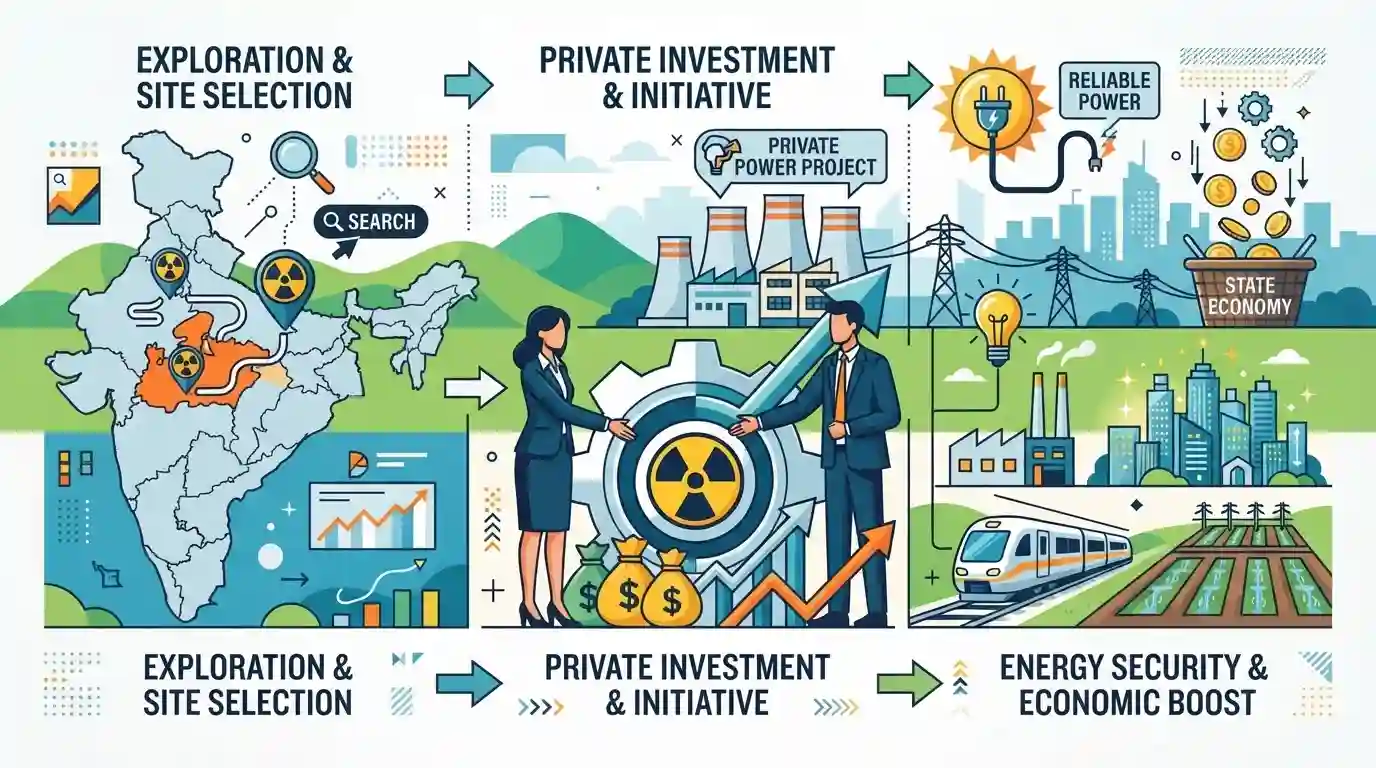
Adani Power is exploring two potential sites in Madhya Pradesh to establish its first nuclear power project. This initiative marks a significant step towards private sector involvement in India's nuclear energy landscape and is expected to bolster the state's power infrastructure and energy security.
Key Points
- Adani Power is reportedly considering two locations in Madhya Pradesh (MP) for its inaugural nuclear power project.
- This development signifies growing private sector participation in India's nuclear energy sector, aligning with national goals for clean and sustainable energy.
- The project aims to significantly enhance power generation capacity and energy security in Madhya Pradesh.
Important Terms
Adani Power

India's largest private thermal power producer, currently diversifying into nuclear energy. It aims to develop 10 GW of nuclear capacity by 2035, evaluating sites like Bina and Nigrie in Madhya Pradesh following recent sector liberalization.
UPSC context
GS-3 (Infrastructure/Energy). Highlights the transition of private energy conglomerates into India's civil nuclear power sector.
Department of Atomic Energy (DAE)
A government department directly under the Prime Minister responsible for India’s nuclear technology, energy programs, and research. It plays a critical role in establishing safety and regulatory guidelines for private sector participation in atomic energy.
UPSC context
GS-3 (Science & Tech). Essential for understanding India's nuclear governance, regulatory framework, and strategic energy planning.
SHANTI Bill
The Sustainable Harnessing and Advancement of Nuclear Energy for Transforming India (SHANTI) Bill, 2025. It is landmark legislation that opened India's tightly controlled civil nuclear energy sector to private sector participation and investments.
UPSC context
GS-3 (Economy/Energy). Crucial policy shift tested in questions on energy sector reforms and private investment liberalization.
Small Modular Reactors (SMRs)
Advanced nuclear reactors with up to 300 MW capacity per unit. They are smaller, cost-effective, and have reduced exclusion zone requirements, making them highly attractive for private sector deployment to meet clean energy targets.
UPSC context
GS-3 (Science & Tech/Environment). Tests knowledge on next-generation nuclear technologies and climate change mitigation strategies.
Nuclear Power Corporation of India Limited (NPCIL)
A public sector enterprise under the DAE responsible for designing, building, and operating nuclear power plants. It operates India's existing nuclear fleet and partners with private firms under new public-private investment frameworks.
UPSC context
GS-3 (Infrastructure). Important for evaluating the institutional framework of India's nuclear power generation and capacity expansion.
Prelims Trap
"Under Indian law, private sector companies are strictly prohibited from owning and operating nuclear power plants."
The SHANTI Act 2025 replaced the Atomic Energy Act 1962, legally permitting private sector entities to build, own, and operate civil nuclear power plants.
Static Concepts Connected
What are the key characteristics of India's Pressurised Heavy Water Reactors (PHWRs)?
- Fuel source: They use natural, unenriched uranium as fuel, bypassing the need for complex and expensive uranium enrichment facilities.
- Moderator and coolant: They utilize heavy water (Deuterium oxide or D2O) as both the neutron moderator and primary coolant.
- Strategic role: PHWRs form the foundational first stage of India's indigenous three-stage nuclear power program envisioned by Homi Bhabha.
How do Bharat Small Reactors (BSRs) differ from conventional nuclear plants?
- Modularity and cost: BSRs are compact (under 300 MW) and modular, allowing components to be factory-assembled and transported, significantly reducing capital costs and build times.
- Indigenous base: They are derived from India's proven 220 MW PHWR technology, newly optimized for quick deployment and private sector investment.
- Siting advantages: Their smaller safety footprint and lower water requirements make them ideal for replacing retiring coal-fired plants on existing brownfield sites.
Cross-Topic Patterns
Just Transition & Coal Phase-down
Small Modular Reactors (BSRs) can be deployed at decommissioned brownfield thermal power sites, utilizing existing transmission grids and offering a practical "just transition" for coal-dependent states like MP.
Civil Liability for Nuclear Damage
Private ownership via the SHANTI Act 2025 will revive debates on the Civil Liability for Nuclear Damage Act 2010, specifically concerning operator versus supplier liability in commercial ventures.

Expect a 2026 GS3 question on the SHANTI Act's impact on private nuclear ownership, coupled with BSR technology and thermal repurposing.
Linked PYQs · 3
Linked PYQs · 3
- 2023MPPSC_PRELIMSGS1
Which of the following thermal power stations is situated at Chachai of Anuppur district?
- 2025MPPSC_PRELIMSGS1
Which of the following atomic power stations had the highest installed capacity in India in the year 2024?
- 2008MPPSC_PRELIMSGS1
India's first atomic power station is :
