Adani Group plans multi specialty hospital project in New Town
Source:digitalhealthnews ↗
কেন এটি গুরুত্বপূর্ণ
This development is important for the WBCS exam as it covers major capital investment and public health infrastructure projects in West Bengal. It touches upon the PPP model for public welfare, regional development, and mentions several specific districts of West Bengal which are frequently tested in state geography sections.
সারসংক্ষেপ
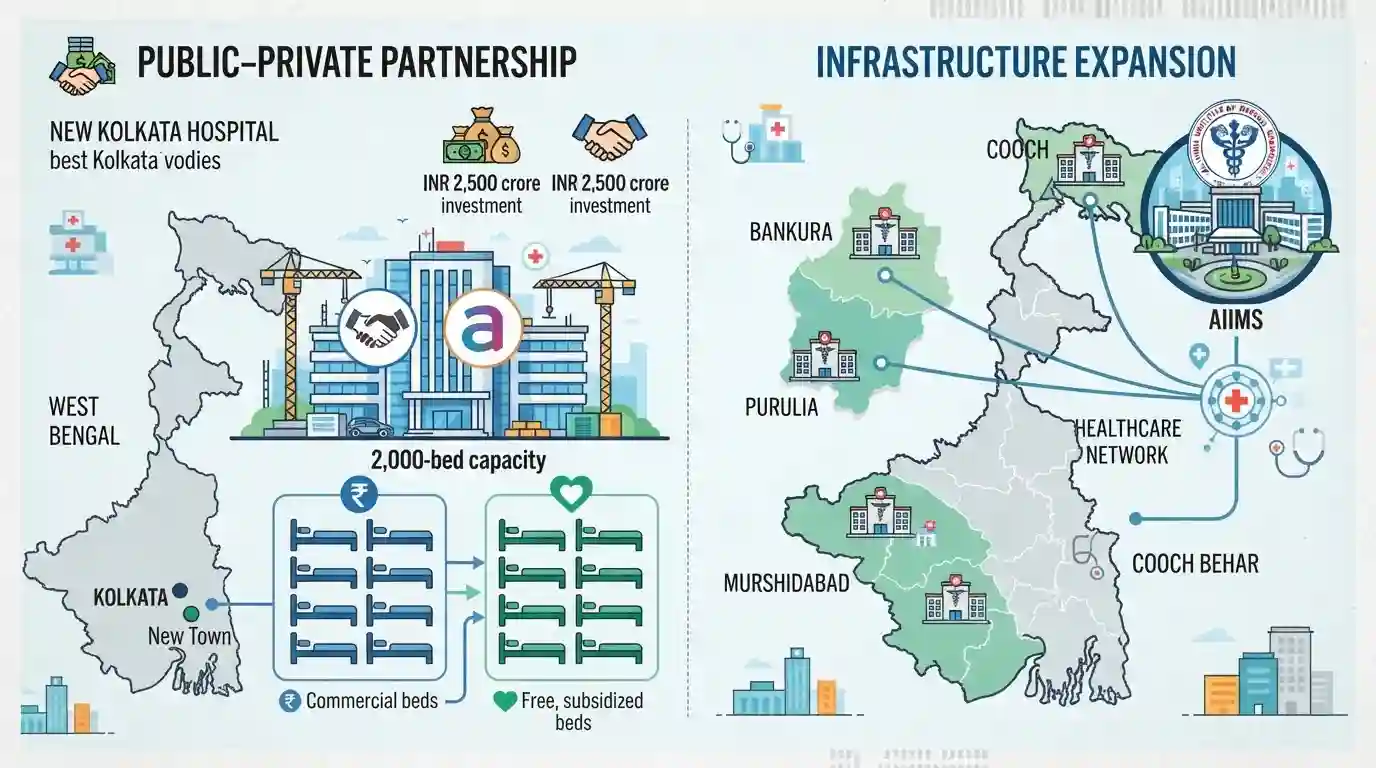
The Adani Group, in a Public-Private Partnership with the West Bengal government, is investing INR 2,500 crore to build a 2,000-bed hospital in New Town, Kolkata. Half of the beds will provide free care to economically disadvantaged patients, subsidized by the remaining commercial beds. Simultaneously, West Bengal is expanding its healthcare infrastructure by planning new medical colleges across four districts and proposing an AIIMS facility in North Bengal.
মূল বিষয়
- The Adani Group is partnering with the West Bengal government to set up a 2,000-bed hospital in New Town, Kolkata under a Public-Private Partnership (PPP) model.
- The project will use a cross-subsidy approach: 1,000 beds will be reserved for free treatment of economically weaker patients, subsidized by the remaining 1,000 commercial beds.
- The initiative involves an investment of approximately INR 2,500 crore to build a comprehensive 'health city' in New Town's Action Area II.
- The state government also plans to set up four new medical colleges in the districts of Kalimpong, Alipurduar, Paschim Bardhaman, and Dakshin Dinajpur.
- There is a proposal to establish an AIIMS in North Bengal, though it is currently awaiting approval from the central government.
গুরুত্বপূর্ণ শব্দ
Public-Private Partnership (PPP)

A collaborative model where government and private entities partner to finance, design, build, and operate public infrastructure and services, sharing resources, risks, and expertise.
UPSC context
GS Paper III (Infrastructure & Investment Models); tested for its efficacy, financing models (like BOT, HAM), and challenges in service delivery.
All India Institute of Medical Sciences (AIIMS)
A group of premier, autonomous public medical universities declared as Institutes of National Importance under an Act of Parliament, integrating top-tier medical education, research, and tertiary healthcare.
UPSC context
GS Paper II (Social Sector/Health); tests policies on tertiary healthcare expansion, infrastructure development, and federal institutional setups.
Ayushman Bharat
India's flagship national health protection scheme launched in 2018 to achieve Universal Health Coverage, combining primary-level Health and Wellness Centres with Pradhan Mantri Jan Arogya Yojana's hospitalisation insurance.
UPSC context
GS Paper II (Social Sector/Health Schemes); highly tested for its impact on reducing out-of-pocket health expenditure and welfare delivery.
National Health Mission (NHM)
A centrally sponsored public health initiative launched in 2013, subsuming rural and urban missions, to provide affordable, equitable, and quality healthcare while strengthening public health infrastructure.
UPSC context
GS Paper II (Government Schemes & Public Health); tests understanding of primary health systems, maternal/child mortality, and health cooperative federalism.
প্রিলিমস ফাঁদ
AIIMS facilities established under PMSSY are funded via a 60:40 cost-sharing formula between the Centre and the respective State Governments.
Aspirants often confuse PMSSY with Centrally Sponsored Schemes (like NHM). Under PMSSY, the establishment of new AIIMS is 100% funded by the Central Government as a Central Sector Scheme, requiring no state matching grants.
সংযুক্ত স্থির ধারণা
What are the objectives and structure of the Pradhan Mantri Swasthya Suraksha Yojana (PMSSY)?
- Dual Objective: Aims to correct regional imbalances in the availability of affordable/reliable tertiary healthcare services and to augment facilities for quality medical education.
- Two Components: Divided into setting up AIIMS-like institutions and upgrading existing state government medical colleges/institutions.
- Funding Pattern: The setting up of new AIIMS is fully funded by the Central Government (Central Sector Scheme), not on a cost-sharing basis with states.
How do Cross-Subsidization and DBFOT models function in public-private social infrastructure?
- Cross-Subsidization: An economic pricing mechanism where revenues from high-paying commercial segments (e.g., private beds) fund free services for economically weaker sections.
- DBFOT Model: Design-Build-Finance-Operate-Transfer; the private concessionaire finances and operates the facility for a fixed tenure before handing it back to the government.
- NITI Aayog Framework: NITI Aayog supports leasing underutilized district hospital spaces to private entities to run tertiary care centers, leveraging private capital for public outcomes.
আন্তঃবিষয় প্যাটার্ন
PPP in Healthcare vs. Right to Health
Links GS-2 (Social Justice/Health) with GS-3 (Infrastructure/PPP) by evaluating whether relying on private concessionaires for tertiary care conflicts with state directives on universal health coverage.
District Reorganization + Fiscal Stress
Connects Indian polity (creation of new districts like Kalimpong) with GS-3 economics, highlighting the fiscal challenges of deploying tertiary social infrastructure in newly bifurcated, low-revenue administrative zones.

Mains 2026 may ask to evaluate the viability of the cross-subsidy PPP model in healthcare as a solution to low public health spending.
সংযুক্ত PYQ · 2
সংযুক্ত PYQ · 2
- 2014WBCS_PRELIMSGS1
Which of the following is in the correct descending order of the districts of West Bengal in terms of area (2011)?
- 2021WBCS_PRELIMSGS1
Mica producing district of West Bengal is
