Adani Group emerges lowest bidder for Bengaluru tunnel road project
Source:Indian Express ↗
Why It Matters
The article touches upon critical GS3 themes such as infrastructure financing (PPP/BOT models), the challenges of urban mobility planning, and the recurring 'Environment vs. Development' debate in the context of urban spaces. It highlights practical hurdles faced by mega-infrastructure projects in Indian metropolises.
Summary
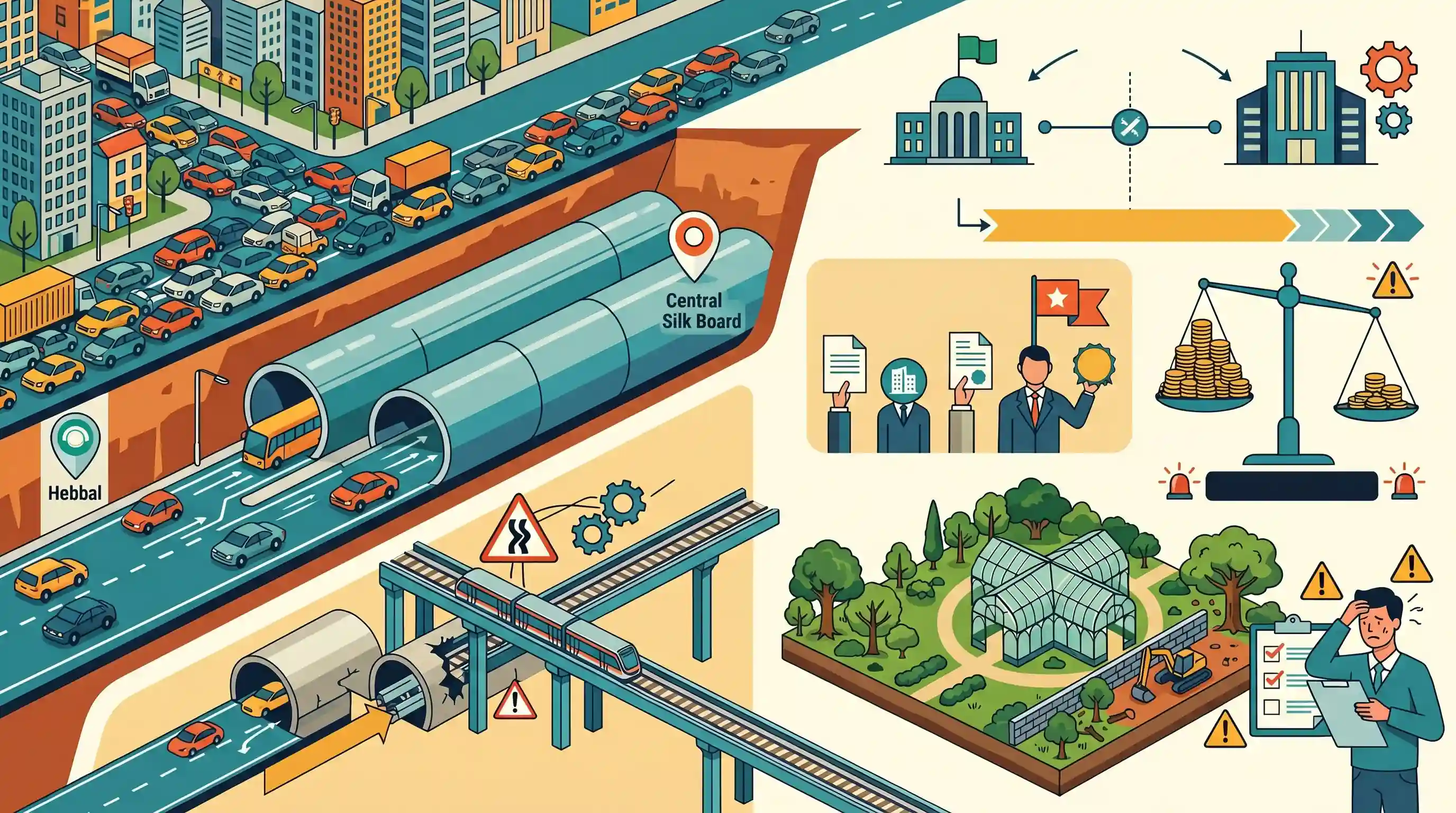
The Adani Group has emerged as the lowest bidder for a significant infrastructure project in Bengaluru—a twin-tube tunnel road designed to alleviate severe traffic congestion between Hebbal and the Central Silk Board. The project is planned under the Build-Operate-Transfer (BOT) PPP model with substantial government funding, but faces significant challenges. The bid of Rs 31,000 crore far exceeds the state's Rs 22,000 crore estimate, posing financial strain. Furthermore, urban planners have highlighted major concerns including conflict with the proposed Namma Metro Phase 3A alignment and potential environmental degradation, particularly the acquisition of land from the historic Lalbagh Botanical Garden.
Key Points
- The Adani Group emerged as the lowest bidder for Bengaluru's first tunnel road project (Hebbal to Central Silk Board), quoting Rs 31,000 crore against the government's estimate of Rs 22,000 crore.
- The infrastructure project will be executed under the Build-Operate-Transfer (BOT) PPP model, with the state government funding 40% of the project cost.
- Urban mobility experts have raised concerns regarding poor multi-modal integration, noting that the tunnel road runs parallel to the proposed Namma Metro Phase 3A, which could result in a severe conflict over ridership.
- The project's alignment has sparked environmental and heritage conservation debates, as it requires acquiring roughly six acres of the historic Lalbagh Botanical Garden.
Important Terms
Public-Private Partnership (PPP)

A collaborative long-term agreement between a government agency and a private sector entity to finance, build, and operate public infrastructure or services, sharing risks and rewards.
UPSC context
Relevant for GS Paper III (Economy and Infrastructure); tests understanding of investment models and resource mobilization for development.
Build-Operate-Transfer (BOT)
A PPP model where a private partner finances, constructs, and operates a project for a concession period to recoup investments via user fees before transferring ownership to the government.
UPSC context
GS Paper III topic on Investment Models; critical for understanding infrastructure financing and risk allocation in large-scale projects.
Namma Metro Phase 3A
A planned 36.59-km "Red Line" corridor of Bengaluru's metro network connecting Sarjapur to Hebbal, featuring both elevated and underground sections to enhance cross-city connectivity.
UPSC context
GS Paper I (Urbanization) and GS III (Infrastructure); illustrates challenges in multi-modal urban transport planning and inter-agency alignment.
Bruhat Bengaluru Mahanagara Palike (BBMP)
The municipal body (historically BBMP, now transitioning to Greater Bengaluru Authority) responsible for civic amenities, zoning, and local infrastructure in the Bengaluru metropolitan area.
UPSC context
GS Paper II (Governance and Local Self-Government); tests knowledge of 74th Constitutional Amendment Act and urban local body functions.
Bangalore Metro Rail Corporation Limited (BMRCL)
A joint venture between the Government of India and the Government of Karnataka tasked with planning, executing, and operating the "Namma Metro" rapid transit system.
UPSC context
GS Paper III (Infrastructure); demonstrates the cooperative federalism model in large-scale public transport projects and sustainable urban mobility.
Directorate of Urban Land Transport (DULT)
The nodal agency in Karnataka responsible for coordinating urban land transport initiatives, preparing mobility plans, and ensuring integrated transport planning across the state's urban areas.
UPSC context
GS Paper III (Urban Planning/Infrastructure); highlights the role of specialized state agencies in managing urbanization and multi-modal transit.
Prelims Trap
Under the standard BOT model, the government pays 40% of the project cost during the construction phase.
This actually describes the Hybrid Annuity Model (HAM). In a standard BOT model, the private developer bears the financing risk and recovers costs via tolls.
Static Concepts Connected
What are the primary differences between EPC, BOT, and HAM infrastructure models?
- EPC Model: Government funds 100% of the project cost. The private entity is solely responsible for engineering, procurement, and construction.
- BOT Model: The private developer finances, builds, and operates the project, recovering their investment through tolls or user fees before transferring it back to the government.
- HAM Model: A mix of EPC and BOT. The government pays 40% during construction, and the remaining 60% is paid as annuities. The government collects the tolls.
What is the historical significance of Bengaluru's Lalbagh Botanical Garden?
- Historical Origin: The garden was commissioned in 1760 by Mysore ruler Hyder Ali and was later expanded significantly by his son, Tipu Sultan.
- Key Architecture: It houses the famous Glass House, built in 1889 to commemorate the visit of the Prince of Wales, modeled after London's Crystal Palace.
- Ecological Role: It serves as a critical ex-situ conservation center, housing India's largest collection of tropical plants and ancient Peninsular Gneiss rock formations.
Cross-Topic Patterns
Urban Infrastructure vs Heritage Conservation
Similar to the Aarey forest metro-shed conflict, the Lalbagh tunnel issue highlights the recurrent friction between mega-infrastructure projects and ecological or heritage preservation in Indian cities.
National Urban Transport Policy (NUTP) friction
Tunnel roads conflict with the National Urban Transport Policy's core philosophy of 'moving people, not vehicles,' risking cannibalization of Mass Rapid Transit ridership like the proposed Metro.

Expect a 2026 Prelims match-the-following on PPP models (HAM vs BOT) or a Mains question on urban mega-roads conflicting with mass transit.
Linked PYQs · 4
Linked PYQs · 4
- 2022MainsGS3
Why is Public Private Partnership (PPP) required in infrastructural projects ? Examine the role of PPP model in the redevelopment of Railway Stations in India.
- 2013MainsGS3
Adoption of PPP model for infrastructure development of the country has not been free of criticism. Critically discuss pros and cons of the model.
- 2021MainsGS3
“Investment in infrastructure is essential for more rapid and inclusive economic growth.” Discuss in the light of India's experience.
- 2013MainsGS1
Discuss the various social problems which originated out of the speedy process of urbanization in India.
