Private Capital and AI Data Center Infrastructure Growth
Source:Indian Express ↗
Why It Matters
This massive corporate investment demonstrates the scale of infrastructure required to sustain the AI revolution. For UPSC aspirants, it is a prime example of private sector capital expenditure driving India's digital infrastructure, relevant to questions on economic growth, technological advancement, and data sovereignty.
Summary
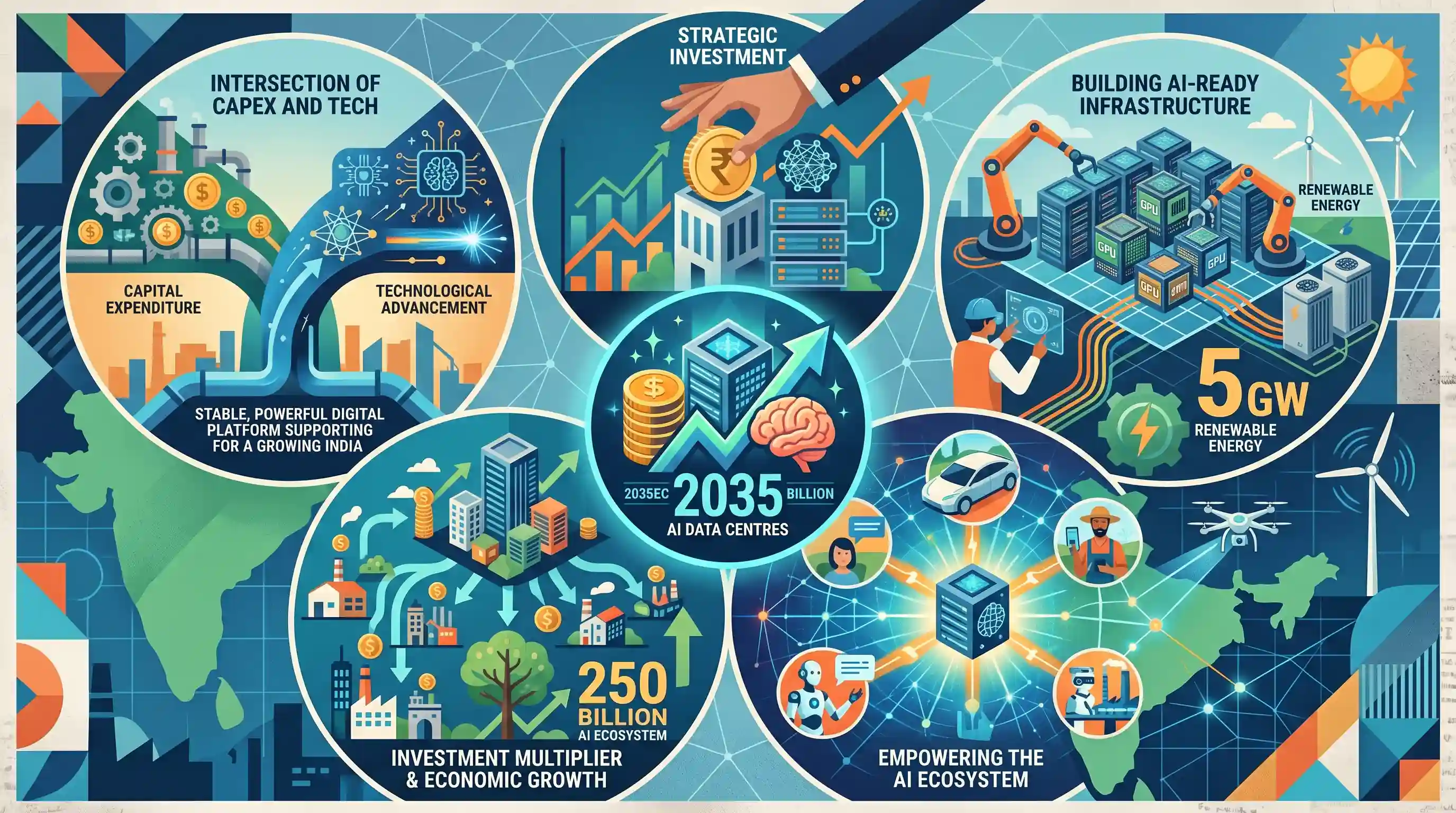
The Adani Group has committed to a $100 billion investment in AI-ready data centres by 2035, aiming to capitalize on the surging demand for advanced computing infrastructure. This strategic move highlights the intersection of massive capital expenditure and technological advancement, positioning India to build robust digital infrastructure necessary to support the growing artificial intelligence ecosystem and broader digital economy.
Key Points
- The Adani Group announced a massive $100 billion investment plan for developing AI-ready data centres by 2035.
- This initiative highlights the immense infrastructure demands associated with the rapid expansion of artificial intelligence and cloud computing globally.
- Such large-scale domestic data centres are crucial for supporting India's digital economy, enhancing data localization, and reducing reliance on overseas servers.
- The move underscores the growing role of private capital expenditure in building critical next-generation digital infrastructure for inclusive economic growth.
Important Terms
Data Centres

Centralised physical facilities housing servers, storage, and networking equipment to manage large volumes of data. They are classified as 'Infrastructure' in India for easier financing.
UPSC context
GS Paper 3: Infrastructure and Science & Technology; focuses on digital sovereignty and economic multiplier effects.
Digital India
A flagship government program launched in 2015 to transform India into a digitally empowered society and knowledge economy through infrastructure, digital services, and literacy.
UPSC context
GS Paper 2 & 3: E-governance, digital divide, and economic transformation via technology.
Artificial Intelligence (AI)
The simulation of human intelligence by machines, particularly computer systems, used in the article to describe specialized 'AI-ready' infrastructure like high-performance GPUs.
UPSC context
GS Paper 3: Science and Technology; critical for understanding emerging technologies and national security.
Digital Economy
Economic activity resulting from billions of daily online connections among people, businesses, devices, and data, powered by the internet and AI.
UPSC context
GS Paper 3: Indian Economy; relates to GDP growth targets and formalization of the economy.
Digital Infrastructure
The foundational physical and software systems (like broadband, data centers, and UPI) that enable the delivery of digital services and economic transactions.
UPSC context
GS Paper 3: Infrastructure; essential for bridging the digital divide and supporting the 'Viksit Bharat' vision.
Prelims Trap
"All data centres established in India automatically enjoy 'Infrastructure Status' for easier credit access."
Infrastructure status is not blanket. It is conditionally granted only to data centres with a minimum capacity (IT load greater than 5 MW).
Static Concepts Connected
What are the benefits of granting "Infrastructure Status" to a sector?
- Cheaper Credit: Enables access to long-term funding from insurance companies, pension funds, and international lenders at easier terms.
- ECB Access: Allows companies to raise funds through External Commercial Borrowings (ECB) under the automatic route.
- Institutional Funding: Makes the sector eligible to borrow from specialized infrastructure-focused institutions like IIFCL.
How does the DPDP Act 2023 approach data localization?
- Negative List Approach: Unlike the strict localization in earlier drafts, the 2023 Act shifts to a "negative list" approach.
- Cross-Border Transfer: Personal data can be transferred outside India unless the destination country is specifically restricted by the Central Government.
Cross-Topic Patterns
AI Infrastructure vs. Urban Water Stress
AI-ready data centres require millions of litres of freshwater daily for cooling, creating direct resource conflicts in drought-prone urban tech hubs and linking digital infrastructure to groundwater depletion.
Private Capex and Digital Public Infrastructure
Reliance on conglomerates for massive digital infrastructure mirrors the broader macroeconomic push to crowd-in private capital expenditure through policy signals like 'Infrastructure Status'.

Expect a 2026 multi-statement question combining the environmental cost of AI data centres (water/energy) and their Infrastructure status.
Linked PYQs · 4
Linked PYQs · 4
- 2023MainsGS3
What is the status of digitalization in the Indian economy? Examine the problems faced in this regard and suggest improvements.
- 2021MainsGS3
“Investment in infrastructure is essential for more rapid and inclusive economic growth.” Discuss in the light of India's experience.
- 2023MainsGS3
Introduce the concept of Artificial Intelligence (AI). How does Al help clinical diagnosis? Do you perceive any threat to privacy of the individual in the use of Al in healthcare?
- 2020PrelimsGS1
With the present state of development, Artificial Intelligence can effectively do which of the following? 1. Bring down electricity consumption in industrial units 2. Create meaningful short stories and songs 3. Disease diagnosis 4. Text-to-Speech Conversion 5. Wireless transmission of electrical energy Select the correct answer using the code given below:
