Activists Demand Immediate Implementation of Womens Reservation Act
Source:The Hindu ↗
Why It Matters
The delay in the implementation of the Nari Shakti Vandan Adhiniyam and its linkage to delimitation is a critical contemporary issue for GS2 Polity. It bridges women's political empowerment with the contentious federal debate over population-based political representation and the redrawing of constituencies.
Summary
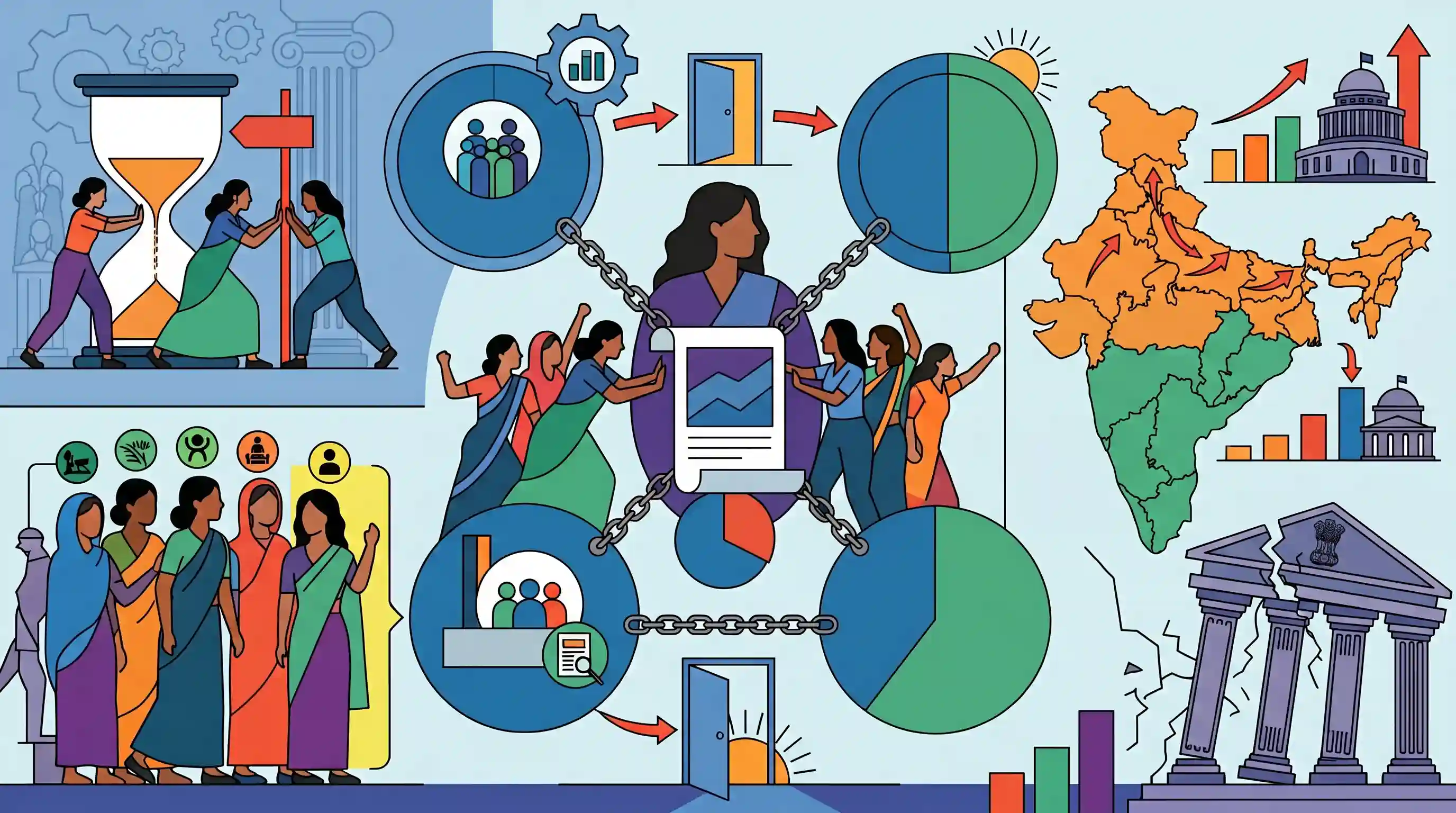
Women's rights organizations and political representatives are advocating for the immediate enforcement of the Women's Reservation Act, 2023 (Nari Shakti Vandan Adhiniyam), which guarantees a 33% legislative quota for women. They oppose the government's linking of the Act to the Census and delimitation exercises, arguing that this delays women's political empowerment. Furthermore, they caution that the impending delimitation could lead to an expansion of Parliament that penalizes Southern states for their successful population control measures, thereby straining India's federal structure. Additional demands include scrapping the 15-year sunset clause for the reservation and ensuring equitable representation for marginalized groups.
Key Points
- Activists and political leaders are demanding the immediate implementation of the Women's Reservation Act (Nari Shakti Vandan Adhiniyam) to provide a 33% quota for women in legislative bodies.
- They strongly oppose the government's stipulation that links the Act's rollout to the completion of the Census and the subsequent delimitation process.
- There is concern that using delimitation to increase parliamentary seats based on population could penalize Southern states that have successfully controlled their population, thereby threatening the federal balance.
- Key demands include the removal of the 15-year sunset clause attached to the reservation and ensuring fair representation for marginalized women.
Important Terms
Nari Shakti Vandan Adhiniyam (Women's Reservation Act, 2023)

Formally the 106th Constitutional Amendment Act, it reserves one-third of seats in the Lok Sabha, State Legislative Assemblies, and the Delhi Assembly for women to enhance political representation.
UPSC context
GS Paper II (Polity/Social Justice); crucial for topics on women's empowerment and constitutional amendments.
Delimitation Commission
A statutory, high-powered body (Article 82) tasked with redrawing electoral constituency boundaries based on population data to ensure 'one person, one vote, one value.'
UPSC context
GS Paper II (Elections/Polity); tests understanding of Article 82 and federal representation challenges.
Article 334A
A new constitutional provision introduced by the 106th Amendment stipulating that women's reservation will only commence after a delimitation exercise following the first post-2023 Census.
UPSC context
GS Paper II (Polity); essential for explaining implementation hurdles and the specific legal triggers of the Act.
Sunset Clause
A legislative provision that specifies a law will automatically expire after a set period; the 2023 Act includes a 15-year sunset clause for women's reservation.
UPSC context
GS Paper II (Governance/Polity); relates to the temporary nature of affirmative action in the Indian Constitution.
Federalism
The constitutional division of power between the Union and States; here, it pertains to the tension between demographic-based seat reallocation and the political interests of Southern states.
UPSC context
GS Paper II (Federal Structure); central to the 'North-South divide' debate regarding parliamentary seat expansion.
Census linkage
The official decennial count of India's population; the 106th Amendment ties the rollout of women’s reservation to the publication of the first Census conducted after the Act's passage.
UPSC context
GS Paper I & II; critical for understanding the administrative timeline and requirements for electoral reforms.
Prelims Trap
"The 106th Amendment Act provides a 33% reservation for women across Parliament and all State Legislatures."
Aspirants often miss that the 106th Amendment excludes the Rajya Sabha and State Legislative Councils, applying only to the Lok Sabha, State Assemblies, and the Delhi Legislative Assembly.
Static Concepts Connected
How does the Constitution mandate the delimitation of constituencies?
- Article 82: Under Article 82, Parliament enacts a Delimitation Act after every census to readjust seat allocations and territorial constituencies.
- Binding Nature: Orders of the Delimitation Commission have the force of law and cannot be questioned before any court.
- Past Commissions: Commissions have been set up only four times so far: 1952, 1963, 1973, and 2002.
What is the current constitutional freeze on parliamentary seats?
- 84th Amendment (2001): Extended the freeze on the total number of seats in the Lok Sabha and State Assemblies until the first census taken after the year 2026.
- Rationale: The freeze was implemented to encourage family planning policies and prevent states that successfully controlled their populations from losing political representation in Parliament.
Cross-Topic Patterns
Women's Quota + Delimitation + Federalism
The linkage of women's reservation to post-2026 delimitation ties gender justice directly to the North-South demographic divide and ongoing fiscal federalism debates regarding Finance Commission population weightages.
Sunset Clauses in Constitutional Quotas
Like the original 10-year limit for SC/ST political reservations under Article 334 (repeatedly extended), the 106th Amendment introduces a 15-year sunset clause, guaranteeing future parliamentary debates on its extension.

Expect a Prelims question combining the 106th Amendment's exclusions (e.g., Rajya Sabha) with the 84th Amendment's 2026 delimitation freeze.
Linked PYQs · 3
Linked PYQs · 3
- 2023MainsGS2
Discuss the contribution of civil society groups for women's effective and meaningful participation and representation in state legislatures in India.
- 2019MainsGS2
“The reservation of seats for women in the institutions of local self-government has had a limited impact on the patriarchal character of the Indian Political Process.” Comment.
- 2024PrelimsGS1
How many Delimitation Commissions have been constituted by the Government of India till December 2023?
