Civil Society Demands on Women Reservation Implementation
Source:The Hindu ↗
Why It Matters
The Nari Shakti Vandan Adhiniyam is a landmark constitutional amendment, but its implementation timeline is fiercely debated due to its statutory linkage to delimitation and the census. This article provides critical civil society perspectives and proposed alternative mechanisms for its implementation, which are highly relevant for Mains questions on electoral reforms, the role of civil society in governance, and challenges in achieving gender justice in political representation.
Summary
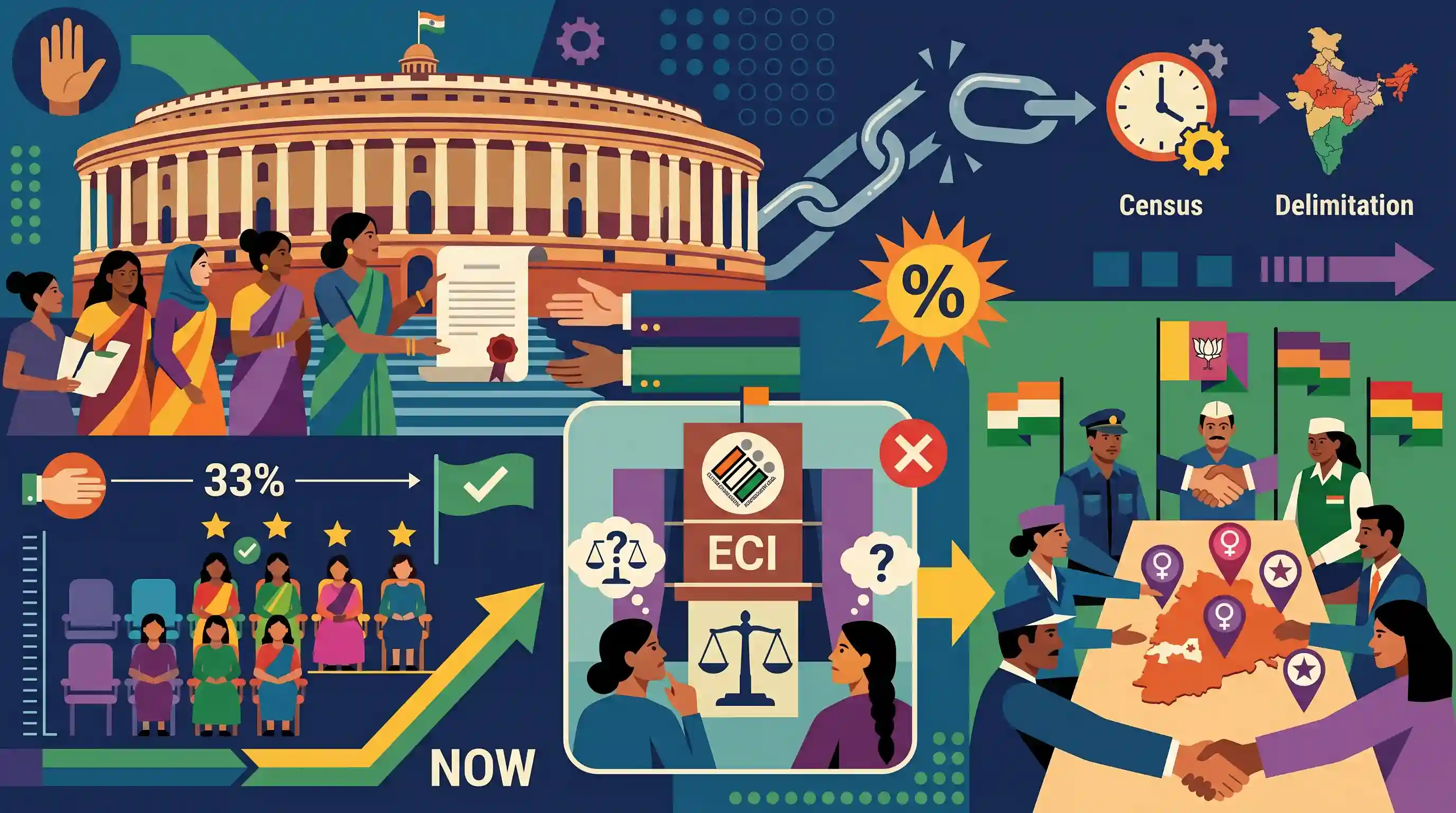
Civil society members and women's rights activists have submitted a petition to Parliament demanding amendments to the Women's Reservation Act (Nari Shakti Vandan Adhiniyam). They seek to delink the implementation of the 33% legislative quota for women from the upcoming 2027 Census and subsequent delimitation process, arguing that the reservation can be applied immediately to the existing strength of the legislative bodies. Highlighting concerns over the impartiality of the Election Commission of India, the activists further proposed establishing 'Special State Committees'—involving election officials and political party representatives—to democratically identify the reserved constituencies instead of giving the ECI sole authority.
Key Points
- Nearly 500 women's rights activists petitioned Parliament to amend the Nari Shakti Vandan Adhiniyam (Women's Reservation Act), demanding the 33% quota be delinked from the upcoming Census and delimitation exercises.
- Activists argued that a flat 33% reservation can be immediately applied to the current strength of the Lok Sabha and State Assemblies, independent of population counts or future legislature expansions.
- Citing doubts over the impartiality of the Election Commission of India (ECI), the petition opposed granting the ECI overriding powers in identifying reserved seats.
- The activists proposed the formation of 'Special State Committees' comprising ECI members, State EC members, cross-party representatives proportionate to vote shares, and independents, with at least 33% women members, to decide on reserved seats.
Important Terms
Nari Shakti Vandan Adhiniyam

The 106th Constitutional Amendment Act (2023) reserving one-third (33%) of seats for women in the Lok Sabha, State Legislative Assemblies, and the Delhi Assembly.
UPSC context
GS Paper II: Polity/Social Justice; essential for questions on legislative reforms and gender representation in Indian democracy.
Delimitation
The process of redrawing boundaries of territorial constituencies to ensure equal representation based on population changes, governed by Articles 82 and 170.
UPSC context
GS Paper II: Elections; critical for understanding the 'one person, one vote, one value' principle and federal representation.
Census 2027
The decennial population count; the 106th Amendment specifies that women's reservation will only take effect after the first census following the 2026 freeze.
UPSC context
GS Paper II: Governance; tests knowledge of the administrative requirements and timelines for implementing major constitutional mandates.
Election Commission of India (ECI)
A permanent constitutional body (Article 324) that oversees elections; it provides the Chief Election Commissioner as a member of the Delimitation Commission.
UPSC context
GS Paper II: Constitutional Bodies; tests understanding of the institutional independence required for fair electoral boundary adjustments.
Delinking (Reservation)
The legislative proposal to remove the statutory link between women's reservation and the completion of the census and delimitation to allow immediate effect.
UPSC context
GS Paper II: Polity/Electoral Reform; relevant for analyzing civil society demands and potential constitutional amendments to fast-track social justice.
Prelims Trap
The 106th CAA mandates 33% reservation for women in Lok Sabha immediately upon receiving presidential assent.
Under Article 334A, the implementation is strictly conditional upon the publication of the first post-Act Census and a subsequent delimitation exercise, not immediate.
Static Concepts Connected
How does the Delimitation Commission operate under the Indian Constitution?
- Constitutional Basis: Under Articles 82 and 170, Parliament enacts a Delimitation Act after a Census to readjust parliamentary and assembly constituencies.
- Legal Immunity: The Commission's orders have the force of law and cannot be challenged in any court (Article 329a).
- No Modification: Neither the Lok Sabha nor the State Assemblies can modify the orders issued by the Delimitation Commission.
What are the core provisions of the 106th Constitutional Amendment Act?
- New Articles: Introduced Articles 330A and 332A to mandate 33% reservation for women in Lok Sabha and State Legislative Assemblies.
- Scope of Quota: The 33% quota applies to the NCT of Delhi (Art 239AA) and includes seats reserved for SCs/STs.
- Sunset Clause: The reservation will automatically cease to exist 15 years after its commencement, unless extended by Parliament.
Cross-Topic Patterns
ECI Independence & Institutional Trust
Civil society demands for 'Special State Committees' to bypass the ECI highlight ongoing debates over the recent CEC Appointment Act and the removal of the CJI from the selection panel.
Data Deficits & Statutory Spillovers
The delayed 2021 Census not only stalls the Women's Reservation Act but also impacts NFSA beneficiary revisions, illustrating how delayed data collection directly freezes socio-political rights.

Prelims 2026: Multi-statement on 106th CAA linking Art 334A, Delimitation (Art 82), and the exact statutory role of ECI in rotating seats.
Linked PYQs · 3
Linked PYQs · 3
- 2023MainsGS2
Discuss the contribution of civil society groups for women's effective and meaningful participation and representation in state legislatures in India.
- 2024MainsGS2
Examine the need for electoral reforms as suggested by various committees with particular reference to "one nation one election" principle.
- 2017MainsGS2
To enhance the quality of democracy in India the Election Commission of India has proposed electoral reforms in 2016. What are the suggested reforms and how far are they significant to make democracy successful?
