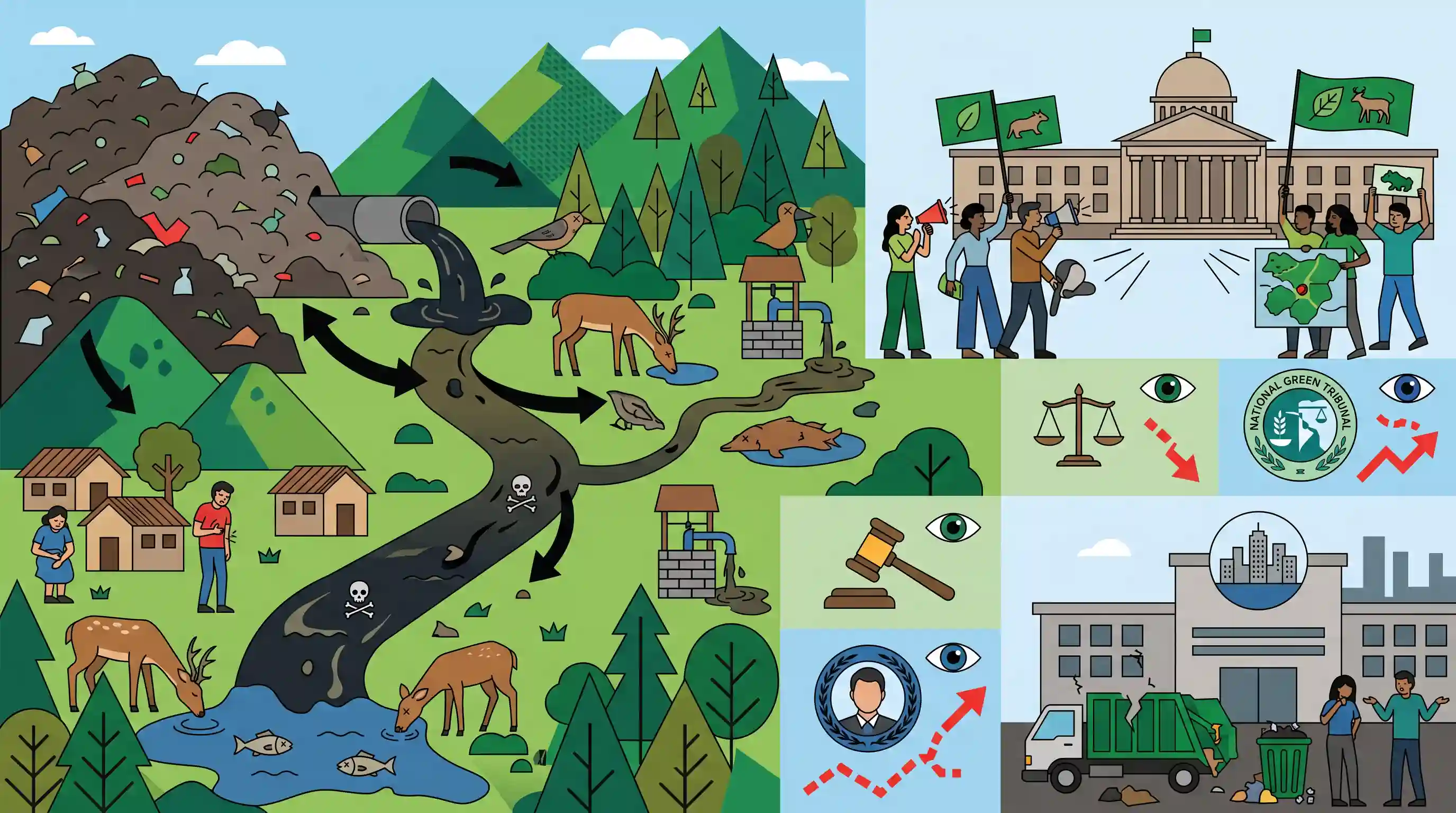
Toxic leachate from Bandhwari landfill threatens Aravali ecosystem
Source:The Hindu ↗
Why It Matters
The article serves as a prime case study for GS3 topics related to environmental degradation, solid waste management, and the impacts of rapid urbanization. It also provides examples for GS2 regarding the efficacy of statutory bodies like NGT and the role of environmental activists (pressure groups) in holding civic bodies accountable.
Summary
Environmentalists and wildlife activists have appealed to the Union Environment Ministry to intervene against the illegal discharge of toxic, untreated leachate from the Bandhwari landfill into the Aravali forests. The continuous discharge has created an ecological and humanitarian crisis, contaminating wildlife water holes and threatening nearby villages. Activists have criticized the Municipal Corporation of Gurugram (MCG) for failing to manage legacy waste and for allegedly encroaching upon forest land, despite ongoing monitoring by the National Green Tribunal (NGT) and the Haryana Human Rights Commission (HHRC).
Key Points
- Toxic leachate from the Bandhwari landfill is continuously discharging into the Aravali forests, posing a severe hazard to local residents and wildlife by contaminating water holes.
- Activists allege the Municipal Corporation of Gurugram (MCG) has failed to prevent the spillage and has encroached upon 20 acres of forest land.
- The environmental crisis underscores the broader challenge of processing legacy waste in rapidly expanding urban centers.
- Despite ongoing monitoring by the National Green Tribunal (NGT) and the Haryana Human Rights Commission (HHRC), activists report minimal improvement on the ground.
- The situation serves as a critical case study of environmental governance failures and the important role of environmental pressure groups in highlighting ecological crises.
Important Terms
National Green Tribunal (NGT)

A specialized judicial body established under the NGT Act 2010 for the effective and expeditious disposal of cases relating to environmental protection and forest conservation.
UPSC context
GS Paper II (Statutory Bodies) and GS Paper III (Environment). Tests understanding of environmental jurisprudence and judicial mechanisms.
Aravali Range
One of the world's oldest fold mountain systems, acting as a crucial ecological barrier against desertification and a primary groundwater recharge zone for the Delhi-NCR region.
UPSC context
GS Paper I (Geography) and GS Paper III (Environment). Relevant for physical geography and ecological conservation challenges.
Leachate
A toxic, foul-smelling liquid formed when water filters through solid waste in landfills, leaching out heavy metals, organic pollutants, and harmful chemicals into soil and groundwater.
UPSC context
GS Paper III (Environmental Pollution). Critical for topics on waste management and its impact on public health and ecology.
Legacy Waste
Historically accumulated municipal solid waste at dump sites that has remained untreated for years, requiring scientific remediation like bio-mining or bioremediation under national waste policies.
UPSC context
GS Paper III (Waste Management). Essential for urban governance topics and the implementation of Swachh Bharat Mission-Urban 2.0.
Ministry of Environment, Forest and Climate Change (MoEFCC)
The nodal agency in the Central Government responsible for planning, promoting, and coordinating India's environmental, forestry, and climate change policies and international commitments.
UPSC context
GS Paper II (Executive/Ministries). Tests knowledge of administrative structures managing India's natural resources and climate actions.
Solid Waste Management (SWM) Rules, 2016
A legal framework notified by the MoEFCC mandating waste segregation at source and scientific processing of waste to reduce landfill dependency and environmental degradation.
UPSC context
GS Paper III (Environment/Disaster Management). Vital for understanding regulatory mechanisms for sustainable urban waste management.
Prelims Trap
Leachate is exclusively an industrial chemical runoff and not related to municipal domestic garbage.
UPSC plays on exact definitions. Leachate is specifically the toxic liquid runoff generated from the decomposition of unsegregated solid municipal garbage in landfills.
Static Concepts Connected
What is the ecological and geographical significance of the Aravali Range?
- Oldest fold mountains: It is one of the world's oldest fold mountain systems, heavily denuded over millions of years and currently existing as relict mountains.
- Desertification shield: Acts as a critical climatic and ecological barrier preventing the eastward expansion of the Thar Desert into the National Capital Region and Uttar Pradesh.
- Groundwater recharge: Its fractured geological structure serves as a primary groundwater recharge corridor for the severely water-stressed regions of Northwest India.
How do Solid Waste Management Rules mandate the processing of legacy waste?
- Biomining: The process of excavating, segregating, and recovering valuable resources (like RDF plastics, metals, or soil fractions) from old accumulated landfill dumpsites.
- Bioremediation: Using biological agents, such as specific microbial cultures, to safely and naturally degrade the accumulated organic waste into stabilized components.
- Leachate management: Scientifically capturing and treating the highly toxic liquid runoff (leachate) before it percolates down and permanently contaminates local groundwater reserves.
Cross-Topic Patterns
Aravali degradation & Eastward Desertification
Encroachment and pollution in the Aravalis compromise its role as a windbreak, linking urban waste mismanagement directly to India's UNCCD targets and the eastward spread of the Thar desert.
Urban Local Body (ULB) Capacity Deficit
The Municipal Corporation's failure highlights GS-2 devolution issues, where ULBs under the 74th Amendment lack the technical and financial capacity to execute scientific legacy waste processing mandates.

Expect a multi-statement question linking legacy waste biomining, leachate groundwater contamination, and the statutory powers of the NGT.
Linked PYQs · 3
Linked PYQs · 3
- 2018MainsGS3
What are the impediments in disposing the huge quantities of discarded solid wastes which are continuously being generated? How do we remove safely the toxic wastes that have been accumulating in our habitable environment?
- 2025MainsGS2
What are environmental pressure groups? Discuss their role in raising awareness, influencing policies and advocating for environmental protection in India.
- 2022MainsGS2
“The most significant achievement of modern law in India is the constitutionalization of environmental problems by the Supreme Court.” Discuss this statement with the help of relevant case laws.
