Prosecution Demands in Pending Paper Leak Cases Involving MLAs
Source:The Hindu ↗
Why It Matters
The issue highlights the enduring problem of paper leaks in public recruitment examinations and the intersection of crime and politics. It underscores the challenges in governance, the delayed judicial and administrative processes regarding political representatives, and the application of specialized state laws like the UP Gangster Act and Public Examination Acts to combat organized cheating networks.
Summary
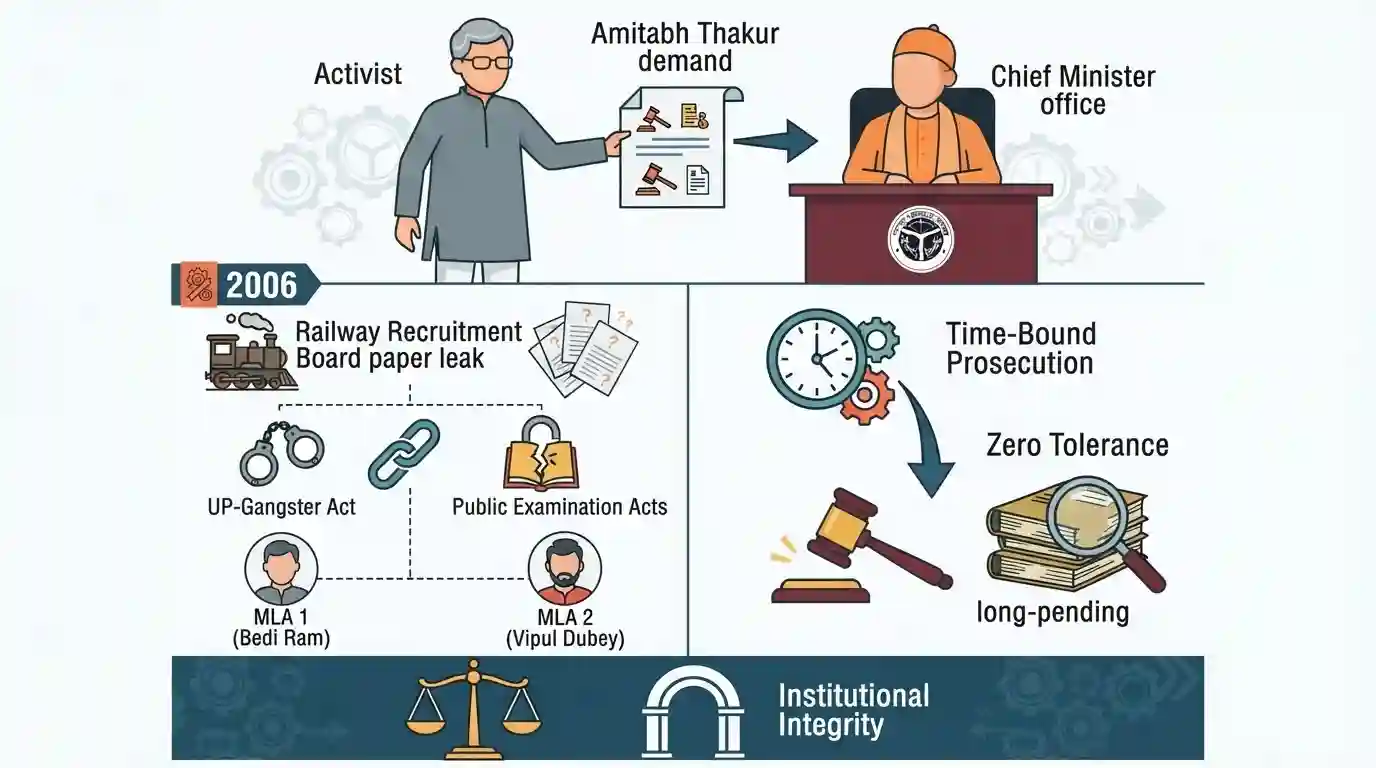
Social activist Amitabh Thakur has written to Uttar Pradesh Chief Minister Yogi Adityanath, demanding effective and time-bound prosecution in long-pending paper leak cases involving two NDA MLAs, Bedi Ram and Vipul Dubey. The cases, which date back to the 2006 Railway Recruitment examination, involve charges under the UP-Gangster Act and the Public Examination (Prevention of Unfair Means) Acts of both Uttar Pradesh and Rajasthan. The activist emphasized that zero-tolerance policies on paper leaks must equally apply to older pending cases to ensure institutional integrity.
Key Points
- Social activist and former IPS officer Amitabh Thakur has urged UP Chief Minister Yogi Adityanath to ensure time-bound prosecution in pending paper leak cases against two NDA MLAs.
- The accused legislators are Bedi Ram of the Suheldev Bharatiya Samaj Party (SBSP) and Vipul Dubey of the Nishad Party.
- The charges stem from multiple examination leaks over the past 20 years, most notably the 2006 Railway Recruitment examination paper leak.
- The MLAs face serious charges under various state-level legislations, including the UP-Gangster Act, 1986, and the UP and Rajasthan Public Examination (Prevention of Unfair Means) Acts.
Important Terms
Uttar Pradesh Gangsters and Anti-Social Activities (Prevention) Act, 1986

A state legislation enacted to prevent organized crime and anti-social activities, allowing for the establishment of Special Courts, fast-tracked prosecution, and attachment of properties acquired through illegal operations.
UPSC context
GS Paper II: Governance and Criminalization of Politics; tests state-level legal frameworks combating organized crime, mafia networks, and law-and-order challenges.
Uttar Pradesh Public Examinations (Prevention of Unfair Means) Act, 1998
A state-level legislation designed to deter question paper leakage, cheating, and unauthorized assistance during public examinations, establishing penalties and summary trial procedures to maintain institutional academic integrity.
UPSC context
GS Paper II: Statutory Bodies and Governance; tests mechanisms to prevent corruption, paper leaks, and systemic reform in public exams.
Rajasthan Public Examination (Prevention of Unfair Means) Act, 1992
A state statute targeting examination malpractices, penalizing unauthorized disclosure of question papers, cheating, and collusion. It was amended in 2022 to categorize such offenses as non-bailable, organized crimes.
UPSC context
GS Paper II: Governance and Public Policy; tests comparative legislative measures adopted by Indian states to curb examination fraud and malfeasance.
Suheldev Bharatiya Samaj Party (SBSP)
A regional political party in Uttar Pradesh founded by Om Prakash Rajbhar, representing marginalized and Other Backward Classes (OBCs), primarily the Rajbhar community, and allied with the NDA.
UPSC context
GS Paper II: Salient Features of Representation of People’s Act and Regionalism; tests political mobilization, identity politics, and coalition dynamics.
Nishad Party
Officially Nirbal Indian Shoshit Hamara Aam Dal, a regional party in Uttar Pradesh focused on mobilizing riverine and fishermen communities (Nishads/OBCs) to demand Scheduled Caste status and socio-economic rights.
UPSC context
GS Paper II: Welfare Schemes for Vulnerable Sections and Representation of People's Act; tests pressure groups, caste mobilization, and electoral politics.
Azad Adhikar Sena
An unregistered political party in Uttar Pradesh founded by former IPS officer Amitabh Thakur, aiming to promote democratic accountability, constitutional values, and citizen rights against state excesses.
UPSC context
GS Paper II: Pressure Groups, NGOs, and Citizen Charters; tests civil society movements, administrative accountability, and advocacy for governance transparency.
Prelims Trap
"The Public Examinations Act, 2024 applies to all exams conducted by State Public Service Commissions."
The 2024 national Act applies exclusively to Central authorities (UPSC, NTA, etc.). State-level exams are governed by respective state laws, some of which have existed for decades.
Static Concepts Connected
How does criminal conviction affect sitting MPs/MLAs?
- RPA 1951: Under Section 8(3), conviction with a sentence of two years or more leads to immediate disqualification from the legislature and a subsequent 6-year ban.
- Lily Thomas Case: The 2013 judgment struck down Section 8(4), removing the three-month grace period that previously protected convicted legislators during appeals.
- Stay on Conviction: If a conviction is stayed by a higher court, the disqualification is suspended, allowing the legislator to retain or reclaim their seat.
What are the features of the Public Examinations Act, 2024?
- Central Scope: It strictly covers central exam authorities like UPSC, SSC, RRB, IBPS, and NTA, explicitly excluding state-level boards.
- Nature of Offences: All offences listed under the Act are legally classified as cognizable, non-bailable, and non-compoundable.
- Harsh Penalties: Organised cheating syndicates can face imprisonment of up to 10 years and a minimum fine of ₹1 crore.
Cross-Topic Patterns
RPA 1951 + Special Courts for MPs/MLAs
The demand for time-bound prosecution links to the Supreme Court's 2014 mandate and subsequent 2017 Union scheme to conclude trials against sitting legislators within a year via fast-track courts.
State Security Laws vs Normal CrPC
Stringent state legislations like the UP Gangsters Act alter CrPC rules, allowing up to one year to file chargesheets, creating friction points with standard civil liberties and Article 21.

Expect a 2026 prelims question merging RPA 1951 legislative disqualification criteria with features of the Public Examinations Act 2024.
Linked PYQs · 1
Linked PYQs · 1
- 2021UPPSC_PRELIMSGS1
The functions of the State Public Service Commission of Uttar Pradesh can be extended by
