Siwan Police Action Follows Firing During Student Protest
Source:The Hindu ↗
Why It Matters
Highlights issues of police accountability, crowd control protocols, and the use of lethal force during peaceful or student protests. Also touches on administrative failures in the education sector leading to public unrest, a significant issue in Bihar politics.
Summary
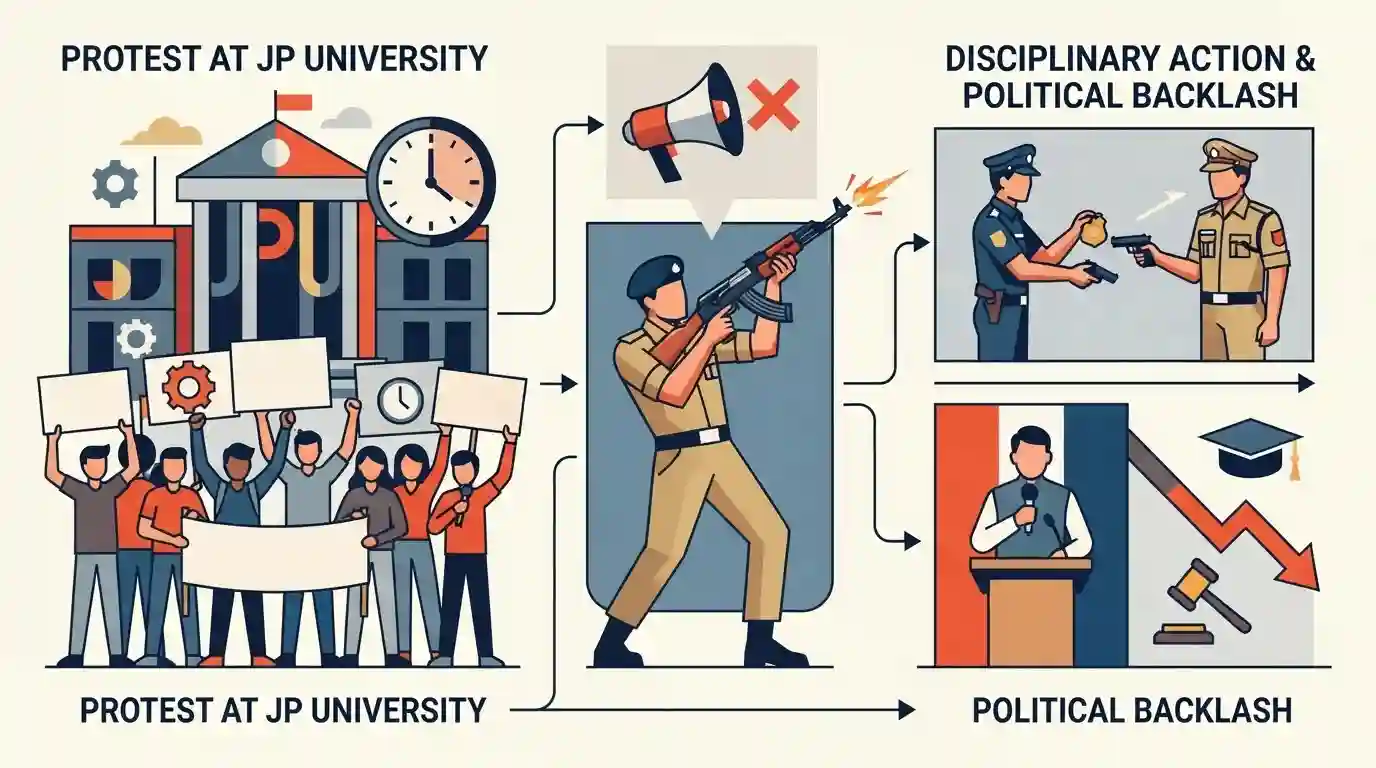
A Bihar police sub-inspector was suspended in Siwan district for firing an AK-47 assault rifle into the air during a protest by students at JP University in Chapra. The students were protesting against the three-year delay in completing degree courses and exams. The use of a lethal weapon during a student demonstration triggered a political backlash, with RJD leader Tejashwi Yadav condemning the Nitish Kumar-led NDA government's approach to law and order and education. Disciplinary action was taken for the disproportionate use of force in crowd control.
Key Points
- A Bihar policeman was suspended after firing from an AK-47 assault rifle during a student protest over delays in college exams.
- The incident occurred outside JP University in Chapra when student members, including ABVP, clashed with authorities.
- RJD leader Tejashwi Yadav criticised the JD(U)-BJP government for using extreme force against students seeking timely exams and degrees.
- Siwan SP Amitesh Kumar initiated disciplinary action against the officer, SI Sudhir Kumar, due to the disproportionate use of a lethal weapon in crowd control.
Important Terms
Bihar Police

The primary law enforcement agency of Bihar. It recently faced scrutiny after a sub-inspector fired an AK-47 assault rifle during a student protest, raising concerns about the use of excessive force.
UPSC context
Relevant to GS Paper 2 and 3 for topics on police reforms, crowd management protocols, and law and order administration.
Jai Prakash University (JP University)
A state university in Chapra, Bihar. Students recently held demonstrations against severe, three-year administrative delays in completing degree courses and conducting academic examinations.
UPSC context
Connects to GS Paper 2 (Education), illustrating systemic administrative challenges and governance issues in Indian higher education institutions.
Rashtriya Janata Dal (RJD)
A major regional political party in Bihar. As the primary opposition, its leadership condemned the state government's approach to law and order following the police firing at student protesters.
UPSC context
Relevant for GS Paper 2 (Polity), highlighting the role of opposition and regional parties in state-level political accountability.
Bharatiya Janata Party (BJP)
A major national political party in India. It is a key partner in the National Democratic Alliance (NDA) government in Bihar, which faced political backlash over recent police actions.
UPSC context
Pertains to GS Paper 2 (Polity) regarding national-state political dynamics, coalition governments, and governance accountability.
Prelims Trap
"Under the new BNSS 2023, only an Executive Magistrate can legally order the dispersal of an unlawful assembly."
Under Section 148 of the new BNSS (2023), an Executive Magistrate, SHO, or any police officer not below the rank of sub-inspector can order dispersal.
Static Concepts Connected
What are the Constitutional provisions for the Right to Assemble?
- Article 19(1)(b): Guarantees all citizens the fundamental right to assemble peacefully and without arms. It does not protect violent or armed protests.
- Article 19(3): Permits the State to impose reasonable restrictions on this right in the interests of the sovereignty and integrity of India, or public order.
- Graded Force Principle: The Supreme Court mandates a graded use of force (warning, tear gas, lathi-charge) for crowd control; lethal force is strictly a last resort.
What was the Total Revolution (Sampoorna Kranti) led by JP Narayan?
- Origins in Bihar: Originating from 1974 student agitations in Bihar against corruption and misrule, JP Narayan transformed it into a national movement for comprehensive systemic change.
- Seven Revolutions: It called for a holistic transformation encompassing seven spheres: political, economic, social, cultural, ideological/intellectual, educational, and spiritual.
Cross-Topic Patterns
Demographic Dividend vs State Capacity
University exam delays highlight a crisis in state capacity, turning the demographic dividend into youth unrest. This links education administration directly to internal security challenges.
Article 21 and Crowd Control
Disproportionate police force (firing an AK-47) violates Supreme Court guidelines on graded use of force, tying criminal procedure (BNSS) directly to Article 21 (Right to Life).

Expect a 2026 Prelims question testing the exact authorities empowered to disperse unlawful assemblies under the new BNSS 2023.
Linked PYQs · 2
Linked PYQs · 2
- 2023BPSC_PRELIMSGS1
Choose the correct order of the following districts of Bihar as per the ascending decadal population growth (2001–2011).
- 2025BPSC_PRELIMSGS1
The constitution of India provides for reasonable restrictions on Fundamental Rights but reasonableness must keep in mind that: 1. The restrictions must be necessary for the protection of the rights of others. 2. The restrictions must be proportionate to the end sought. 3. The restrictions must be reasonable in the light of the circumstances. 4. The restrictions must be in the public interest.
