Kerala Implements Comprehensive Action Plan to Clean Kadambrayar River
Source:The Hindu ↗
Why It Matters
Serves as a crucial case study for environmental governance, demonstrating the functional relationship between the NGT, CPCB, and state-level bodies in executing integrated river rejuvenation and urban pollution control measures.
Summary
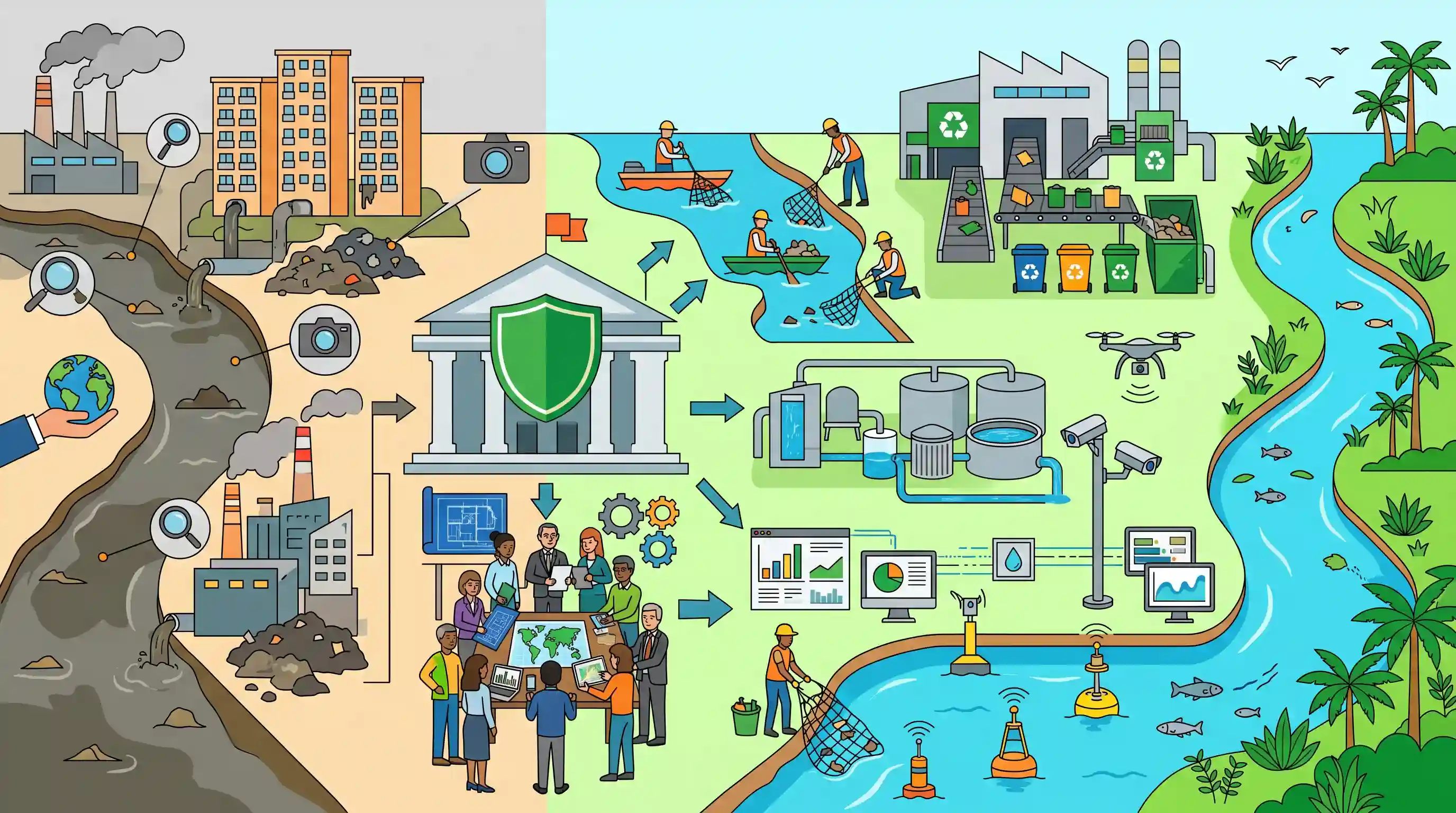
The Kerala State Environment Department has informed the National Green Tribunal (NGT) about a comprehensive action plan to curb pollution in the Kadambrayar river in Ernakulam. Approved by the Central Pollution Control Board (CPCB), the multi-pronged strategy involves cleaning the river, identifying pollution sources like industries and apartment complexes, and augmenting waste management infrastructure. The plan also emphasizes robust surveillance and continuous water quality monitoring, executed through a dedicated district-level technical committee.
Key Points
- The Kerala Environment Department submitted a multi-pronged action plan to the National Green Tribunal (NGT) to tackle severe pollution in the Kadambrayar river.
- Approved by the Central Pollution Control Board (CPCB), the plan focuses on five core areas: cleaning the river, identifying pollution sources, upgrading infrastructure, continuous monitoring, and robust surveillance.
- A district-level technical committee involving the Irrigation Department, State Pollution Control Board, and local self-governments will execute the plan.
- Key interventions include the removal of water hyacinths, establishing sewage treatment plants (STPs), monitoring unauthorized discharges from industries and apartments, and installing CCTV cameras to prevent illegal waste dumping.
Important Terms
National Green Tribunal (NGT)

A statutory quasi-judicial body established under the NGT Act 2010 for the "expeditious disposal" of cases related to environmental protection and conservation of forests and other natural resources.
UPSC context
GS3 (Environment). Often tested on its statutory origin, quasi-judicial powers, and role in enforcing the "Polluter Pays" principle.
Central Pollution Control Board (CPCB)
A statutory organization established in 1974 under the Water (Prevention and Control of Pollution) Act, providing technical services to the Ministry of Environment and coordinating activities of state-level boards.
UPSC context
GS3 (Environment & Governance). Key for understanding institutional frameworks for pollution control and national water quality monitoring.
State Pollution Control Board (SPCB)
Statutory bodies established under the Water Act 1974 and Air Act 1981 to implement and enforce environmental regulations and pollution standards at the state level.
UPSC context
GS2 (Statutory Bodies) and GS3 (Environment). Crucial for questions on federal environmental governance and field-level enforcement.
Polluted River Stretches (PRS)
River segments identified by the CPCB where water quality fails to meet bathing standards, specifically when Bio-Chemical Oxygen Demand (BOD) levels exceed 3 mg/L.
UPSC context
GS3 (Environment/Water Conservation). Important for "Priority" classification (I to V) and river rejuvenation strategies like the Kadambrayar action plan.
Bio-Chemical Oxygen Demand (BOD)
A key water quality parameter representing the amount of dissolved oxygen needed by aerobic biological organisms to break down organic matter in a water sample.
UPSC context
Prelims (Science/Environment). The primary metric used by CPCB and NGT to define and prioritize river pollution levels.
Polluter Pays Principle
An environmental law principle requiring that those who produce pollution should bear the costs of managing it to prevent damage to human health or the environment.
UPSC context
GS3 (Environment). A core legal principle used by the NGT to levy fines and mandate remediation by industries or local bodies.
Prelims Trap
The NGT is the primary technical body responsible for designing and approving river pollution action plans.
NGT is a statutory adjudicatory body for environmental disputes. Technical standard-setting and approval of pollution action plans strictly fall under the mandate of the CPCB and State Pollution Control Boards.
Static Concepts Connected
What are the differing core mandates of the NGT and CPCB?
- NGT Adjudication: Formed under the NGT Act 2010 to expedite cases relating to environmental protection, conservation of forests, and enforcement of environmental legal rights.
- CPCB Regulation: Formed under the Water Act 1974; it advises the government, coordinates State Boards, sets technical pollution standards, and approves mitigation plans.
How does Water Hyacinth degrade freshwater river ecosystems?
- Light Blockage: Dense surface mats prevent sunlight from penetrating the water column, effectively halting photosynthesis for native submerged aquatic flora.
- Oxygen Depletion: Its rapid proliferation and subsequent decomposition consume massive amounts of Dissolved Oxygen (DO), leading to large-scale fish mortality.
- Eutrophication Link: It aggressively thrives in nutrient-heavy waters, acting as a direct biological indicator of advanced urban water pollution and untreated sewage discharge.
Cross-Topic Patterns
Invasive flora as pollution indicators
The proliferation of Water Hyacinth directly correlates with heavy nutrient loading from untreated sewage, linking urban solid waste management failures to critical biodiversity loss in freshwater ecosystems.
Tribunals driving executive environmental action
NGT demanding state-level action plans reflects a recurring polity theme: statutory environmental tribunals stepping in to remedy persistent executive inaction in ecological governance and pollution control.

Expect a 2026 multi-statement question linking BOD/COD spikes, invasive aquatic species (water hyacinth), and CPCB's statutory powers.
Linked PYQs · 3
Linked PYQs · 3
- 2018PrelimsGS1
How is the National Green Tribunal (NGT) different from the Central Pollution Control Board (CPCB)? 1. The NGT has been established by an Act whereas the CPCB has been created by an executive order of the Government. 2. The NGT provides environmental justice and helps reduce the burden of litigation in the higher courts whereas the CPCB promotes cleanliness of streams and wells, and aims to improve the quality of air in the country. Which of the statements given above is/are correct?
- 2024MainsGS3
Industrial pollution of river water is a significant environmental issue in India. Discuss the various mitigation measures to deal with this problem and also the government's initiatives in this regard.
- 2018MainsGS3
What are the impediments in disposing the huge quantities of discarded solid wastes which are continuously being generated? How do we remove safely the toxic wastes that have been accumulating in our habitable environment?
