Marathi Language Proficiency Mandatory for Commercial Drivers
Source:The Hindu ↗
Why It Matters
This development reflects state-level administrative enforcement of regional language policies. For MPSC aspirants, it connects to broader constitutional concepts regarding official languages, linguistic minorities, and the balance between regional cultural promotion and the livelihoods of migrant transport workers.
Summary
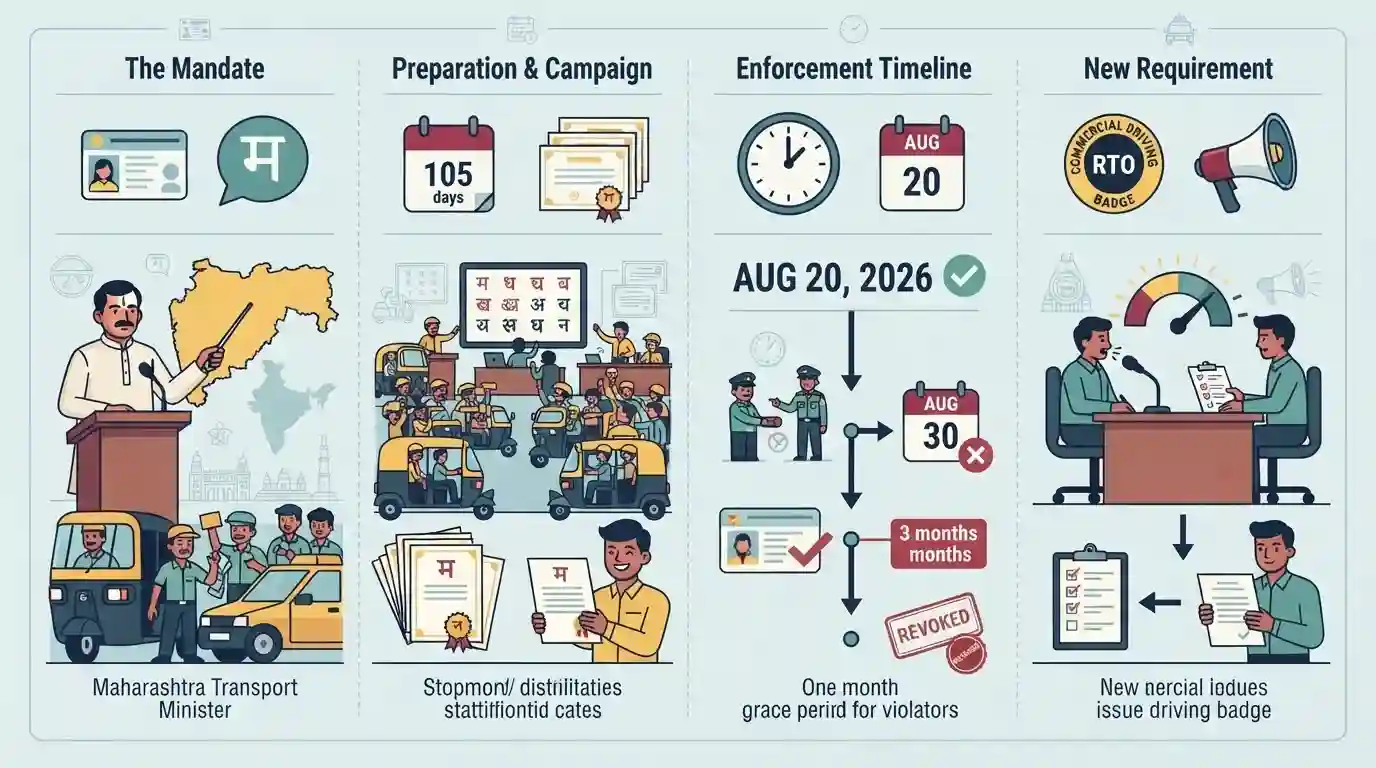
Maharashtra Transport Minister Pratap Sarnaik announced that auto-rickshaw and taxi drivers must demonstrate a working knowledge of Marathi to retain their driving licenses. Following a 105-day campaign to promote the language—during which 1.65 lakh drivers received Marathi skill certificates—the state will begin enforcing the rule on August 20, 2026. Drivers violating the mandate will be given a one-month grace period, after which their licenses face a three-month suspension and potential cancellation. Additionally, a mandatory Marathi-speaking test has been introduced for commercial drivers before they are issued their driving badges.
Key Points
- The Maharashtra government has mandated that auto-rickshaw and taxi drivers must possess a 'working knowledge' of Marathi, effective August 20, 2026.
- Drivers refusing to learn Marathi face a one-month grace period after receiving a notice, followed by a three-month license suspension and potential cancellation.
- A Marathi-speaking test will now be mandatory for drivers when receiving their commercial badge after getting a driving license.
- 1.65 lakh auto and taxi drivers were awarded Marathi proficiency certificates following a 105-day government campaign.
Important Terms
Maharashtra State Transport Department

The apex state government body regulating road transport, vehicle registration, and driver licensing in Maharashtra.
UPSC context
Critical for State Administration and Governance topics, illustrating state enforcement of language regulations under transport codes.
Autorickshaw Drivers and Owner Association Samyukta Kriti Samiti
An umbrella union representing auto-rickshaw drivers and owners in Maharashtra.
UPSC context
Relevant to Social Issues and Labor Rights, showing the role of trade unions in responding to state transport policies.
Working Knowledge of Marathi
A legal requirement under the Maharashtra Motor Vehicles Rules, mandating that commercial drivers possess functional communication skills in the state's official language.
UPSC context
Tests understanding of Linguistic Policies, Regionalism, and Employment criteria in state-level public service delivery.
Commercial Driving Badge
An official authorization issued alongside a driving license that legally permits an individual to drive transport vehicles for passengers or goods.
UPSC context
Important for Regulatory Frameworks and Transport Economics, as its suspension restricts the livelihood of gig and traditional transport workers.
Prelims Trap
"The mandate requires written proficiency in Marathi for all commercial vehicles, including inter-state trucks."
The amendment only requires a 'working/conversational knowledge' (verified via a speaking test) and specifically targets public transport drivers (autos, taxis, and app-cabs), not written fluency or all commercial vehicles.
Static Concepts Connected
What Constitutional provisions govern the official languages of a State?
- Article 345: Empowers state legislatures to adopt any one or more of the languages in use in the State, or Hindi, as the official language.
- Article 347: Allows the President to direct that a language spoken by a substantial proportion of a State's population be officially recognised, if demanded.
- Article 29: States that linguistic minorities have the right to conserve their distinct language, script, or culture.
How is motor vehicle licensing governed between the Centre and States?
- Concurrent Subject: Motor vehicles fall under the Concurrent List, allowing both Centre and States to legislate. The Motor Vehicles Act, 1988 is the central framework.
- State Delegated Powers: State governments exercise delegated legislative powers to frame specific rules (like the Maharashtra Motor Vehicles Rules) governing local permits, badges, and licensing conditions.
Cross-Topic Patterns
Linguistic Mandates vs Article 19(1)(g)
Language mandates often spark debates around Article 19(1)(g) (freedom of profession). This mirrors recent legal battles over mandatory Marathi signboards for shops and establishments in Maharashtra.
Gig Economy & State Transport Regulations
Applying the Marathi rule to app-based aggregators (Ola/Uber) via Rule 22(3A) reflects the state's growing regulatory push into the gig economy, tying into broader debates on gig worker regulations.

MPSC often tests the constitutional limits of state language mandates (Art. 345 vs Art. 19) and delegated legislation under the MV Act.
Linked PYQs · 2
Linked PYQs · 2
- 2026MPSC_PRELIMSGS1
Match the correct pairs of the following articles of the Constitution of India with the subject. Subject (a) Language to be used in the complaint for redressal of grievances (b) Facilities for education in mother tongue at primary level (c) Special officer for linguistic minority communities (d) Directive for development of Hindi Language Articles (i) 350 A (ii) 351 (iii) 350 (iv) 350 B Code: (a) (b) (c) (d)
- 2023MPSC_PRELIMSGS1
Which of the following is/are the main objective/s of Committee of Parliament on Official language ? A. To review the progress made in the use of Hindi for official purposes of the Union and to make recommendations to increase the use of Hindi. B. Looking into the linguistic demands for new States and make suggestions in that regard. C. Identify the endangered language and make recommendations to protect and preserve them. D. Examine the vernacular education and make recommendations for effective implementation of the three languages formula.
