ACME Solar secures funding for peak power storage project in Rajasthan
Source:renewable-watch ↗
Why It Matters
Highlights the growing scale of infrastructure financing in Rajasthan's renewable energy sector and demonstrates the technological shift toward integrating Battery Energy Storage Systems (BESS) to ensure assured peak power, a critical step for grid stability. It is highly relevant for RPSC Prelims given the project's location in Rajasthan and its implications for state-level economic development.
Summary
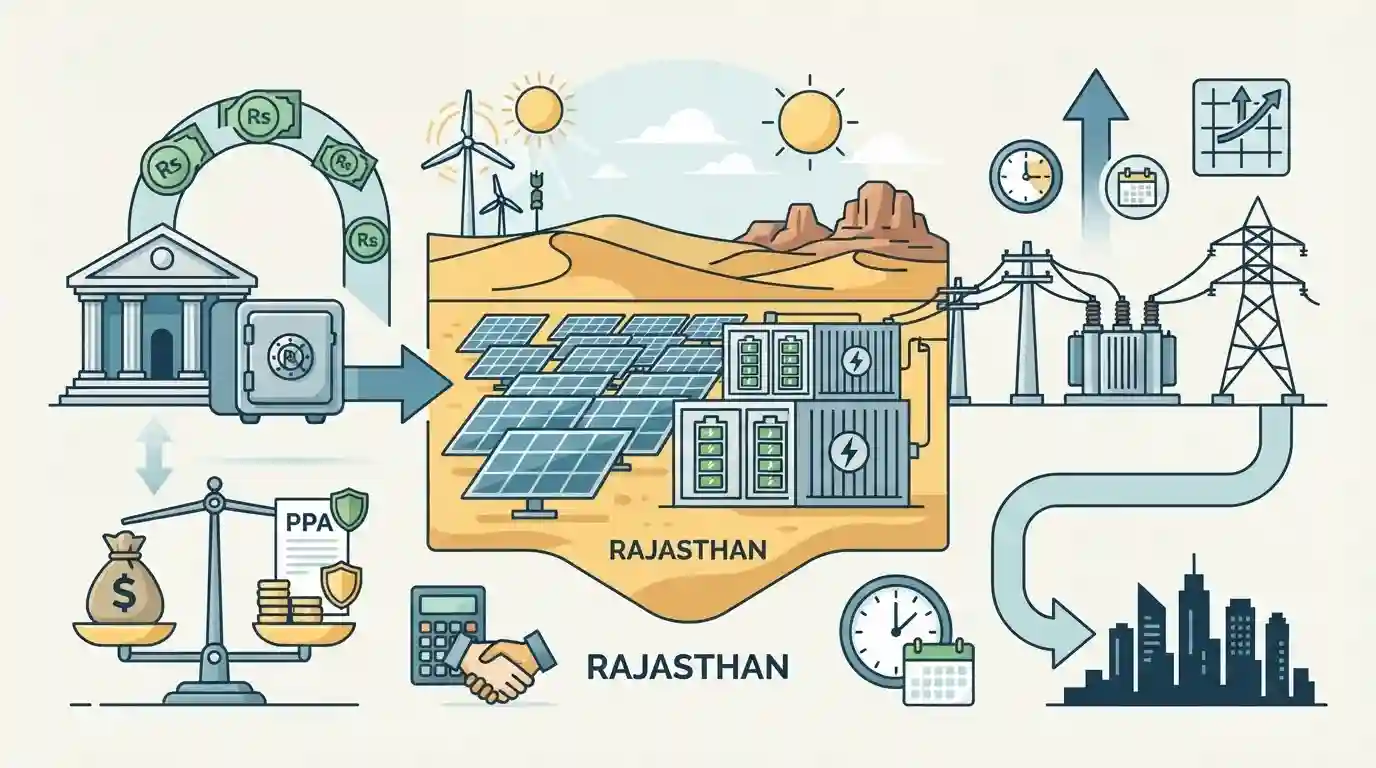
ACME Solar Holdings Limited has secured Rs 15.71 billion in long-term funding from India Infrastructure Finance Company Limited (IIFCL) to develop a 300 MW assured peak power project in Rajasthan. Requiring a total capital expenditure of Rs 21.23 billion, the project integrates solar generation with a 1,350 MWh battery energy storage system (BESS) and features a 25-year Power Purchase Agreement (PPA) with SECI. The development underscores Rajasthan's growing prominence in renewable energy infrastructure and the shift toward incorporating energy storage for grid stability.
Key Points
- ACME Solar Holdings Limited has secured Rs 15.71 billion in long-term project funding from the India Infrastructure Finance Company Limited (IIFCL).
- The funding will be utilized for a 300 MW assured peak power project in Rajasthan, which integrates solar power generation with a 1,350 MWh battery energy storage system (BESS).
- The project is backed by a 25-year Power Purchase Agreement (PPA) with the Solar Energy Corporation of India Limited (SECI) at a tariff of Rs 6.28 per unit.
- The total capital expenditure for the Rajasthan-based peak power project is Rs 21.23 billion, and its grid connectivity is already operational.
- In a separate development, ACME Marigold Urja signed a 25-year PPA with the Northeast Frontier Railway for a 130 MW round-the-clock renewable energy project at a tariff of Rs 4.35 per kWh.
Important Terms
Power Purchase Agreement (PPA)

A long-term legal contract between an electricity generator and a buyer that outlines energy sales terms, tariffs, and supply conditions over a set period.
UPSC context
Relevant for GS Paper I (Economy/Infrastructure), testing knowledge of regulatory frameworks securing investments in Rajasthan's energy sector.
India Infrastructure Finance Company Limited (IIFCL)
A wholly-owned government institution established in 2006 to provide long-term debt and financial assistance for viable infrastructure projects, including renewable energy initiatives.
UPSC context
Important for GS Paper I (Economy), regarding institutional financing mechanisms supporting large-scale public and private infrastructure projects.
Solar Energy Corporation of India Limited (SECI)
A Navratna central public sector enterprise under the Ministry of New and Renewable Energy that facilitates, develops, and tenders solar and renewable energy projects nationwide.
UPSC context
Crucial for GS Papers II & III, assessing the central regulatory bodies driving India’s and Rajasthan's clean energy transition.
ACME Solar Holdings Limited
An Indian independent renewable energy producer currently developing large-scale solar and battery storage infrastructure, notably executing significant firm and dispatchable clean power projects in Rajasthan.
UPSC context
Relevant for Rajasthan Current Affairs and Economy, tracking major private sector execution and corporate investments in the state's solar boom.
Prelims Trap
The 300 MW ACME solar project in Rajasthan will supply Round-The-Clock (RTC) power to the grid.
The Rajasthan project is an 'assured peak power' project using BESS. The Round-The-Clock (RTC) model was signed in a separate agreement for the Northeast Frontier Railway.
Static Concepts Connected
What is a Battery Energy Storage System (BESS) and its role in solar?
- Intermittency mitigation: Stores excess energy generated during peak solar hours (day) for deployment during low generation periods.
- Grid stability: Regulates frequency and voltage, which is crucial for states like Rajasthan with high renewable energy penetration.
- Peak shaving: Supplies power during evening peak demand, reducing reliance on expensive and polluting fossil-fuel peaker plants.
What is the India Infrastructure Finance Company Limited (IIFCL)?
- Government ownership: Set up in 2006, it is a wholly-owned Government of India enterprise.
- Core mandate: Provides long-term financial assistance to commercially viable infrastructure projects across energy, transport, and communication.
- Regulatory status: Registered with the RBI as an NBFC-ND-IFC (Non-Banking Financial Company - Infrastructure Finance Company).
Cross-Topic Patterns
BESS & Rajasthan RE Policy
Rajasthan's recent Renewable Energy policies heavily incentivize Energy Storage Systems to solve the grid instability (duck curve) caused by massive daytime solar generation.
Indian Railways' Net Zero Goal
The 130 MW RTC power agreement with Northeast Frontier Railway aligns with Indian Railways' broader mission to become a Net Zero Carbon Emitter by 2030.

Expect RPSC to frame a multi-statement question contrasting 'Assured Peak Power' (using BESS) with 'Round-The-Clock' (RTC) RE models.
Linked PYQs · 3
Linked PYQs · 3
- 2023RPSC_PRELIMSGS1
Which agency has been given the responsibility of implementing the PM-KUSUM scheme (Component A) in Rajasthan, which involves the establishment of solar power plants with a capacity of 0.5 MW to 2 MW?
- 2021RPSC_PRELIMSGS1
In which year was the Rajasthan Solar Energy Policy announced?
- 2023RPSC_PRELIMSGS1
Which of the following is not a part of the Rajasthan Urban Drinking Water, Sewage and Infrastructure Corporation Limited?
