Socio-economic impacts of the Indian space programme
Source:The Hindu ↗
Why It Matters
The article provides excellent, quotable examples of how India's space missions fulfill socio-economic objectives (a frequent GS3 theme). It also connects technological advancement with the constitutional duty of developing scientific temper and touches on the contemporary ethical debate surrounding AI's impact on human cognition.
Summary
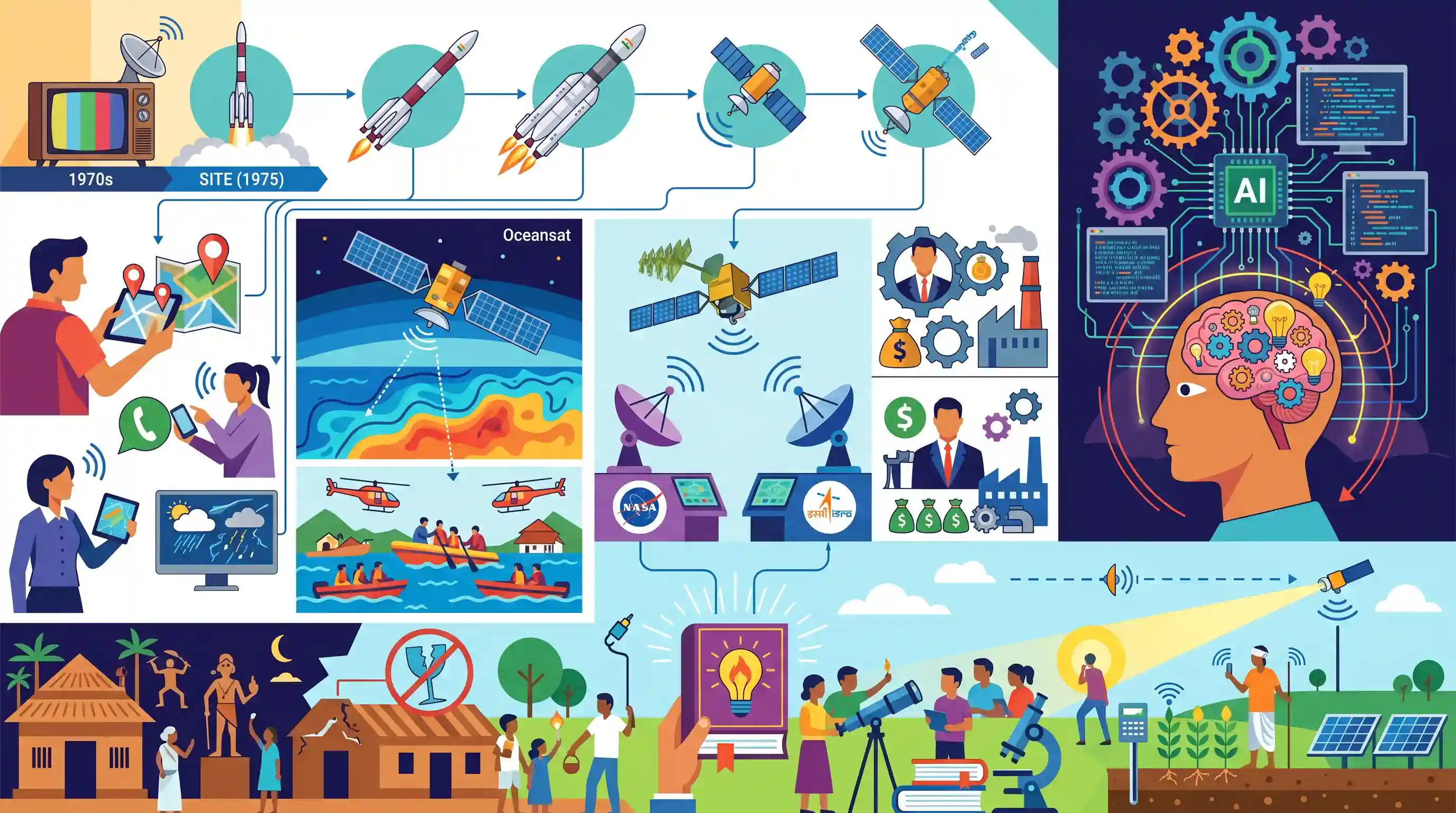
Former ISRO Chairman A.S. Kiran Kumar emphasized the transformative impact of the Indian space programme on everyday lives, tracing its roots from the 1975 Satellite Instructional Television Experiment (SITE) to contemporary applications like Oceansat and disaster management. He highlighted ongoing collaborations, such as the NASA-ISRO Synthetic Aperture Radar (NISAR) mission, and private sector partnerships. Alongside these technological advancements, he warned that the rapid rise of Artificial Intelligence (AI) and Machine Learning could compromise independent human thinking. Furthermore, the event underscored the critical need to promote scientific temper and eradicate superstitions in rural India through community-level science initiatives.
Key Points
- The Indian space programme has historically focused on societal applications, starting with the 1975 Satellite Instructional Television Experiment (SITE) that reached 2,400 villages.
- Modern space technology applications include Oceansat data assisting fishermen and communication satellites minimizing cyclone damage.
- Future initiatives include international collaborations such as the NASA-ISRO Synthetic Aperture Radar (NISAR) and partnerships with private entities like BlueBird.
- Former ISRO Chairman A.S. Kiran Kumar expressed concerns about the advent of Artificial Intelligence (AI) and Machine Learning, warning that over-reliance could diminish human cognitive capacities.
- Grassroots programs like 'Nanu Vijnani' are being organized to foster scientific temper in rural areas and combat local superstitions.
Important Terms
NASA-ISRO Synthetic Aperture Radar (NISAR)

A collaborative Earth-observation mission between NASA and ISRO using dual-frequency radar to map Earth's surface; critical for monitoring climate change, natural hazards, and sea-level rise.
UPSC context
GS Paper 3 (Space Technology); tests knowledge of international scientific cooperation and technology applications in disaster management.
Satellite Instructional Television Experiment (SITE)
A 1975 landmark project using a satellite to broadcast educational programs to 2,400 rural Indian villages, pioneering the use of space technology for social development and rural education.
UPSC context
GS Paper 3 (Science & Tech); relevant for the history of Indian space achievements and technology's role in social empowerment.
Scientific Temper
Enshrined in Article 51A(h) of the Indian Constitution, it is the duty of every citizen to develop an attitude of logical thinking, inquiry, and reform to combat superstition.
UPSC context
GS Paper 2 (Fundamental Duties) and GS Paper 4 (Ethics); tests understanding of constitutional values and social modernization.
Bharat Gyan Vigyan Samiti (BGVS)
A national voluntary organization and part of the 'Peoples’ Science Movement' that promotes literacy, scientific awareness, and social transformation through community-level initiatives in rural India.
UPSC context
GS Paper 2 (Development Processes); relates to the role of NGOs and civil society in promoting scientific temper and rural development.
Oceansat
A series of ISRO-developed Earth-observation satellites (e.g., EOS-06) designed specifically for oceanographic studies, coastal zone management, and providing data for fishery forecasting and weather prediction.
UPSC context
GS Paper 3 (Space Tech/Resource Management); essential for understanding India’s capabilities in maritime monitoring and climatic research.
Prelims Trap
"In the NASA-ISRO (NISAR) mission, both the L-band and S-band synthetic aperture radars are provided by NASA."
NASA provides the L-band radar, while ISRO provides the S-band radar. UPSC often swaps agency contributions in joint international missions to confuse aspirants.
Static Concepts Connected
What are the unique capabilities of the NISAR satellite mission?
- All-weather capability: Synthetic Aperture Radar (SAR) can penetrate clouds and darkness, providing high-resolution Earth observation images regardless of day/night or weather conditions.
- Dual-frequency radar: It uniquely combines NASA's L-band and ISRO's S-band radars to penetrate forest canopies, monitor biomass, and measure minute tectonic surface deformations globally.
How is 'Scientific Temper' enshrined in the Indian Constitution?
- Article 51A(h): Added by the 42nd Amendment, it makes cultivating scientific temper, humanism, and the spirit of inquiry a civic duty for all citizens.
- Non-justiciable nature: Though not legally enforceable, courts consistently rely on this duty to uphold the constitutional validity of state laws designed to eradicate superstitions.
Cross-Topic Patterns
Space Tech + Coastal Livelihoods
Oceansat data mapping phytoplankton via Ocean Colour Monitors connects space technology directly to the blue economy and the livelihood security of coastal fishing communities.
AI ethics + Fundamental Duties
The threat of AI causing 'cognitive offloading' creates a modern ethical tension with Article 51A(h), which mandates citizens to actively cultivate independent inquiry and scientific temper.

Expect a 2026 Prelims statement mixing up NASA's L-band and ISRO's S-band contributions in NISAR, alongside INCOIS's role in PFZ data.
Linked PYQs · 4
Linked PYQs · 4
- 2016MainsGS3
Discuss India's achievements in the field of Space Science and Technology. How the application of this technology has helped India in its socio-economic development?
- 2015PrelimsGS1
In which of the following activities are Indian Remote Sensing (IRS) satellites used? 1. Assessment of crop productivity 2. Locating groundwater resources 3. Mineral exploration 4. Telecommunications 5. Traffic studies Select the correct answer using the code given below.
- 2020PrelimsGS1
With the present state of development, Artificial Intelligence can effectively do which of the following? 1. Bring down electricity consumption in industrial units 2. Create meaningful short stories and songs 3. Disease diagnosis 4. Text-to-Speech Conversion 5. Wireless transmission of electrical energy Select the correct answer using the code given below:
- 2023MainsGS3
What is the main task of India's third moon mission which could not be achieved in its earlier mission? List the countries that have achieved this task. Introduce the subsystems in the spacecraft launched and explain the role of the Virtual Launch Control Centre' at the Vikram Sarabhai Space Centre which contributed to the successful launch from Sriharikota.
