Judicial Accessibility and Rights of Persons with Disabilities
Source:The Hindu ↗
Why It Matters
Highlights the practical challenges in implementing inclusivity mandates like the Rights of Persons with Disabilities (RPwD) Act within the judiciary. It provides a strong contemporary example for GS2 questions on systemic barriers to justice, minority rights, and institutional sensitization.
Summary
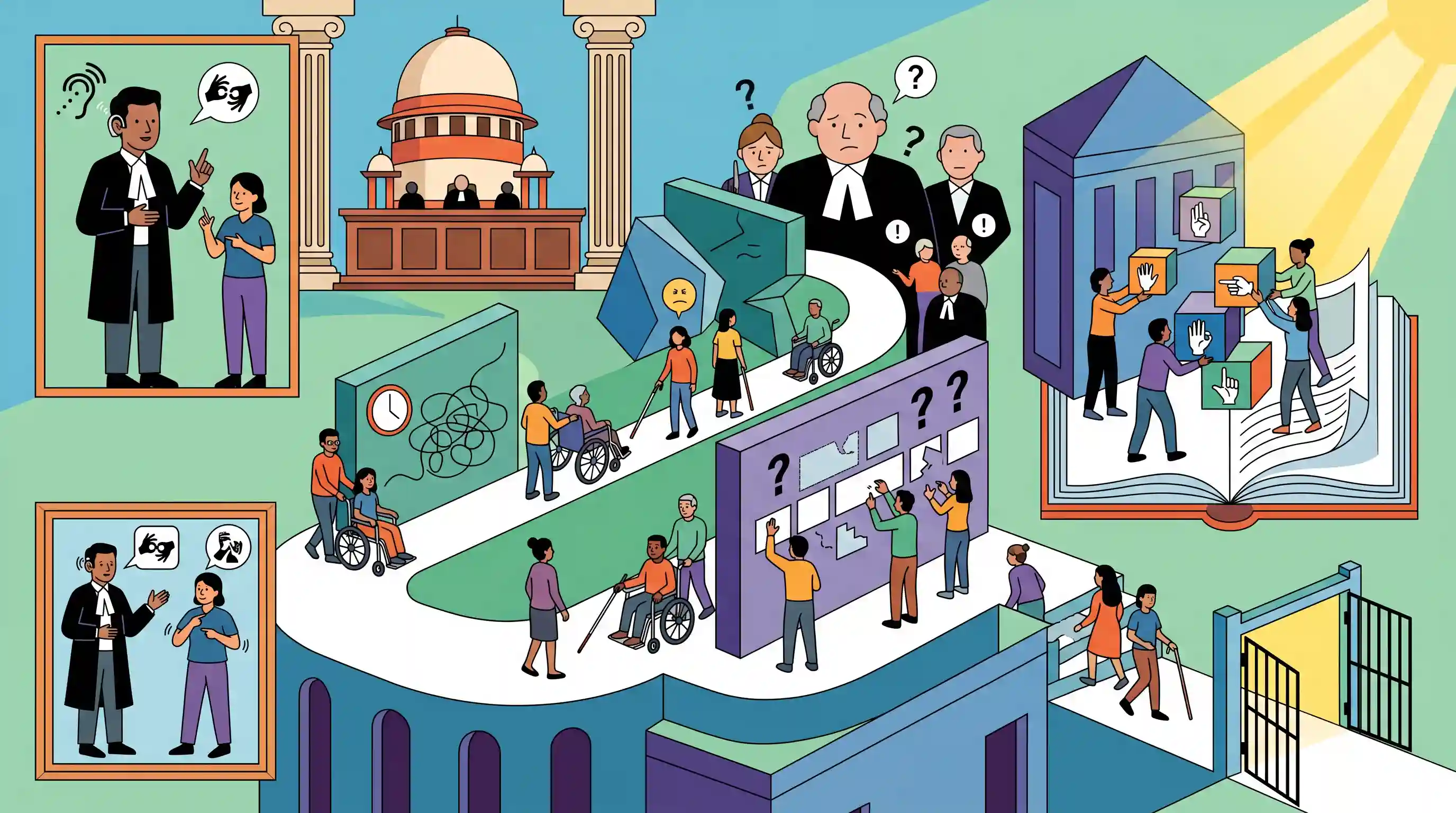
Despite the Supreme Court introducing a sign language interpreter during proceedings for a hearing-impaired lawyer over two years ago, true accessibility in Indian courts remains a distant goal. Advocates emphasize that the process of securing interpreters is cumbersome and often hindered by a lack of awareness among judges and court staff. Challenges such as the absence of a standardized legal vocabulary in Indian Sign Language (ISL) further complicate legal translation. Although efforts are underway to build an ISL legal thesaurus, systemic issues continue to restrict equal access to justice for Persons with Disabilities (PwDs) across all levels of the judiciary.
Key Points
- More than two years after a sign language interpreter was first used in the Supreme Court, ensuring accessibility for hearing-impaired lawyers remains a tedious and inconsistent process.
- Advocates report instances of judges and court staff displaying a lack of sensitization, such as asking hearing-impaired lawyers and their interpreters to leave the courtroom.
- Live transcription is inadequate for deaf professionals who communicate exclusively via Indian Sign Language (ISL), making dedicated interpreters essential.
- Advocates are currently developing a legal thesaurus in sign language to standardize complex legal terminology and improve interpretation accuracy.
- A lack of inclusive infrastructure in the judiciary poses a systemic barrier to equal access to justice and opportunities for Persons with Disabilities (PwDs).
Important Terms
Rights of Persons with Disabilities (RPwD) Act, 2016

2016 legislation replacing the 1995 Act, expanding disability categories to 21 and mandating accessibility in buildings, transport, and the justice system (Section 12).
UPSC context
GS Paper II: Social Justice. Essential for questions on welfare of vulnerable sections and statutory rights.
Access to Justice (for PwDs)
The state's obligation to ensure PwDs can effectively participate in legal proceedings as litigants, witnesses, or advocates through physical and communication support.
UPSC context
GS Paper II: Judiciary/Social Justice. Tests understanding of inclusive governance and barriers to the legal system.
Reasonable Accommodation
A legal principle requiring necessary and appropriate modifications to ensure PwDs enjoy human rights and fundamental freedoms on an equal basis with others.
UPSC context
GS Paper II: Social Justice/Polity. A core judicial standard for assessing state compliance with disability rights.
Indian Sign Language (ISL)
The visual-gestural language used by India's deaf community; currently lacks a comprehensive standardized legal vocabulary, though the ISLRTC is expanding its legal dictionary.
UPSC context
GS Paper II: Social Justice. Relevant for issues of linguistic barriers and educational/legal inclusion.
Committee on Accessibility (SC)
A body constituted by Chief Justice D.Y. Chandrachud to conduct an accessibility audit of the Supreme Court and recommend systemic improvements for PwDs.
UPSC context
GS Paper II: Judiciary. Recent judicial initiative showing proactive institutional reform for inclusivity.
Sarah Sunny Case
A landmark proceeding where the Supreme Court first permitted a deaf lawyer to argue using a sign language interpreter, setting a precedent for judicial inclusion.
UPSC context
GS Paper II: Judiciary. A key case study for the "Rights of Persons with Disabilities" topic.
Prelims Trap
"Indian Sign Language (ISL) is officially recognized as a scheduled language under the Eighth Schedule of the Indian Constitution."
While disability rights activists continually advocate for its inclusion, ISL is not currently listed in the Eighth Schedule. Also, ISLRTC operates under the Ministry of Social Justice, not Education.
Static Concepts Connected
What guarantees does the RPwD Act, 2016 provide for access to justice?
- Section 12 Mandate: Directs the government to ensure all courts, tribunals, and investigating authorities are physically and functionally accessible to PwDs.
- Document Accessibility: Requires that all public documents, court filings, and judicial records be made available in accessible formats.
- Communication Support: Mandates the recording of testimonies via appropriate support measures, including the provision of sign language interpreters.
How does the Indian Constitution mandate accessibility in the justice system?
- Article 39A: Directs the State to provide free legal aid, ensuring opportunities for justice are not denied due to "economic or other disabilities."
- Articles 14 & 21: Together, they ensure equality before the law and fair trial procedures, which inherently demand reasonable accommodations for marginalized and disabled citizens.
Cross-Topic Patterns
E-Courts Phase III and digital accessibility
While live transcription aids some, the lack of WCAG-compliant portals and virtual ISL integration leaves deaf professionals excluded from the judiciary's digital transformation.
Legal translation tools like SUVAS
The ISL legal thesaurus initiative parallels the Supreme Court's AI software (SUVAS) efforts to translate judgments into regional languages, both tackling deep-rooted linguistic barriers in the justice system.

Expect a GS2 Mains question evaluating the RPwD Act 2016's efficacy in ensuring 'Access to Justice' (Sec 12) beyond just physical ramps.
Linked PYQs · 1
Linked PYQs · 1
- 2017MainsGS2
Does the Rights of Persons with Disabilities Act, 2016 ensure effective mechanism for empowerment and inclusion of the intended beneficiaries in the society? Discuss.
