Accenture Guidance Cut Signals IT Sector Vulnerability to Shocks
Source:The Hindu ↗
Why It Matters
This article highlights the vulnerability of India's formal service sector (IT industry) to global macroeconomic shocks and geopolitical conflicts. It also signals a critical structural shift in technological adoption, emphasizing the growing importance of cybersecurity and AI compliance over traditional IT infrastructure. This is highly relevant for GS-3 (Economy and S&T) regarding industrial growth, employment models, and technological shifts.
Summary
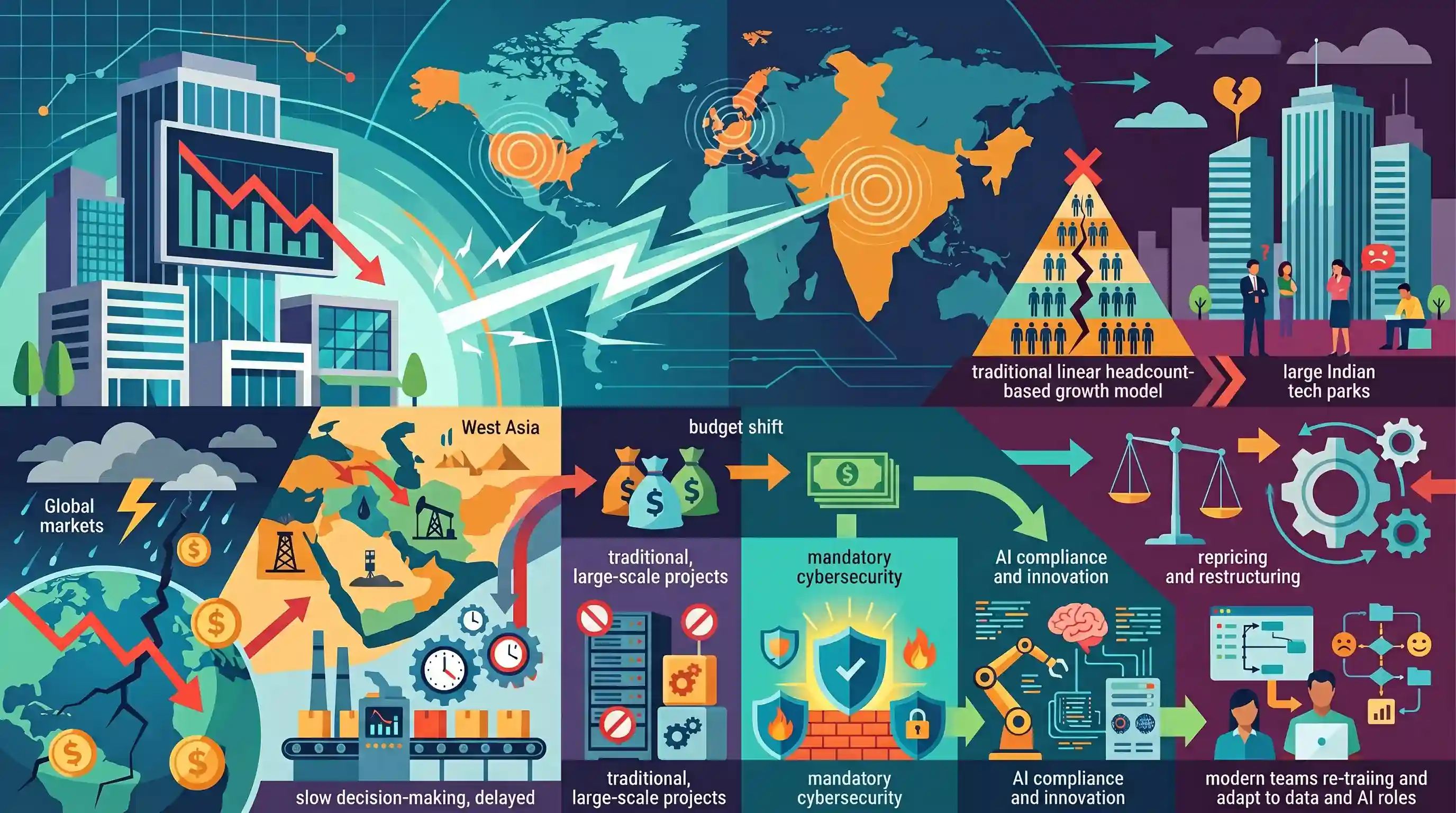
Accenture's unexpected decision to lower its full-year 2026 revenue growth guidance has sent shockwaves through the global tech industry, particularly impacting the Indian IT sector. The downgrade reflects a broader slowdown in technology spending, characterized by longer decision-making cycles and a slower conversion of deal pipelines into actual revenue. This sluggishness is largely attributed to global macroeconomic instability and geopolitical tensions, specifically in West Asia. Furthermore, there is a structural shift in IT spending patterns: corporate boards are freezing budgets for traditional, large-scale digital initiatives and reallocating funds toward mandatory cybersecurity and artificial intelligence (AI) compliance projects. This transition threatens the traditional linear headcount-based growth model upon which many Indian IT service providers rely, forcing a potential repricing and restructuring within the industry.
Key Points
- Accenture lowered its FY26 revenue growth guidance to 3-4%, down from 3-5%, triggering widespread concern across the global and Indian IT sectors.
- The slowdown is driven by deal slippages, delayed decision-making, and macroeconomic uncertainties exacerbated by geopolitical conflicts in West Asia.
- Global corporate boards are freezing discretionary IT budgets, pivoting away from traditional infrastructure and maintenance projects.
- There is a definitive shift in IT spending priorities toward mandatory cybersecurity and AI compliance initiatives.
- This trend threatens traditional linear headcount-based revenue models, compelling Indian IT firms to restructure their service offerings and pricing models.
Important Terms
Headcount-based Growth Model

A business strategy where revenue increases in direct proportion to the number of employees. Indian IT firms traditionally used this to scale, though AI-driven automation now threatens this linear relationship.
UPSC context
GS Paper 3: Indian Economy. Relevant for discussions on employment elasticity, jobless growth, and the structural transformation of the service sector.
AI Governance and Compliance
The legal and ethical frameworks ensuring Artificial Intelligence is used safely and legally. Spending is currently shifting from general digital projects toward these mandatory compliance and security requirements.
UPSC context
GS Paper 3: Science and Technology. Tests knowledge of emerging digital regulations and their impact on global trade and industrial ethics.
IT Services Sector
A major segment of India's service economy providing software, consulting, and support. It is a primary driver of service exports and formal sector employment in India.
UPSC context
GS Paper 3: Indian Economy. Critical for topics on export-led growth, foreign exchange reserves, and tertiary sector contributions to GDP.
Revenue Growth Guidance
Public financial forecasts provided by companies regarding their expected future earnings. Downward revisions by global firms (like Accenture) often serve as lead indicators for broader economic slowdowns.
UPSC context
GS Paper 3: Economy. Relates to corporate governance, market sentiment, and how global demand cycles affect domestic industry performance.
Geopolitical Risk
Potential disruptions to trade and economy caused by political instability. Tensions in West Asia currently impact global tech through energy costs, supply chain delays, and cautious corporate spending.
UPSC context
GS Paper 2: International Relations. Examines the link between regional conflicts (West Asia) and their global macroeconomic consequences.
Discretionary IT Spending
Corporate spending on non-essential, flexible projects (e.g., new digital initiatives). Budget freezes in this area signal economic uncertainty and directly reduce the order books of service providers.
UPSC context
GS Paper 3: Economy. Important for understanding business cycles and how external shocks lead to domestic revenue volatility in IT.
Prelims Trap
"The traditional Indian IT revenue model is inherently non-linear and decoupled from headcount."
Aspirants often confuse modern SaaS/AI models with traditional Indian IT models. India's legacy IT growth has been highly linear, relying heavily on mass-hiring low-cost engineers.
Static Concepts Connected
How do IT service exports impact India's Balance of Payments?
- Current Account: IT exports fall under 'Invisibles' (Services), generating massive forex receipts that crucially help offset India's chronic merchandise trade deficit.
- Net Services Surplus: India consistently maintains a significant surplus in net services trade, heavily driven by software, telecommunications, and IT-enabled services.
What is the difference between linear and non-linear IT business models?
- Linear Model: Revenue growth requires a proportional increase in employees. It relies on wage arbitrage and massive hiring, typical of legacy Indian IT services.
- Non-linear Model: Revenue scales without a matching increase in headcount. It is driven by intellectual property, AI, automation, cloud platforms, and SaaS products.
Cross-Topic Patterns
AI automation & the white-collar job trap
The shift towards AI compliance creates a "mid-career band gap," fundamentally altering the narrative of India's demographic dividend from a blue-collar skilling challenge to a white-collar restructuring crisis.
West Asian conflicts & Indian service exports
Geopolitics isn't just about oil shocks. Macroeconomic uncertainty from West Asia freezes Western corporate CAPEX, directly translating into delayed deal pipelines for India's export-driven IT sector.

Expect a Mains question linking AI-driven automation to structural transformations in India's service-led growth and white-collar employment.
Linked PYQs · 4
Linked PYQs · 4
- 2023MainsGS3
What is the status of digitalization in the Indian economy? Examine the problems faced in this regard and suggest improvements.
- 2023MainsGS3
Introduce the concept of Artificial Intelligence (AI). How does Al help clinical diagnosis? Do you perceive any threat to privacy of the individual in the use of Al in healthcare?
- 2020MainsGS3
Discuss different types of cyber crimes and measures required to be taken to fight the menace.
- 2016MainsGS3
How globalization has led to the reduction of employment in the formal sector of the Indian economy? Is increased informalization detrimental to the development of the country?
