Global Tech Spending Slowdown Impacts Indian IT Industry Stocks
Source:Indian Express ↗
Why It Matters
The IT services sector is a crucial driver of India's service exports, foreign exchange earnings, and formal employment. A sustained global technology slowdown or a structural shift caused by AI can significantly impact India's macroeconomic stability, current account dynamics, and job creation in the service sector.
Summary
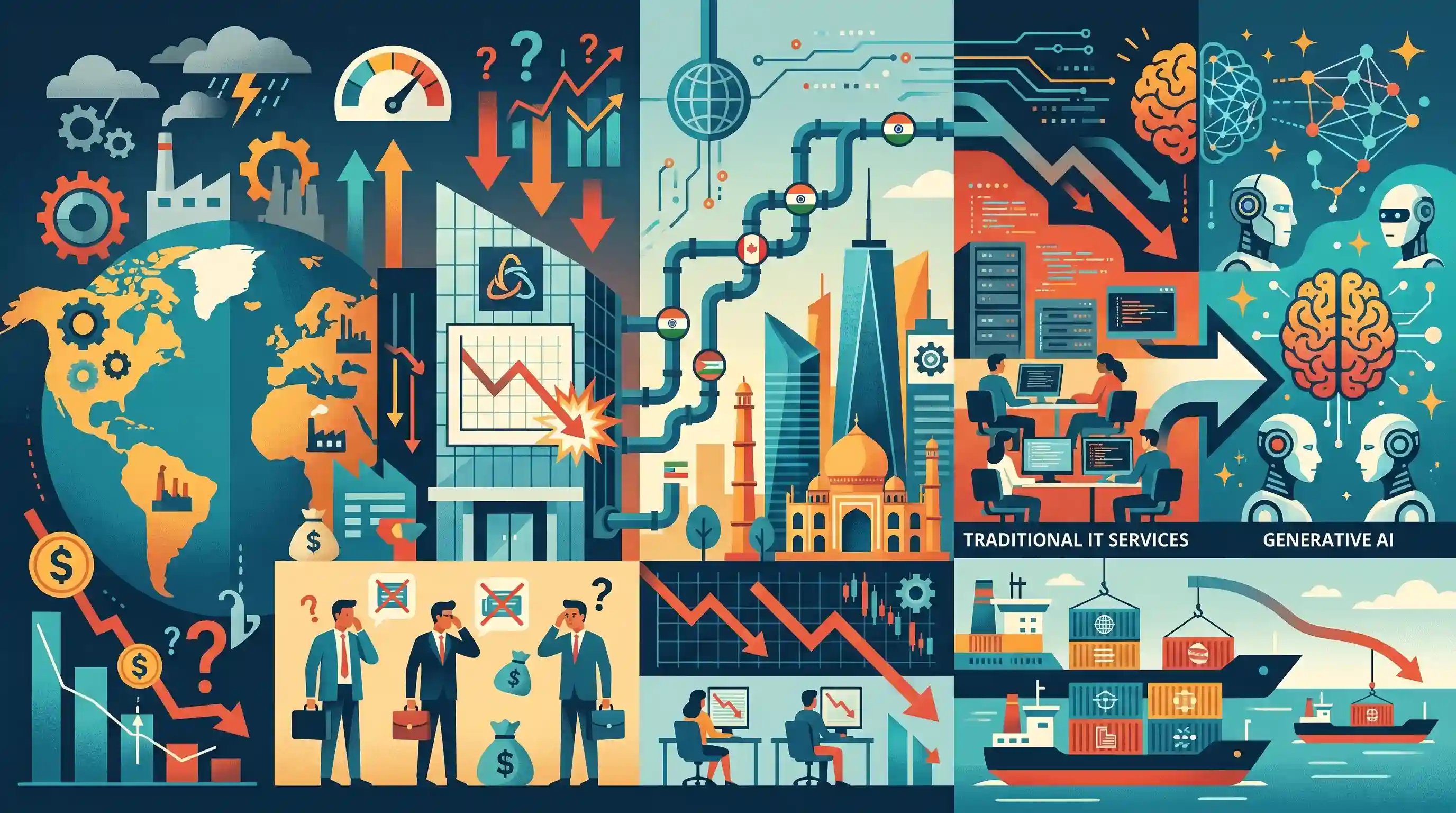
Global consulting and technology firm Accenture slashed its FY24 revenue guidance, prompting a sharp drop in Indian IT stocks such as Infosys, TCS, and Wipro. The forecast reduction highlights a broader slowdown in global technology spending, as macroeconomic uncertainty and elevated interest rates compel clients to curtail discretionary technology investments. Since Indian IT firms share similar geographic markets (North America and Europe) and client portfolios with Accenture, their growth prospects are deeply tethered to these trends. While demand for Generative AI (GenAI) solutions is surging, it is currently cannibalizing traditional IT consulting spending, raising concerns about potential AI disruption and slowing service export growth for India in the near term.
Key Points
- Global IT major Accenture lowered its FY24 revenue guidance to 1-3%, reflecting a broader slowdown in technology spending.
- Clients are curtailing discretionary tech spending globally due to macroeconomic uncertainty and an elevated interest rate environment.
- The guidance cut sparked a sharp sell-off in Indian IT stocks (Infosys, TCS, Wipro) because their client mix and geographic exposure (US and Europe) heavily overlap with Accenture's.
- Generative AI (GenAI) is seeing strong new bookings, but it is currently cannibalizing traditional IT consulting and non-GenAI technology spending.
- Analysts highlight high valuations, macroeconomic headwinds, and potential AI disruption as key near-term risks for the Indian IT services sector.
Important Terms
Nifty IT index

A sectoral stock market index on the National Stock Exchange (NSE) that tracks the performance of the top 10 Indian IT companies.
UPSC context
GS III (Indian Economy). Relevant for understanding sectoral benchmarks and the stock market's role as a barometer for economic health.
Accenture
A global IT services giant often viewed as an industry 'bellwether' because its performance provides early signals for demand trends affecting Indian tech firms.
UPSC context
GS III (Economy). Highlights global economic interlinkages where the health of multinational firms impacts India’s service export prospects.
TCS (Tata Consultancy Services)
India's largest IT services provider; a flagship of the Tata Group and a major driver of the nation’s service exports and foreign exchange.
UPSC context
GS III (Economy/Services). Crucial for topics related to GDP contribution, private-sector employment, and the Balance of Payments.
Infosys
A leading Indian multinational providing IT and business consulting; a pioneer in the 'global delivery model' that defined India’s services-led growth.
UPSC context
GS III (Services Sector). Key to understanding India's role as the 'services factory of the world' and digital transformation trends.
Discretionary Spending
Non-essential corporate investments in technology projects that are often curtailed or postponed during macroeconomic uncertainty or periods of high interest rates.
UPSC context
GS III (Indian Economy). Essential for analyzing the cyclical nature of service demand and its vulnerability to global monetary policy shifts.
Generative AI (GenAI)
Advanced AI capable of content creation; its emergence is currently redirecting IT budgets away from traditional consulting toward automated, high-value tech solutions.
UPSC context
GS III (S&T / Economy). Tests understanding of disruptive technologies and their potential to 'cannibalize' existing service-based economic models.
Service Sector Exports
The export of intangible products like software and consulting, which significantly offsets India’s merchandise trade deficit and stabilizes the Current Account.
UPSC context
GS III (External Sector). Critical for discussions on the Balance of Payments (BoP) and India's strategic transition up the value chain.
Prelims Trap
The surge in Generative AI globally translates to proportional job creation and export growth for India's traditional IT sector.
GenAI is currently 'cannibalizing' traditional tech spending and disrupting the labor-arbitrage model, leading to specialized hiring rather than mass job creation.
Static Concepts Connected
How do IT service exports affect India's Balance of Payments (BoP)?
- Invisibles Surplus: IT and software exports form the bulk of India's net invisible receipts in the Current Account.
- Trade Deficit Cushion: This persistent service surplus is vital for offsetting India's chronic merchandise trade deficit, keeping the CAD manageable.
- Currency Stability: Robust IT export earnings ensure steady foreign exchange inflows, mitigating extreme rupee depreciation.
What is the 'labor arbitrage' model in India's service sector?
- Cost Advantage: Firms offshore tasks to exploit the massive wage differential between advanced economies and Indian talent.
- Mass Employment: Traditionally relied on mass campus hiring of engineering graduates for routine software maintenance and back-office tasks.
- AI Vulnerability: Highly susceptible to disruption by GenAI, which automates routine tasks and demands specialized skill-based recruitment instead.
Cross-Topic Patterns
US Fed Rates & India's CAD
Monetary tightening in the US forces corporate spending cuts, directly hitting Indian IT exports and subsequently widening India's Current Account Deficit.
AI Disruption & Demographic Dividend
GenAI's cannibalization of routine IT jobs shifts recruitment from mass hiring to specialized skills, threatening to worsen India's entry-level 'jobless growth' challenge.

Expect a 2026 multi-statement question linking US monetary tightening, AI-induced labor cannibalization, and pressures on India's CAD.
Linked PYQs · 4
Linked PYQs · 4
- 2025MainsGS3
What are the challenges before the Indian economy when the world is moving away from free trade and multilateralism to protectionism and bilateralism? How can these challenges be met?
- 2015MainsGS3
The nature of economic growth in India in recent times is often described as jobless growth. Do you agree with this view ? Give arguments in favour of your answer.
- 2016MainsGS3
How globalization has led to the reduction of employment in the formal sector of the Indian economy? Is increased informalization detrimental to the development of the country?
- 2018MainsGS3
How would the recent phenomena of protectionism and currency manipulations in world trade affect macroeconomic stability of India?
