Student Groups Call for College Bandh Over Education Demands
Source:The Hindu ↗
Why It Matters
The article underscores the critical issues within the education sector and welfare administration in Andhra Pradesh. It highlights the role of student organizations as pressure groups in democratic setups and draws attention to significant policy challenges such as funding for fee reimbursement schemes, regulatory orders (G.O. 77), and the management of social welfare infrastructure. These themes are highly relevant for questions on state-level welfare initiatives and social justice in the APPSC Group 1 syllabus.
Summary
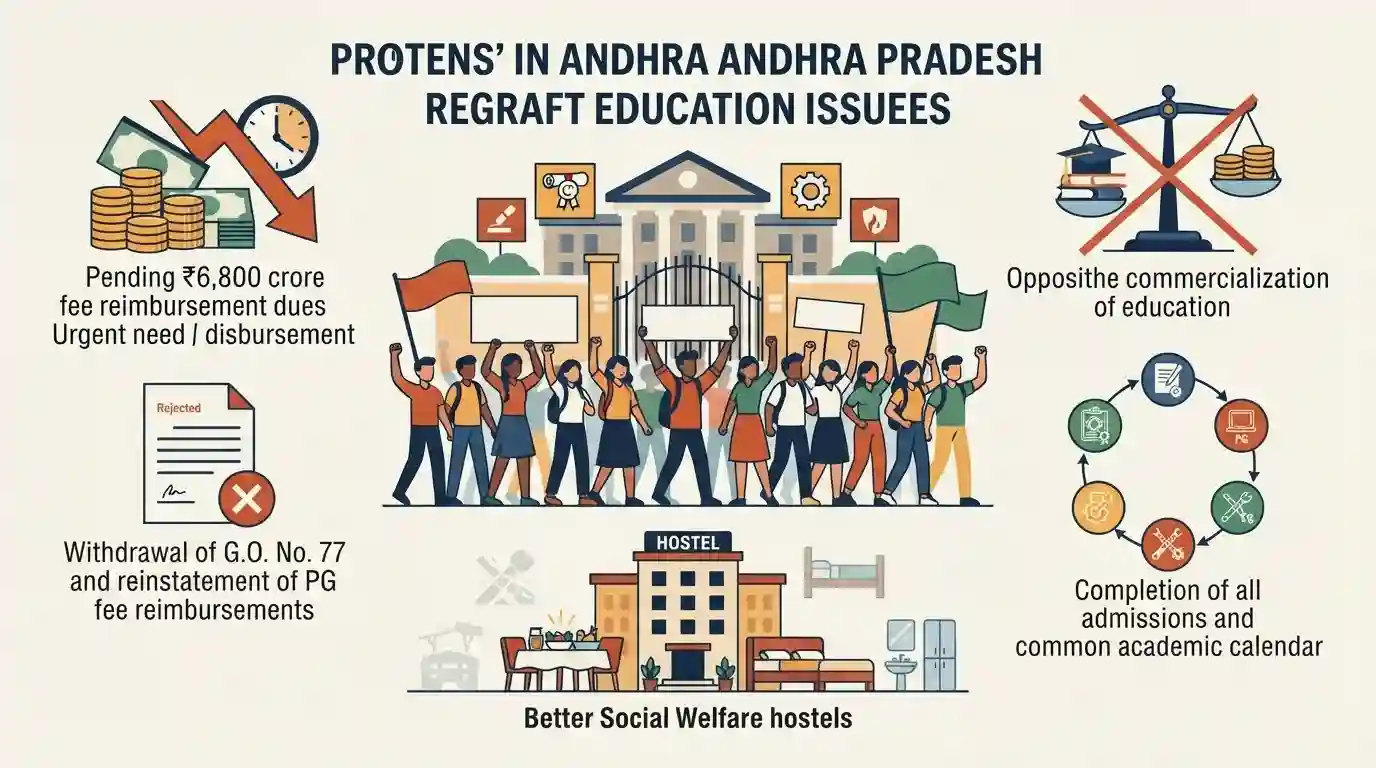
The Akhil Bharatiya Vidyarthi Parishad (ABVP) has declared a state-wide bandh of degree, post-graduate, and engineering colleges in Andhra Pradesh on August 5. The protest aims to pressure the state government to address several unresolved issues in the education sector. Chief among their demands is the release of ₹6,800 crore in pending fee reimbursement dues and the withdrawal of G.O. No. 77 to reinstate fee reimbursements for PG students. Furthermore, the ABVP is calling for an end to the commercialization of education, the completion of admissions across all courses, and the implementation of a common academic calendar. They are also advocating for improved infrastructure, better food, and basic amenities in Social Welfare hostels, urging the NDA alliance government to fulfill its election promises to the student community.
Key Points
- The ABVP called for a state-wide bandh of colleges in Andhra Pradesh on August 5 to address multiple education-related grievances.
- A major demand is the immediate release of ₹6,800 crore in pending fee reimbursement dues.
- The student body is demanding the withdrawal of G.O. No. 77, aiming to restore fee reimbursements for post-graduate courses.
- Other demands include measures to stop the commercialization of education, ensure admissions across all courses, and establish a common academic calendar.
- The ABVP also highlighted the need for permanent buildings, quality food, and essential amenities in Social Welfare hostels across the state.
Important Terms
Government Order (G.O.) No. 77

An administrative order issued by the Andhra Pradesh government in 2021 that controversially excluded students pursuing postgraduate courses in private and unaided colleges from the state's fee reimbursement scheme.
UPSC context
Relates to GS Paper II (Social Justice) regarding state education policies, funding, and the impact of welfare interventions on higher education accessibility.
Fee Reimbursement Scheme
An educational sponsorship program in Andhra Pradesh providing financial assistance to cover higher education tuition fees for students from economically weaker sections and marginalized communities.
UPSC context
Crucial for GS Paper II under welfare schemes for vulnerable populations and issues relating to the development and management of the education sector.
Akhil Bharatiya Vidyarthi Parishad (ABVP)
A prominent right-wing all-India student organization affiliated with the Rashtriya Swayamsevak Sangh (RSS). It frequently organizes protests and campaigns to address student welfare and educational policies.
UPSC context
Relevant to GS Paper II under the role of pressure groups, student movements, and formal/informal associations in Indian polity and governance.
National Democratic Alliance (NDA)
A political coalition in India led by the Bharatiya Janata Party (BJP). In Andhra Pradesh, the NDA alliance includes the Telugu Desam Party (TDP) and the Jana Sena Party (JSP).
UPSC context
Falls under GS Paper II concerning the functioning of political parties, regional alliances, and the dynamics of coalition governments in India.
Prelims Trap
"Education is exclusively a State subject, giving states sole authority over higher education fee reimbursements."
Education was moved to the Concurrent List (Entry 25) by the 42nd Amendment (1976), allowing both the Centre and States to legislate on it.
Static Concepts Connected
How do Associational Pressure Groups differ from Political Parties?
- Objective: Pressure groups aim to influence specific government policies without seeking to capture political power or form governments.
- Membership Focus: Groups like ABVP represent specific demographic or professional interests, whereas political parties seek broad, mass-based electoral appeal.
- Methods: They rely on lobbying, advocacy, protests, and strikes (like bandhs) rather than legislative majorities.
How is the jurisdiction over Education divided in the 7th Schedule?
- Concurrent List: Entry 25 covers general education, including technical/medical education and universities, granting both Centre and States legislative power.
- Union List (Entry 66): Entry 66 gives the Centre exclusive power over the coordination and determination of standards in higher education/research institutions.
- Union List (Entry 63-65): Entries 63-65 cover specific institutions of national importance wholly or partly financed by the Government of India.
Cross-Topic Patterns
Pressure groups and fiscal federalism
Student unions acting as associational pressure groups frequently compel state governments to adjust fiscal allocations for welfare schemes, heavily impacting state exchequer management (GS3/GS2).
Commercialization vs. Equitable Education
The demand to end commercialization of education connects GS2 social sector management with GS4 (Ethics), questioning the balance between private sector participation and equitable access.

Expect Mains GS2 questions linking the financial burden of state educational welfare schemes with the role of associational pressure groups.
Linked PYQs · 4
Linked PYQs · 4
- 2023APPSC_PRELIMSGS1
One of the following welfare programmes implemented by Government of Andhra Pradesh is not part of Navaratnalu.
- 2023APPSC_PRELIMSGS1
Government of Andhra Pradesh is implementing YSR Rythu Bharosa - PM Kisan Scheme for the benefit of farmers of Andhra Pradesh. Which of the following statements are correct about the above scheme ?
- 2023APPSC_PRELIMSGS1
With child labour being made illegal and right to education becoming a fundamental right for children, this right against exploitation has become more meaningful. Which of the following pairs of Articles provide for right to education and prohibition of child labour respectively?
- 2023APPSC_PRELIMSGS1
Which of the following entries of the Indian Constitution deals with the institutions for scientific or technical education financed by the Government of India, wholly or in part, and declared by Parliament, by law to be institutions of national importance ?
