IMD southwest monsoon forecast and summer heatwave mitigation
Source:Indian Express ↗
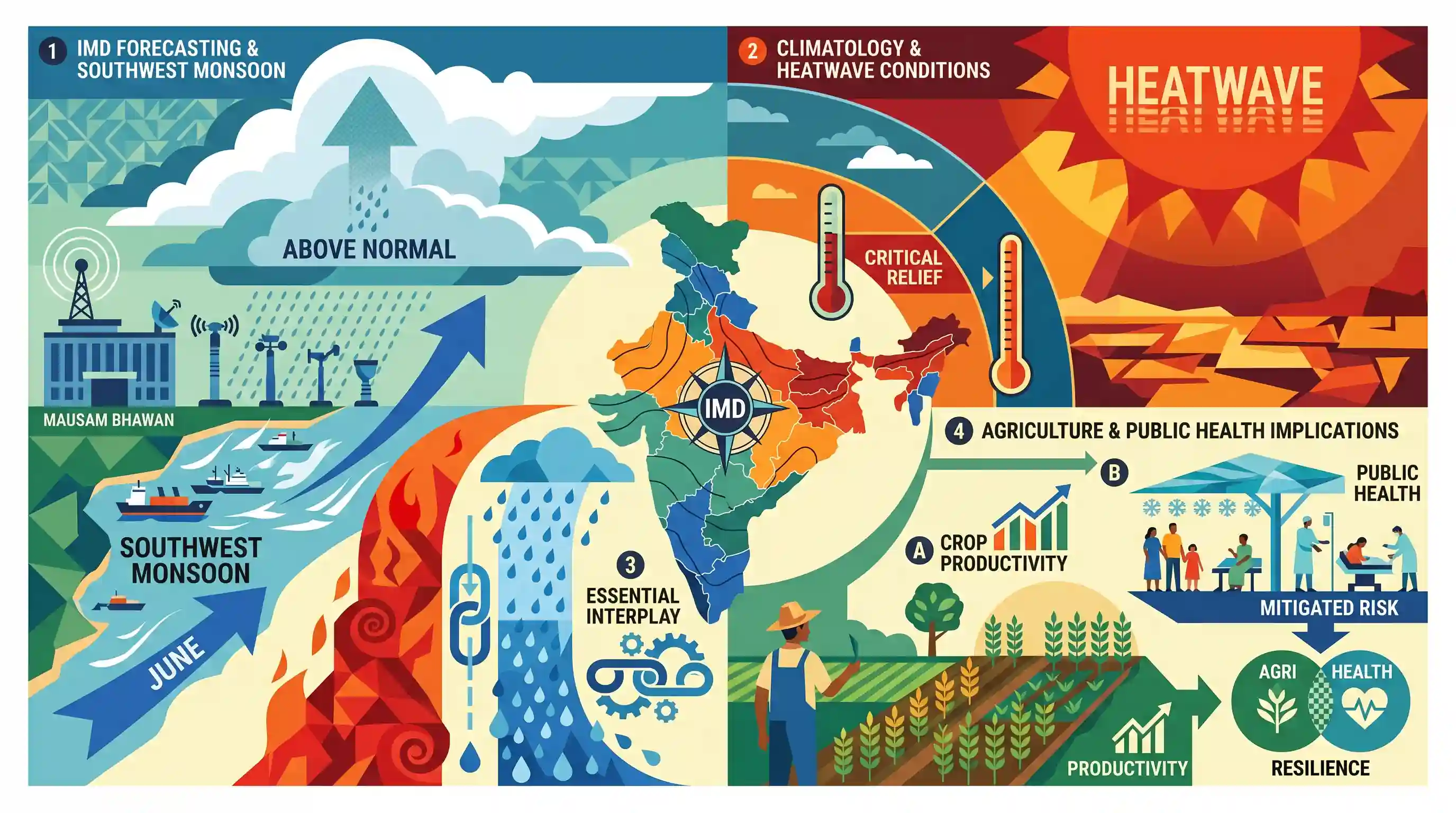
Why It Matters
The Indian monsoon determines the agricultural output and economic stability of the country. Accurate IMD forecasts regarding the monsoon's intensity are crucial for managing extreme heatwaves, ensuring food security, and proactive disaster management.
Summary
The India Meteorological Department (IMD) has forecast above-normal rainfall during the upcoming Southwest monsoon season. This expected precipitation is anticipated to help mitigate the severe heatwave conditions typically experienced in June, providing critical relief across the country. The forecast underscores the essential interplay between monsoon onset dynamics and extreme temperature management in the Indian subcontinent, which carries broad implications for agriculture and public health.
Key Points
- The India Meteorological Department (IMD) forecasts an above-normal Southwest monsoon season.
- The expected rainfall is anticipated to provide relief from intense summer heatwaves typically experienced in June.
- The transition from summer to the monsoon season highlights the critical role of atmospheric dynamics in temperature regulation.
- Timely and accurate monsoon predictions by the IMD remain essential for agricultural planning and extreme weather mitigation.
Important Terms
India Meteorological Department (IMD)

Established in 1875 under the Ministry of Earth Sciences, it is India's principal agency for meteorological observations, weather forecasting, and seismology, including cyclone and heatwave warnings.
UPSC context
GS Paper 1 (Geography) and GS Paper 3 (Disaster Management). Tests institutional frameworks for climate monitoring and safety.
Southwest Monsoon
India's primary rainy season from June to September, delivering nearly 75% of the country's annual rainfall; it is driven by intense low pressure over the Tibetan Plateau.
UPSC context
GS Paper 1: Indian Physical Geography. Essential for understanding the agrarian economy and water resource management.
Long Period Average (LPA)
The 50-year average of rainfall used as a benchmark to define 'normal' seasons; the current LPA for all-India monsoon rainfall (1971–2020) is 87 cm.
UPSC context
GS Paper 1: Geography. Tests technical precision in interpreting climate data and rainfall classification (Deficient vs. Excess).
Heatwave
A condition declared when maximum temperatures reach 40°C in plains (30°C in hills) with a departure of 4.5°C to 6.4°C from the normal climatological value.
UPSC context
GS Paper 3: Disaster Management. Tests awareness of extreme geophysical phenomena and their impacts on public health.
La Niña
The 'cold phase' of the ENSO cycle involving below-average sea surface temperatures in the central/eastern Pacific, which typically enhances the Indian Southwest Monsoon rainfall.
UPSC context
GS Paper 1: Climatology. Fundamental for explaining inter-annual variability and large-scale atmospheric-oceanic interactions.
Indian Ocean Dipole (IOD)
An ocean-atmosphere phenomenon in the Indian Ocean involving temperature differences between its western and eastern parts; a 'positive' phase often aids monsoon intensity.
UPSC context
GS Paper 1: Geography. Tests advanced understanding of regional factors influencing the Indian Monsoon beyond the Pacific ENSO.
Prelims Trap
A heatwave is declared uniformly across India when the maximum temperature crosses 40°C.
IMD criteria vary by topography: 40°C for plains, 37°C for coastal regions, and 30°C for hills, coupled with specific temperature departures from normal.
Static Concepts Connected
How does the IMD calculate and categorize the Long Period Average (LPA) for monsoons?
- Base Definition: It is the average rainfall recorded over a 50-year period, currently updated to the 1971-2020 baseline, used to smooth out historical anomalies.
- Normal Range: Rainfall is categorized as 'Normal' when it falls between 96% and 104% of the LPA.
- Above Normal: The season is termed 'Above Normal' when quantitative precipitation ranges between 104% and 110% of the LPA.
Which oceanic phenomena typically drive an above-normal Southwest Monsoon in India?
- La Niña: Cooler-than-average sea surface temperatures in the central/eastern equatorial Pacific strengthen moisture-bearing winds towards the Indian subcontinent.
- Positive IOD: Warmer sea surface temperatures in the western Indian Ocean relative to the east boost monsoon rainfall across India.
Cross-Topic Patterns
Monsoon dynamics + RBI Monetary Policy
Above-normal monsoons stabilize Kharif crop yields, directly cooling food inflation. This agrarian performance heavily influences the RBI's Monetary Policy Committee decisions regarding benchmark repo rates.
Heatwaves + Disaster Management Act
Despite increasing severe heat, heatwaves remain excluded from the 'notified disasters' list under the national Disaster Management Act, restricting states from utilizing SDRF funds for mitigation.

Expect a 2026 multi-statement question linking IMD's updated LPA (1971-2020) baseline, La Niña impacts, and regional heatwave thresholds.
Linked PYQs · 4
Linked PYQs · 4
- 2017PrelimsGS1
With reference to 'Indian Ocean Dipole (IOD)' sometimes mentioned in the news while forecasting Indian monsoon, which of the following statements is/are correct? 1. IOD phenomenon is characterised by a difference in sea surface temperature between tropical Western Indian Ocean and tropical Eastern Pacific Ocean. 2. An IOD phenomenon can influence an El Nino's impact on the monsoon. Select the correct answer using the code given below:
- 2011PrelimsGS1
La Nina is suspected to have caused recent floods in Australia. How is La Nina different from El Nino? 1. La Nina is characterised by unusually cold ocean temperature in equatorial Indian Ocean whereas El Nino is characterised by unusually warm ocean temperature in the equatorial Pacific Ocean. 2. El Nino has adverse effect on south-west monsoon of India, but La Nina has no effect on monsoon climate. Which of the statements given above is/are correct?
- 2014MainsGS1
Most of the unusual climatic happenings are explained as an outcome of the El-Nino effect. Do you agree?
- 2022MainsGS1
Discuss the meaning of colour-coded weather warnings for cyclone prone areas given by India Meteorological Department.
