Punjab Woman Exports Traditional Black Carrot Beverage Globally
Source:Indian Express ↗
Why It Matters
This case study serves as an excellent example for Mains answers related to the food processing sector (GS3), doubling farmers' income (GS3), and women's empowerment in rural India (GS1/GS2). It illustrates how localized, traditional products can achieve global market penetration.
Summary
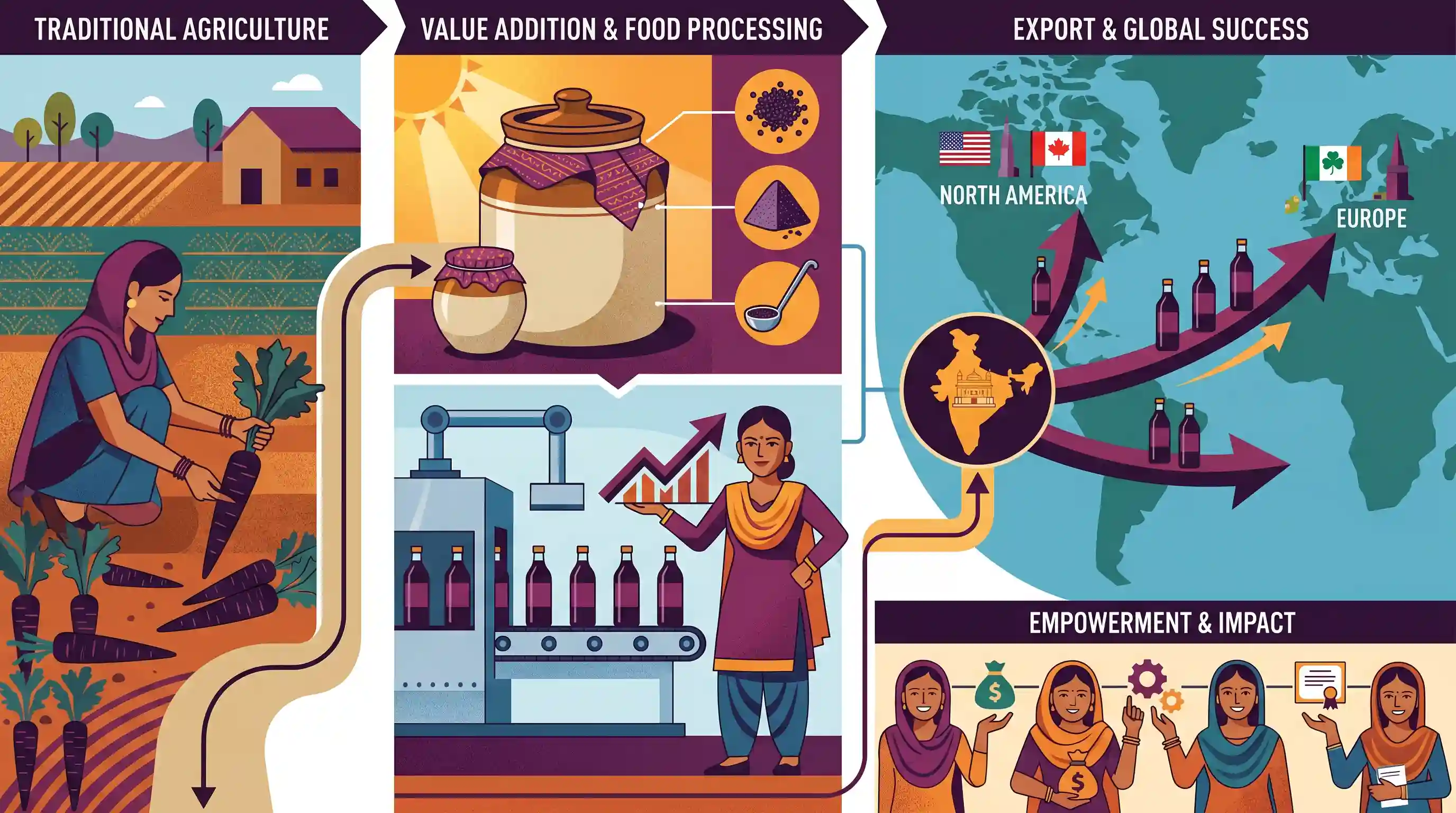
A woman entrepreneur from Abohar, Punjab, has successfully commercialized and exported 'kaali gaajar kaanji', a traditional fermented drink made from black carrots. The venture has achieved significant global success, reaching markets in the US, Canada, and Ireland, highlighting the immense potential of food processing, value addition, and rural women entrepreneurship in India.
Key Points
- Showcases the scope of value addition and food processing in transforming raw agricultural produce into high-value export commodities.
- Highlights rural women entrepreneurship and empowerment through the commercialization of traditional knowledge and recipes.
- Demonstrates the export potential of indigenous Indian foods to the global market, aiding in farmers' income augmentation.
- Revives the cultivation and utilization of black carrots, promoting crop diversification and nutritional security.
Prelims Trap
"Probiotics found in fermented foods like Kaanji consist exclusively of beneficial bacteria."
Probiotics comprise both beneficial bacteria (like Lactobacillus) AND beneficial yeasts. UPSC tested this exact distinction in 2022; assuming they are strictly bacterial is a classic trap.
Static Concepts Connected
What is the biological difference between Probiotics and Prebiotics?
- Probiotics: Live beneficial microbes (bacteria and yeasts) introduced into the body to improve gut health, naturally found in fermented foods like Kaanji, kefir, and yogurt.
- Prebiotics: Non-digestible plant fibers that act as food to nourish and stimulate the growth of existing beneficial bacteria in the gut (e.g., garlic, oats, onions).
- Synbiotics: Products or supplements that contain a synergistic mixture of both probiotics and prebiotics to maximize gut microbiome health.
What are the key features of the PMFME Scheme for food processing?
- Scheme Type: It is a Centrally Sponsored Scheme (60:40 ratio for general states) targeting the formalization and upgrading of unorganized micro food processing enterprises.
- ODOP Approach: Adopts this approach to reap economies of scale for procurement of inputs, availing common services, and product marketing.
- Financial Support: Provides a 35% credit-linked capital subsidy (up to ₹10 lakh) per micro-enterprise, alongside seed capital support for Self Help Group (SHG) members.
Cross-Topic Patterns
SHGs linking with Agri-Export Supply Chains
Transitioning rural women from local sales to global markets aligns directly with the Lakhpati Didi initiative, APEDA's processed food export promotion, and the scaling of Self-Help Groups (SHGs).
Traditional Knowledge and IP Protection
Commercializing indigenous recipes like Kaanji ties into the protection of Traditional Knowledge Digital Library (TKDL) and potential Geographical Indications (GI) for localized agricultural processing.

Expect a Prelims question matching plant pigments (anthocyanins in black carrots) and fermentation microbes to their dietary health roles.
Linked PYQs · 5
Linked PYQs · 5
- 2020MainsGS3
What are the challenges and opportunities of food processing sector in the country? How can income of the farmers be substantially increased by encouraging food processing?
- 2022MainsGS3
Elaborate the scope and significance of the food processing industry in India.
- 2025MainsGS3
Examine the scope of the food processing industries in India. Elaborate the measures taken by the government in the food processing industries for generating employment opportunities.
- 2020MainsGS2
Micro-Finance as an anti-poverty vaccine, is aimed at asset creation and income security of the rural poor in India". Evaluate the role of the Self Help Groups in achieving the twin objectives along with empowering women in rural India.
- 2021MainsGS2
Can the vicious cycle of gender inequality, poverty and malnutrition be broken through microfinancing of women SHGs? Explain with examples.
