Foreign policy realism versus moral leadership in West Asia
Source:Indian Express ↗
Why It Matters
This development highlights the evolving nature of India's foreign policy—transitioning from idealism and non-alignment to pragmatic multi-alignment. It serves as a vital case study for GS2 (Foreign Policy/Diaspora) and GS4 (Ethics in International Relations), exploring whether nations should prioritize moral leadership or narrow national interests.
Summary
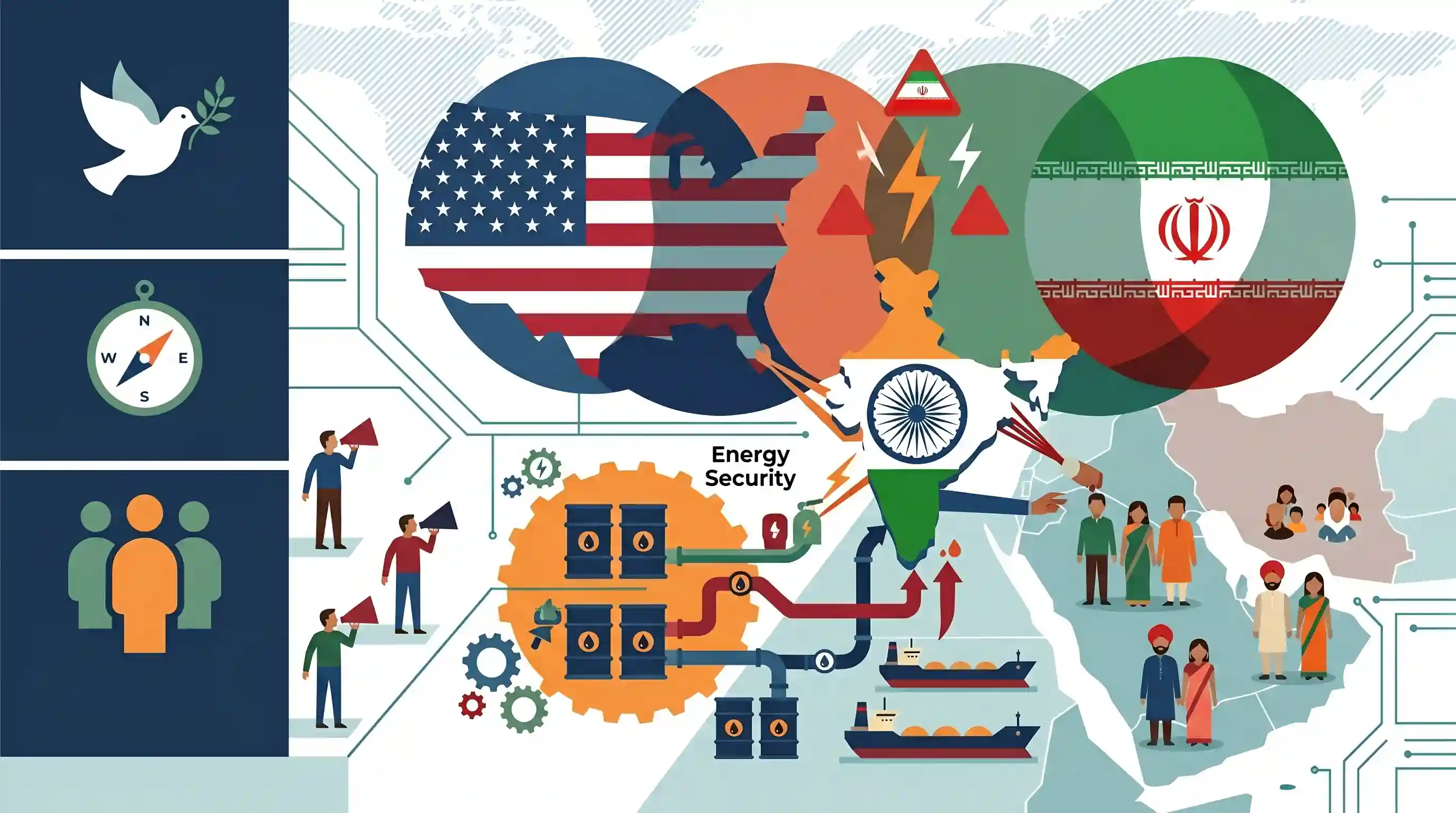
Amid escalating tensions between the US and Iran, India's political Opposition has strongly criticized the government for a perceived "abdication of moral leadership." The criticism highlights a shift in India's foreign policy from its historical emphasis on strategic autonomy and principled moral stances (often associated with the Non-Aligned Movement) to a more pragmatic, realpolitik approach. While critics argue India is abandoning its role as a voice for global peace in order to appease the US, the government's cautious balancing act reflects the complex realities of modern diplomacy. India maintains deep strategic ties with both nations and must safeguard critical national interests, particularly its energy security and the welfare of the large Indian diaspora in West Asia.
Key Points
- The Indian Opposition has criticized the government for remaining largely muted on the escalating US-Iran conflict, framing it as an 'abdication of moral leadership.'
- Critics point out that India historically took a strong, principled stand on global peace and anti-imperialism as a leader of the Non-Aligned Movement (NAM).
- The current administration's approach reflects a shift from ideological 'moral diplomacy' to realpolitik and pragmatism, prioritizing strategic partnerships, notably with the US.
- India's cautious balancing act is driven by crucial national interests, primarily energy security and the safety of the massive Indian diaspora working in the volatile West Asian region.
- This political debate underscores the core GS4 dilemma regarding ethics in international relations: balancing national self-interest with global moral duties.
Important Terms
Strategic Autonomy

A nation's ability to pursue its national interests and independent foreign policy without being constrained by other states or forced into formal military alliances.
UPSC context
GS Paper II (International Relations). Central to evaluating India's independent decision-making in a multipolar world.
Non-Aligned Movement (NAM)
An international forum of 120 developing states founded in 1961 to remain independent of major power blocs, pioneered by India during the Cold War.
UPSC context
GS Paper II (IR History). Essential for understanding the historical foundations and evolution of India’s foreign policy.
Realpolitik
A geopolitical system based on practical and material factors (power, national interest) rather than moral, ideological, or ethical premises.
UPSC context
GS Paper II & IV (Ethics). Tests the tension between pragmatic national interest and principled foreign policy.
Ethics in International Relations
The study of moral principles—such as sovereignty, human rights, and justice—that guide behavior and interactions between states and international organizations.
UPSC context
GS Paper IV (Ethics). Evaluates the moral dimensions of state actions like interventions or neutrality.
West Asia
The subregion of Asia covering the Middle East; India's 'extended neighborhood' critical for energy, trade, and the welfare of its resident community.
UPSC context
GS Paper II (Regional Groupings). A high-priority area due to energy dependence and the Indian diaspora.
Energy Security
Ensuring the uninterrupted availability of energy sources at an affordable price; for India, this largely depends on oil/gas imports from the Persian Gulf.
UPSC context
GS Paper II & III (Economy). Critical for analyzing India's vulnerability to global supply chain disruptions.
Indian Diaspora
The community of over 9 million Indian expatriates in West Asia who contribute significant remittances and require state protection during regional conflicts.
UPSC context
GS Paper II. Focuses on the role of the global Indian community in shaping foreign policy.
Prelims Trap
"India's shift to realpolitik means it has officially abandoned the principle of 'Strategic Autonomy'."
India has not abandoned Strategic Autonomy; rather, it has evolved from ideological Non-Alignment (staying equidistant) to pragmatic Multi-alignment (engaging all poles actively).
Static Concepts Connected
What distinguishes 'Multi-alignment' from the traditional 'Non-Aligned Movement' (NAM)?
- Core Philosophy: NAM largely focused on maintaining an ideological distance from Cold War blocs. Multi-alignment embraces active, parallel engagement with competing global powers.
- Primary Objective: NAM aimed at third-world solidarity, anti-imperialism, and global peace advocacy. Multi-alignment strictly prioritizes pragmatic national interest, trade, and security capability building.
Why is Iran indispensable to India's regional geopolitical strategy despite US pressures?
- Strategic Access: The Chabahar Port project provides India with a crucial maritime-to-land route to access Afghanistan and Central Asian Republics (CARs), circumventing Pakistan.
- INSTC Node: Iran serves as a critical territorial transit hub for the International North-South Transport Corridor (INSTC), aiming to connect India to Russia and Europe.
- Energy Security: Though crude imports fluctuate heavily under the threat of US sanctions, Iran's geographical proximity makes it a natural, highly efficient energy partner.
Cross-Topic Patterns
GS4 Ethics in Foreign Policy
The critique of India abandoning 'moral leadership' mirrors a classic GS4 dilemma: prioritizing immediate national self-interest (energy, diaspora) over absolute ethical idealism and global peace advocacy.
Gulf Remittances and Macroeconomic Stability
Protecting the 9 million-strong West Asian diaspora isn't just a consular duty; their remittances are structurally critical to financing India’s Current Account Deficit (CAD) under GS3 Macroeconomics.

GS2 Mains 2026 will likely demand evaluating India's shift from "moral diplomacy" to "issue-based multi-alignment" amid regional crises.
Linked PYQs · 4
Linked PYQs · 4
- 2025MainsGS2
"Energy security constitutes the dominant kingpin of India's foreign policy, and is linked with India's overarching influence in Middle Eastern countries.” How would you integrate energy security with India's foreign policy trajectories in the coming years?
- 2017MainsGS2
The question of India's Energy Security constitutes the most important part of India's economic progress. Analyze India's energy policy cooperation with West Asian countries.
- 2020MainsGS4
‘The will to power exists, but it can be tamed and be guided by rationality and principles of moral duty.’ Examine this statement in the context of international relations.
- 2015MainsGS4
At the international level, the bilateral relations between most nations are governed on the policy of promoting one's own national interest without any regard for the interest of other nations. This leads to conflicts and tensions between the nations. How can ethical consideration help resolve such tensions? Discuss with specific examples.
