Administrative Bottlenecks in Aatmanirbharta in Pulses Mission
Source:Indian Express ↗
ఇది ఎందుకు ముఖ్యం
It highlights critical administrative and structural bottlenecks in India's strategic agricultural missions aimed at achieving self-reliance (Aatmanirbharta) in essential food commodities like pulses.
సారాంశం
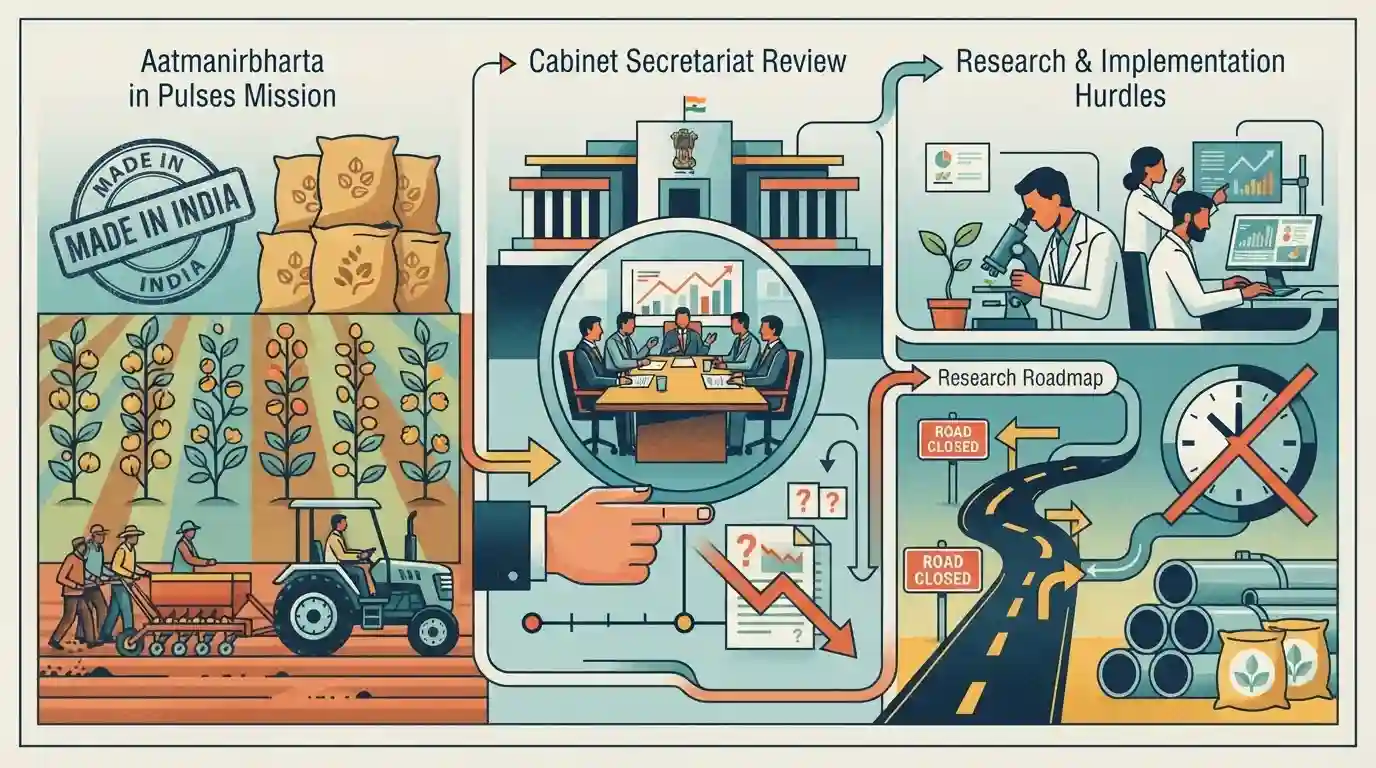
The Cabinet Secretariat has raised concerns regarding delays in research and implementation under the 'Aatmanirbharta in Pulses' mission, which aims to achieve self-sufficiency in pulse production in India and reduce dependence on imports.
ముఖ్య అంశాలు
- The Cabinet Secretariat has flagged administrative and research delays in the implementation of the 'Aatmanirbharta in Pulses' mission.
- India heavily relies on pulse imports to meet domestic demand, making self-sufficiency (aatmanirbharta) a strategic agricultural and economic priority.
- Delays in agricultural research, seed distribution, and inter-ministerial coordination hinder efforts to scale up indigenous pulse varieties and farming adoption.
- Addressing these bottlenecks is critical for ensuring nutritional security, farmer income stability, and cutting down import bills.
ముఖ్యమైన పదాలు
Aatmanirbharta in Pulses Mission

A 6-year Union government initiative (2025–26 to 2030–31) with an ₹11,440 crore outlay aimed at boosting domestic pulse production, expanding cultivation, and achieving import self-sufficiency.
UPSC context
Relevant for GS Paper III (Agriculture - Food Security & Production). Tests awareness of major government interventions targeting food self-sufficiency.
Cabinet Secretariat
The apex executive coordinating body in India under the Prime Minister, responsible for inter-ministerial coordination, policy implementation monitoring, and administrative functioning of government business.
UPSC context
Relevant for GS Paper II (Polity - Executive bodies). Tests understanding of higher civil services, policy oversight, and governmental machinery.
Ministry of Agriculture and Farmers Welfare
The apex governmental body in India responsible for formulating and administering national policies, research, and schemes related to agricultural development, farmer welfare, and food security.
UPSC context
Relevant for GS Paper II & III (Governance and Agriculture). Tests knowledge of nodal agencies handling agrarian policies.
Indian Council of Agricultural Research (ICAR)
India's apex autonomous body under the Ministry of Agriculture, responsible for coordinating, guiding, and managing research and education across agriculture, horticulture, and animal sciences.
UPSC context
Relevant for GS Paper III (Agricultural Research & Development). Evaluates knowledge of institutional frameworks driving scientific farming and food security.
ప్రిలిమ్స్ ఉచ్చు
India has achieved complete self-sufficiency in pulse production and no longer relies on imports to meet domestic demand.
Aspirants often assume pulses self-sufficiency has already been achieved due to past government claims, missing that structural import dependence and research delays persist.
అనుసంధానమైన స్థిర భావనలు
What are the major categories of pulses grown in India and their seasonal classification?
- Kharif Crops: Kharif Pulses include Tur (arhar), Moong, and Urad, grown during the southwest monsoon season.
- Rabi Crops: Rabi Pulses include Chana (gram), Masoor (lentil), and Field Pea, accounting for a major share of total pulse production.
- Zaid Crops: Zaid Pulses include short-duration crops like Moong grown during the summer months between Rabi and Kharif seasons.
What key institutional bodies drive agricultural research and price support for pulses in India?
- ICAR Role: ICAR coordinates and manages agricultural research and education across a network of central and state institutions.
- NFSM Scheme: NFSM-Pulses (National Food Security Mission) provides targeted interventions for seed distribution, cluster demonstrations, and crop management.
- Price Support: CACP recommends Minimum Support Prices (MSPs) for major pulses to incentivize domestic cultivation and protect farmers from price volatility.
అంతర-అంశ నమూనాలు
Pulses Mission + WTO Food Security Rules
India's heavy reliance on pulse imports intersects with WTO Agreement on Agriculture provisions regarding domestic support, MSP calculations, and public stockholding for food security.
Agricultural R&D + Extension Service Gaps
The push for climate-resilient seed varieties under ICAR connects agricultural research funding bottlenecks with agricultural extension service failures at the state level.

Expect a statement-based Prelims question on the financial outlay, target year, and output/yield goals of the Aatmanirbharta in Pulses Mission.
అనుసంధాన PYQలు · 3
అనుసంధాన PYQలు · 3
- 2024MainsGS3
Explain the role of millets for ensuring health and nutritional security in India.
- 2020PrelimsGS1
Consider the following statements: 1. In the case of all cereals, pulses and oil-seeds, the procurement at Minimum Support Price (MSP) is unlimited in any State/UT of India. 2. In the case of cereals and pulses, the MSP is fixed in any State/UT at a level to which the market price will never rise. Which of the statements given above is/are correct?
- 2020PrelimsGS1
With reference to pulse production in India, consider the following statements: 1. Black gram can be cultivated as both kharif and rabi crop. 2. Green-gram alone accounts for nearly half of pulse production. 3. In the last three decades, while the production of kharif pulses has increased, the production of rabi pulses has decreased. Which of the statements given above is/are correct?
