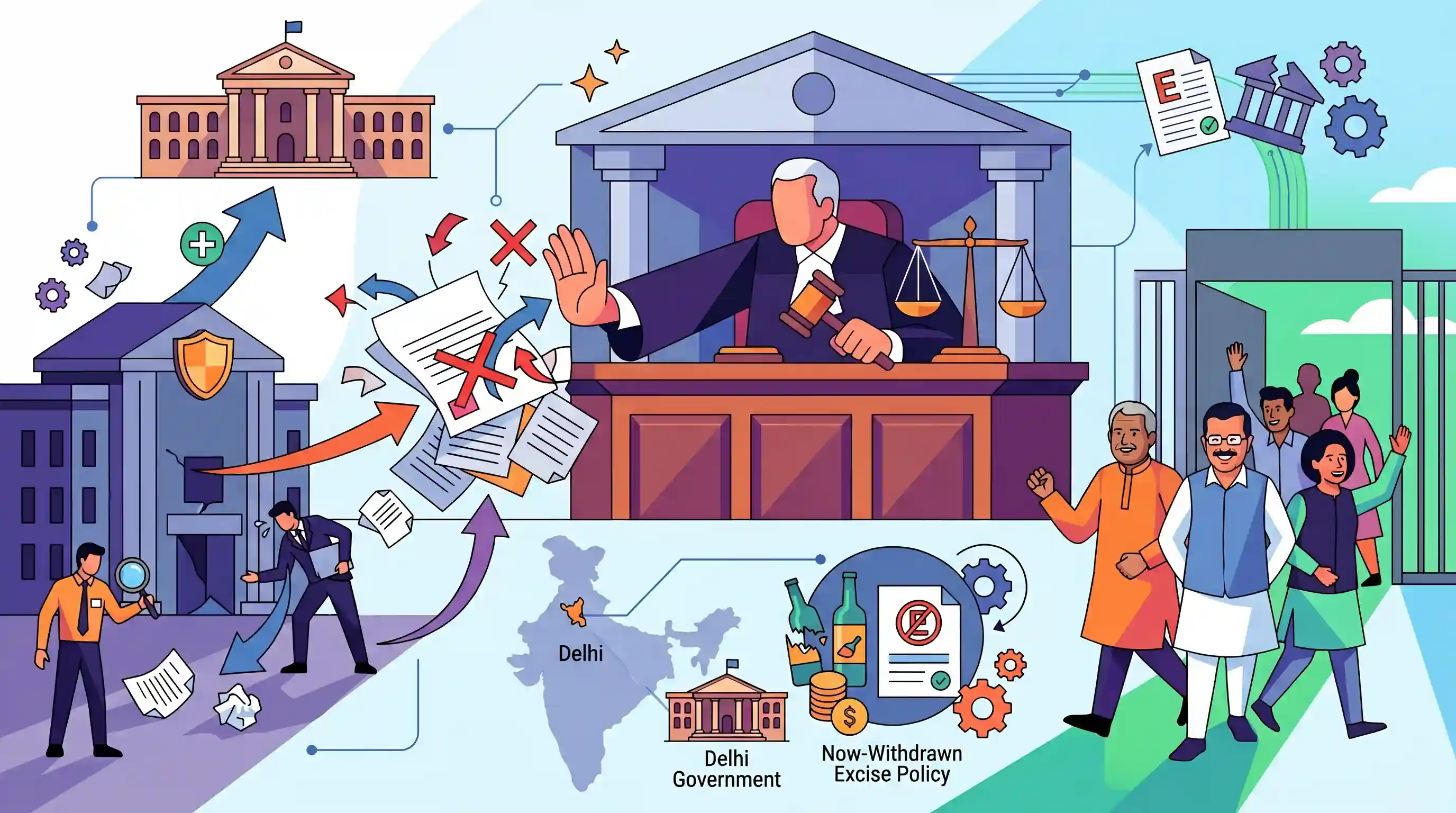
Trial court discharge order in Delhi excise policy corruption case
Source:The Hindu ↗
Why It Matters
This event is a prominent case study for GS-2 regarding the autonomy and credibility of central investigative agencies (CBI/ED), the essential checks and balances provided by the lower judiciary against arbitrary prosecution, and the ongoing administrative-political friction in the NCT of Delhi.
Summary
A Delhi special court has discharged AAP leaders Arvind Kejriwal, Manish Sisodia, K. Kavitha, and several others in the CBI’s corruption case concerning the now-withdrawn Delhi Excise Policy. Special Judge Jitendra Singh declined to take cognisance of the CBI chargesheet, pointing out severe 'internal contradictions' and rapping the agency for investigative lapses. The CBI plans to appeal the decision in the Delhi High Court. This development underscores the role of judicial review at the trial court level in holding investigative agencies accountable and demands a high evidentiary threshold before individuals are subjected to a criminal trial.
Key Points
- A Delhi Special Court discharged AAP leaders Arvind Kejriwal, Manish Sisodia, and others in the corruption case related to the Delhi Excise Policy.
- The court refused to take cognisance of the CBI chargesheet, citing significant 'internal contradictions' and structural lapses in the investigation.
- The CBI has announced its intention to appeal the discharge order before the Delhi High Court.
- The case originally arose after the Delhi Chief Secretary submitted a report highlighting alleged irregularities, reflecting the administrative tensions in the capital.
- This judicial outcome highlights the crucial role of trial courts in exercising judicial oversight over central investigative agencies before framing charges.
Important Terms
Delhi Excise Policy

A 2021-22 regime intended to privatize Delhi's liquor trade and boost revenue. It was scrapped following allegations of 'procedural lapses,' corruption, and kickbacks, leading to major investigations by the CBI and ED.
UPSC context
GS Paper 2 (Governance) and GS Paper 3 (Economy); focuses on administrative transparency and corruption in public policy implementation.
Central Bureau of Investigation (CBI)
India's premier investigating agency, deriving its power from the Delhi Special Police Establishment Act, 1946. It investigates high-profile corruption, economic offenses, and serious crimes of national importance.
UPSC context
GS Paper 2 (Statutory/Non-statutory bodies); tests issues of institutional autonomy and federal-state relations (general consent).
Enforcement Directorate (ED)
An economic intelligence agency under the Ministry of Finance that enforces the Prevention of Money Laundering Act (PMLA) and Foreign Exchange Management Act (FEMA) to combat financial crimes.
UPSC context
GS Paper 3 (Internal Security/Money Laundering); examines the agency's powers, conviction rates, and potential for executive overreach.
Rouse Avenue Court
A specialized court complex in Delhi designated to hear criminal cases involving Members of Parliament (MPs) and Members of Legislative Assemblies (MLAs), ensuring expedited trials for elected representatives.
UPSC context
GS Paper 2 (Judiciary); relevant to fast-tracking trials for lawmakers and the criminalization of politics.
Judicial Cognizance
The judicial act where a Magistrate or Judge takes formal notice of an alleged offense to initiate proceedings, requiring the application of 'judicial mind' to determine if a case exists.
UPSC context
GS Paper 2 (Judiciary); tests understanding of criminal procedure and the threshold for initiating a trial.
Discharge
A legal order releasing an accused person at the pre-trial stage because the court finds the evidence insufficient to even frame charges. Unlike acquittal, it doesn't always bar future retrial.
UPSC context
GS Paper 2 (Criminal Justice System); highlights the judiciary’s role in screening meritless cases before a full trial.
Prelims Trap
An accused 'discharged' by a court is protected from future trials for the same offence under double jeopardy.
Discharge occurs pre-trial due to lack of prima facie evidence and does not bar fresh charges. Double jeopardy (Article 20(2)) only applies post-trial.
Static Concepts Connected
What is the legal difference between a Discharge and an Acquittal?
- Discharge (Pre-trial): Granted before charges are framed if the judge finds the police report or chargesheet groundless.
- Acquittal (Post-trial): A formal verdict of innocence delivered only after the complete examination of witnesses and a full trial.
- Double Jeopardy: A discharged person can technically be re-investigated and charged again. Double jeopardy protections (Article 20(2)) apply primarily to convictions/acquittals.
How does 'taking cognisance' work in corruption cases?
- Meaning of Cognisance: It refers to a judge formally applying their judicial mind to the facts in a chargesheet to decide if a trial is warranted.
- Special Judge Powers: Under the Prevention of Corruption Act, a Special Judge operates with Sessions Court powers and takes direct cognisance without lower-court committal.
- Judicial Check: Refusing cognisance is the primary pre-trial judicial check against structurally flawed or politically motivated investigations.
Cross-Topic Patterns
CBI jurisdiction and Federal friction
The deployment of central agencies in Delhi ties into the broader federal friction over 'general consent' under the DSPE Act and dual control of civil servants under Article 239AA.
Special Courts under anti-graft statutes
Special Judges under the Prevention of Corruption Act can take direct cognisance without a magistrate's committal, a procedural deviation frequently compared with PMLA special courts in Mains answers.

Expect a Polity Prelims statement testing the exact procedural difference between 'taking cognisance', 'framing charges', and 'discharge'.
Linked PYQs · 3
Linked PYQs · 3
- 2021MainsGS2
The jurisdiction of the Central Bureau of Investigation (CBI) regarding lodging an FIR and conducting probe within a particular State is being questioned by various States. However, the power of the States to withhold consent to the CBI is not absolute. Explain with special reference to the federal character of India.
- 2016MainsGS2
Discuss the essentials of the 69th Constitutional Amendment Act and anomalies, if any, that have led to recent reported conflicts between the elected representatives and the institution of the Lieutenant Governor in the administration of Delhi. Do you think that this will give rise to a new trend in the functioning of the Indian federal politics?
- 2018MainsGS2
Whether the Supreme Court Judgement (July 2018) can settle the political tussle between the Lt. Governor and elected government of Delhi? Examine.
