Political debate over stubble burning and Delhi air quality
Source:Indian Express ↗
Why It Matters
The recurrent Delhi air quality crisis illustrates the intersection of environmental management, technological interventions like cloud seeding, and federal political dynamics. It is highly relevant for GS-3 (Environment) regarding urban pollution mitigation and agricultural practices like stubble burning.
Summary
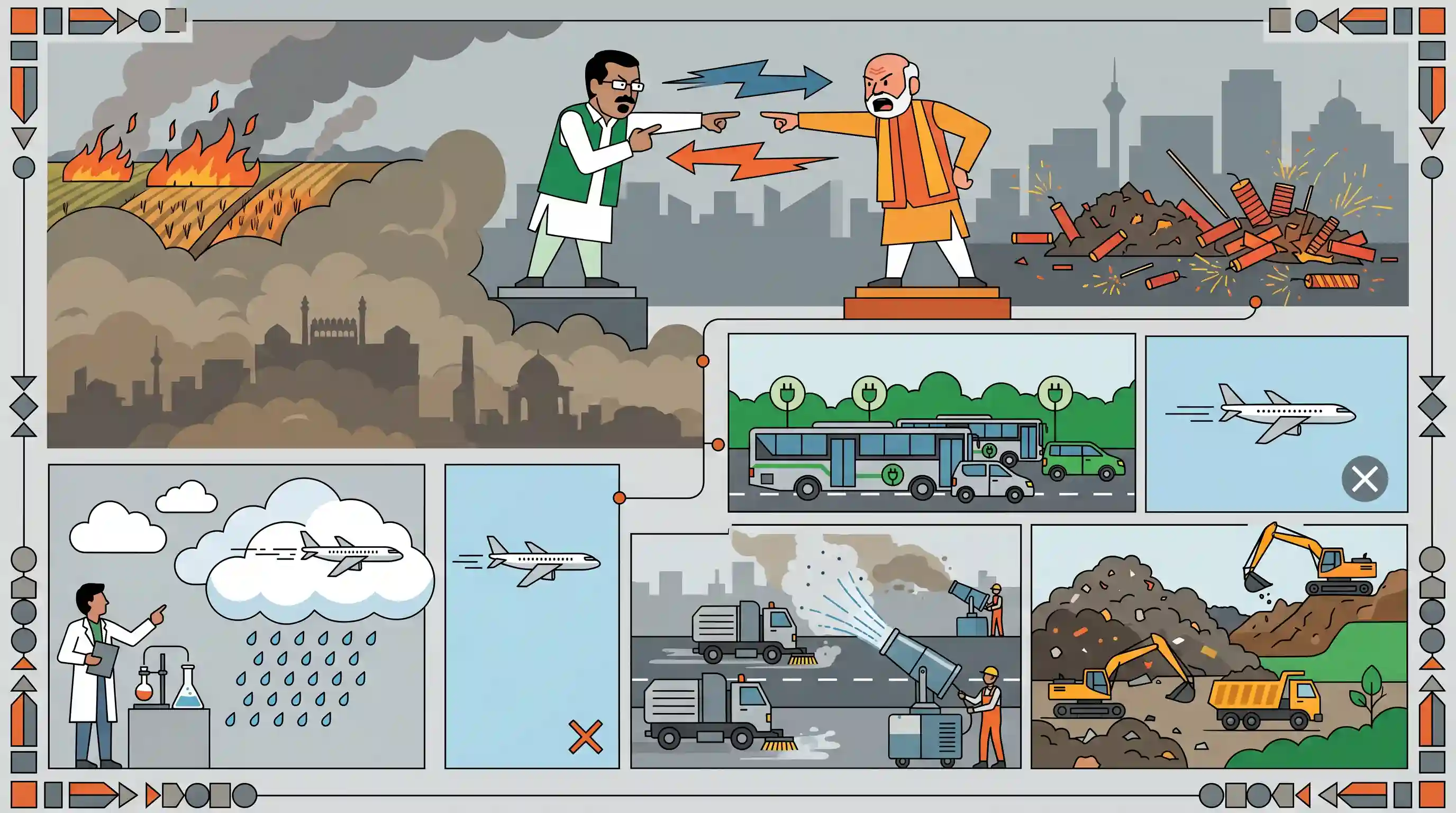
Severe post-Diwali air pollution in Delhi has sparked a political clash between AAP and BJP, centering on the roles of firecrackers versus stubble burning in Punjab. In response to criticism over delayed artificial rain, Environment Minister Manjinder Singh Sirsa emphasized that cloud seeding requires pre-existing clouds to be scientifically feasible. Meanwhile, the Delhi government detailed ongoing mitigation efforts, including the use of anti-smog guns, mechanical road sweepers, legacy waste removal, and the expansion of the electric vehicle fleet to control dust and emissions.
Key Points
- Following Diwali, Delhi's AQI surged to 351 (very poor), leading to a political dispute between AAP and BJP over the primary causes: firecrackers vs. stubble burning in Punjab.
- Environment Minister Manjinder Singh Sirsa clarified that cloud seeding (artificial rain) to mitigate pollution cannot be conducted without pre-existing clouds, responding to AAP's criticism of unfulfilled promises.
- The Delhi government highlighted its pollution control measures, including deploying 140 anti-smog guns, 70 mechanical road sweepers, and expanding the electric/CNG bus fleet.
- Additional environmental efforts in Delhi include the removal of 27 lakh metric tonnes of legacy waste and strict monitoring of large construction sites for dust control.
Important Terms
Indian Meteorological Department (IMD)

India’s principal government agency for meteorological observations, weather forecasting, and seismology. Operating under the Ministry of Earth Sciences, it monitors air quality through systems like SAFAR and provides critical data for disaster management.
UPSC context
GS Paper 3: Science & Technology and Disaster Management; tests knowledge of national institutions and their role in environmental monitoring.
Climate Trends
A research-based consultancy and communication initiative that analyzes weather patterns and environmental data. It tracks long-term shifts in air quality and climate, providing evidence-based reports often cited in environmental policy debates.
UPSC context
GS Paper 3: Environmental Pollution; highlights the role of civil society and research organizations in monitoring pollution and supporting evidence-based policymaking.
Delhi Government
The executive body of the National Capital Territory (NCT), responsible for implementing urban pollution control measures like the Graded Response Action Plan (GRAP), dust mitigation, and regulating local emissions.
UPSC context
GS Paper 2: Governance/Federalism; tests the administrative response to urban crises and the division of powers in managing the National Capital’s environment.
Punjab Government
The executive authority of Punjab, tasked with managing agricultural practices and crop residue. Its role is central to reducing stubble burning through incentives for in-situ and ex-situ biomass management.
UPSC context
GS Paper 3: Agriculture/Environment; focuses on state-level implementation of sustainable farming and inter-state cooperation in managing transboundary air pollution.
Prelims Trap
"Cloud seeding can generate artificial rain in clear, cloudless skies to settle particulate matter."
Cloud seeding strictly requires pre-existing moisture-bearing clouds. It only provides condensation nuclei (like Silver Iodide) to accelerate droplet formation, not moisture itself.
Static Concepts Connected
How does cloud seeding scientifically induce artificial rain?
- Nucleating agents: It disperses chemicals like Silver Iodide (AgI), Potassium Iodide, or Dry Ice (Solid CO2) into the air.
- Mechanism: These agents act as condensation nuclei, accelerating water vapor condensation into rain droplets large enough to fall.
- Meteorological prerequisite: The process strictly requires pre-existing moisture-bearing clouds; it cannot create rain from clear, dry skies.
What drives stubble burning and what are its exact emissions?
- Narrow window: A short 15-20 day turnaround window between the Kharif paddy harvest and Rabi wheat sowing forces farmers into quick field-clearing.
- Economic constraint: Mechanized in-situ management (e.g., using Happy Seeders) remains cost-prohibitive and time-consuming compared to burning.
- Toxic emissions: Releases massive quantities of Particulate Matter, Methane (CH4), Carbon Monoxide (CO), and carcinogenic volatile organic compounds (VOCs).
Cross-Topic Patterns
Biomining and Solid Waste Rules 2016
Delhi's legacy waste removal links to Solid Waste Management Rules 2016, which mandate scientific biomining (extraction and segregation) of aged municipal waste instead of traditional soil capping.
Agriculture cropping patterns and air quality
The stubble burning crisis highlights how MSP-backed paddy cultivation in Northwest India creates direct negative externalities for urban air quality, linking agricultural policy to environmental degradation.

Expect a 2026 Prelims question mixing the chemical agents used in cloud seeding (AgI) with its strict pre-requisite of existing clouds.
Linked PYQs · 4
Linked PYQs · 4
- 2024MainsGS3
Industrial pollution of river water is a significant environmental issue in India. Discuss the various mitigation measures to deal with this problem and also the government's initiatives in this regard.
- 2025PrelimsGS1
Artificial way of causing rainfall to reduce air pollution makes use of
- 2019PrelimsGS1
In the context of which of the following do some scientists suggest the use of cirrus cloud thinning technique and the injection of sulphate aerosol into stratosphere?
- 2018MainsGS3
What are the impediments in disposing the huge quantities of discarded solid wastes which are continuously being generated? How do we remove safely the toxic wastes that have been accumulating in our habitable environment?
