Rajya Sabha Defections from Punjab and Anti Defection Law Mergers
Source:Indian Express ↗
Why It Matters
The event serves as a live case study of the Tenth Schedule's merger provision, where mass defections evade disqualification. It also illustrates the mechanisms national parties use to penetrate politically resistant regions, making it highly relevant for questions on electoral democracy, federalism, and legislative ethics.
Summary
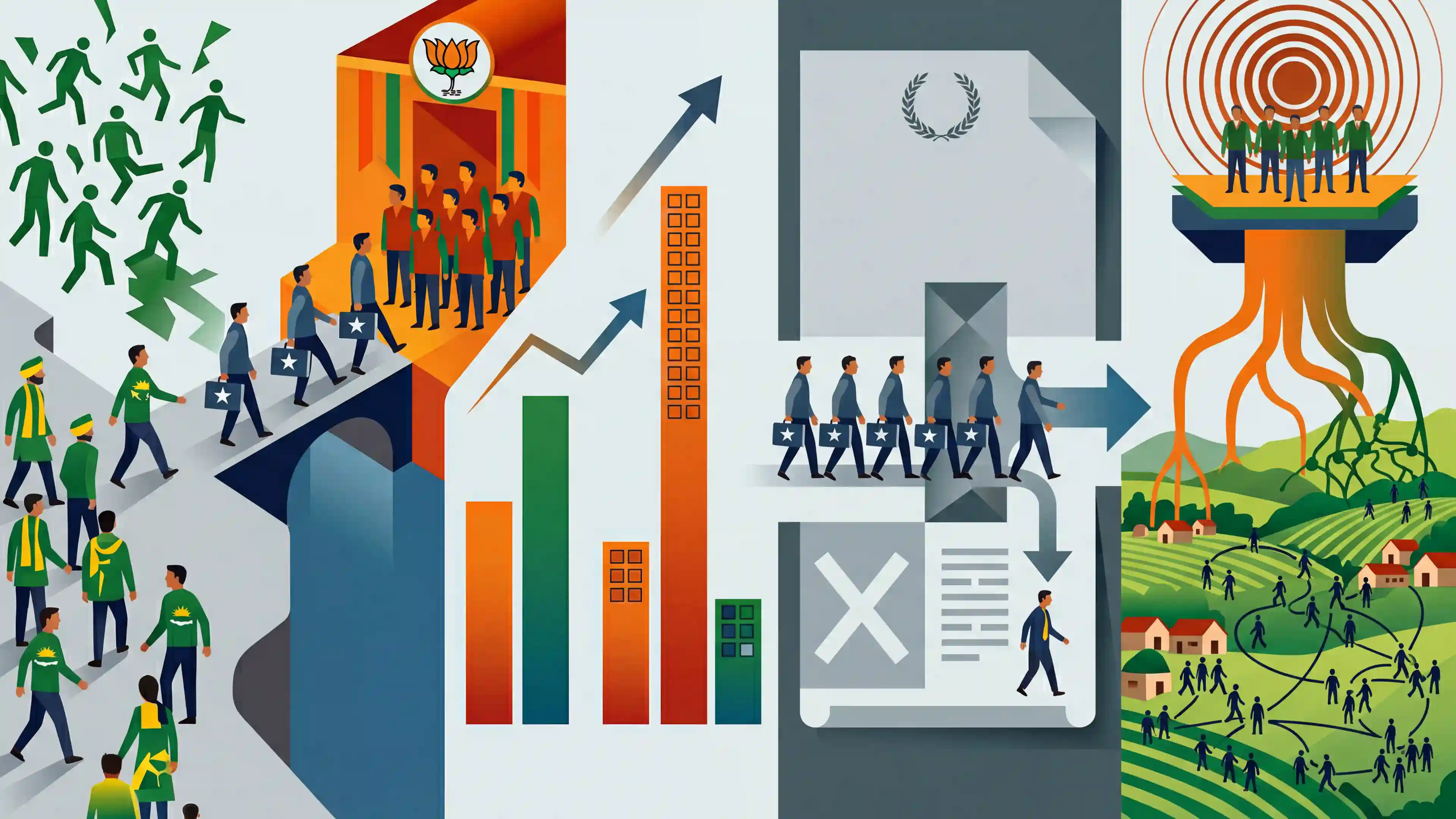
The defection of six AAP Rajya Sabha MPs from Punjab to the BJP provides the national party with its highest-ever Upper House representation from the state, bolstering its legislative numbers while fragmenting anti-BJP forces ahead of state elections. The mass defection highlights vulnerabilities in anti-defection frameworks—specifically the two-thirds merger exception—and underscores the shifting political dynamics in a key border state. The real challenge for the BJP will be converting these high-profile acquisitions into tangible grassroots support in a region dominated by strong rural networks and local loyalties.
Key Points
- Six of AAP's seven Rajya Sabha MPs from Punjab defected to the BJP, giving the latter its highest-ever representation from the state in the Upper House.
- The defectors include prominent leaders and public figures such as Raghav Chadha, Sandeep Pathak, Ashok Mittal, and Harbhajan Singh.
- Since the defecting MPs constitute more than two-thirds of AAP's total Rajya Sabha strength from Punjab, they likely bypass disqualification under the merger exception of the Tenth Schedule.
- The BJP views this as a strategic breakthrough to expand its influence among the diaspora, industrialists, and celebrities, while fracturing the anti-BJP opposition space.
- AAP and its supporters have termed the defection a betrayal, and the BJP acknowledges that converting these elite inductions into grassroots electoral support in rural Punjab remains a major challenge.
Important Terms
Tenth Schedule (Anti-Defection Law)

Added by the 52nd Amendment (1985) to prevent 'floor-crossing,' it provides for the disqualification of elected members (MPs/MLAs) who voluntarily resign or vote against their party's whip.
UPSC context
GS Paper II (Polity); tests understanding of legislative stability, the Speaker's role, and constitutional amendments (52nd and 91st).
Merger Exception
Paragraph 4 of the Tenth Schedule exempting members from disqualification if at least two-thirds of the legislative party members agree to join another political party.
UPSC context
GS Paper II; a critical 'loophole' often debated in Mains regarding the effectiveness of anti-defection measures.
Rajya Sabha
The Upper House of Parliament, representing States and UTs. Members are indirectly elected by State Legislative Assemblies using proportional representation (Single Transferable Vote).
UPSC context
GS Paper II; tests the federal character of the Constitution and the chamber's role in checking the Lower House.
National Party
A status granted by the Election Commission of India based on specific poll performance (e.g., recognition in 4 states). Currently, both AAP and BJP hold this status.
UPSC context
GS Paper II (Elections); tests criteria under the Election Symbols Order (1968) and benefits like 'Star Campaigners.'
Border State Dynamics
A state sharing an international boundary. Punjab shares a 553km border with Pakistan, making its internal political stability vital for national security.
UPSC context
GS Paper III (Internal Security); explores the nexus between political stability, cross-border smuggling, and national defense.
Prelims Trap
"Two-thirds of the members of the original political party must agree to the merger to bypass disqualification."
The Tenth Schedule exception specifically requires two-thirds of the *legislature party* (the elected members in that specific House) to agree, not the broader original political party.
Static Concepts Connected
What are the valid exceptions to disqualification under the Anti-Defection Law?
- Two-thirds Merger: Disqualification does not apply if an original political party merges with another, provided at least two-thirds of the legislature party members agree to the merger.
- Presiding Officer Exemption: Members elected as Speaker, Chairman, or Deputy Chairman who voluntarily give up their party membership to maintain neutrality are exempt from disqualification.
How did the 91st Constitutional Amendment Act (2003) modify the Tenth Schedule?
- Omission of Splits: It deleted the earlier provision that protected a 'split' by one-third of the legislature party's members from disqualification.
- Remunerative Posts Bar: It explicitly barred any defector disqualified under the Tenth Schedule from holding a ministerial berth or any remunerative political post.
Cross-Topic Patterns
Tenth Schedule + Speaker's neutrality
Mass defections repeatedly expose the quasi-judicial delays of Presiding Officers, linking anti-defection flaws to systemic debates on Speaker neutrality and the Keisham Meghachandra ruling.
Rajya Sabha maths + Article 249
Altering Upper House arithmetic via defections impacts the ruling party's ability to clear constitutional amendments and state-list legislation under Article 249, reshaping the federal balance.

Expect a multi-statement question in 2026 contrasting 'legislature party' vs 'original political party' under the 10th Schedule merger rules.
Linked PYQs · 5
Linked PYQs · 5
- 2014PrelimsGS1
Which one of the following Schedules of the Constitution of India contains provisions regarding anti-defection?
- 1998PrelimsGS1
Which one of the following Schedules of the Constitution of India contains provisions regarding Anti-Defection Act?
- 2022PrelimsGS1
With reference to anti-defection law in India, consider the following statements: 1. The law specifies that a nominated legislator cannot join any political party within six months of being appointed to the House. 2. The law does not provide any time-frame within which the presiding officer has to decide a defection case. Which of the statements given above is/are correct?
- 2020MainsGS2
Once a Speaker, Always a Speaker' ! Do you think this practice should be adopted to impart objectivity to the office of the Speaker of Lok Sabha ? What could be its implications for the robust functioning of parliamentary business in India?
- 2022MainsGS2
Discuss the role of the Vice-President of India as the Chairman of the Rajya Sabha.
