Aajeevika Mission and Rural Women Economic Empowerment
Source:The Hindu ↗
Why It Matters
The article provides key data points (e.g., women's 18% GDP contribution) and policy updates (digital loans for SHGs, expansion of Saras Melas) highly relevant for GS-2 (SHGs and NGOs) and GS-3 (inclusive growth and rural economy) questions.
Summary
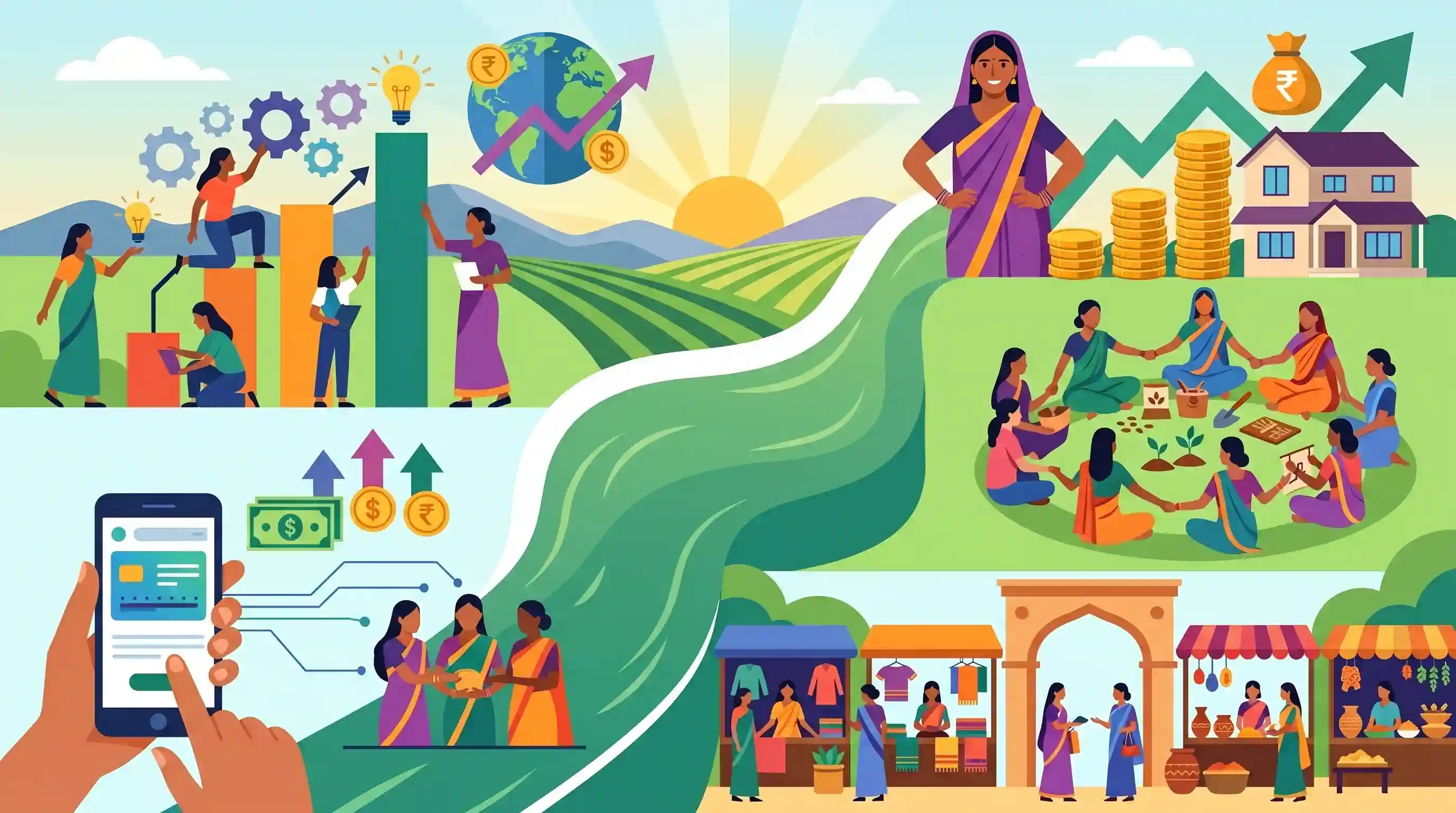
Union Rural Development Minister Shivraj Singh Chouhan stated that the Deendayal Antyodaya Yojana-National Rural Livelihoods Mission (DAY-NRLM), or Aajeevika Mission, has transformed into a national movement for rural women's empowerment. Highlighting the economic contributions of women—who account for 18% of the GDP and run 10% of startups—the Ministry emphasized the importance of SHGs and the 'Lakhpati Didi' initiative. Initiatives such as digital end-to-end loans for SHGs and the nationwide expansion of Saras Melas aim to boost financial inclusion and market access for rural women.
Key Points
- The DAY-NRLM (Aajeevika Mission) has evolved into a movement, heavily empowering rural women through Self-Help Groups (SHGs).
- The government is focusing on digital end-to-end loans to improve financial access and ease of credit for SHG members.
- Women currently contribute 18% to India's GDP and lead 10% of start-ups, demonstrating their growing economic role.
- The Ministry of Rural Development plans to expand Saras Melas beyond Delhi to enhance market linkages for products manufactured by SHGs and 'Lakhpati Didis'.
Important Terms
Deendayal Antyodaya Yojana-National Rural Livelihoods Mission (DAY-NRLM)

A flagship poverty alleviation program under the Ministry of Rural Development, launched in 2011 to mobilize rural poor women into Self-Help Groups and provide sustainable livelihood opportunities.
UPSC context
GS Paper II: Welfare schemes for vulnerable sections; GS Paper III: Inclusive growth, poverty issues, and rural development strategies.
Aajeevika Mission
The original name for the National Rural Livelihoods Mission (NRLM) launched in 2011, later renamed DAY-NRLM in 2015, focusing on women-led rural transformation.
UPSC context
GS Paper II: Important for understanding the evolution of government interventions in rural livelihoods and social justice.
Lakhpati Didi initiative
A government program aiming to empower SHG members to earn a sustainable annual household income of at least ₹1 lakh through skill training and micro-enterprise support.
UPSC context
GS Paper III: Women empowerment, entrepreneurship, and economic development; frequently featured in contemporary socio-economic policy discussions.
Saras Melas
National-level exhibitions organized by the Ministry of Rural Development to provide a marketing platform for rural SHG artisans to sell their products directly to urban consumers.
UPSC context
GS Paper III: Marketing of agricultural and handicraft products; role of institutional support in bridging the rural-urban divide.
Self-Help Groups (SHGs)
Informal associations of 10-25 local women who pool savings to provide mutual credit and collective support for income-generating activities and social empowerment.
UPSC context
GS Paper II: Development processes and the development industry; GS Paper III: Financial inclusion and microfinance as tools for poverty alleviation.
Prelims Trap
"Saras Melas are organized by the Ministry of Culture or the Ministry of Textiles to promote traditional rural handicrafts."
Saras Melas are explicitly organized by the Ministry of Rural Development (under DAY-NRLM) to provide a direct marketing platform for rural SHG women, not by Culture or Textiles.
Static Concepts Connected
What are the core components of the SHG-Bank Linkage Programme (SBLP)?
- NABARD Origins: Launched by NABARD in 1992, it is the world's largest microfinance project connecting informal Self-Help Groups directly to the formal banking sector.
- Collateral-Free Credit: It allows unregistered SHGs to open savings bank accounts and avail collateral-free loans based on their thrift and credit habits.
- DAY-NRLM Synergy: DAY-NRLM heavily relies on SBLP, providing Revolving Funds to SHGs to catalyze their creditworthiness before approaching banks.
What are the primary pillars of the DAY-NRLM (Aajeevika) strategy?
- Universal Mobilization: Aims to mobilize at least one woman from every rural poor household into a community institution, primarily an SHG.
- Financial Support: Provides critical financial support via Revolving Funds (RF) and Community Investment Support Funds (CISF) to strengthen the resource base of SHGs.
- Livelihood Promotion: Focuses on farm and non-farm enterprises, utilizing sub-schemes like the Mahila Kisan Sashaktikaran Pariyojana (MKSP) for agricultural empowerment.
Cross-Topic Patterns
SHGs & Digital Public Infrastructure
The push for digital end-to-end loans connects DAY-NRLM with the Account Aggregator framework and JAM trinity, rapidly expanding formal institutional credit access to rural women.
Convergence with ODOP and PMFME
Saras Melas scaling up heavily synergizes with the PM Formalisation of Micro food processing Enterprises (PMFME) scheme and ODOP, upgrading local SHG products into competitive branded commodities.

Expect a multi-statement Prelims question merging Lakhpati Didi targets, NABARD's SHG-Bank Linkage, and DAY-NRLM nodal ministries.
Linked PYQs · 4
Linked PYQs · 4
- 2014MainsGS2
The penetration of Self Help Groups (SHGs) in rural areas in promoting participation in development programmes is facing socio-cultural hurdles. Examine.
- 2021MainsGS2
Can the vicious cycle of gender inequality, poverty and malnutrition be broken through microfinancing of women SHGs? Explain with examples.
- 2017MainsGS2
The emergence of the Self-Help Groups (SHGs) in contemporary times points to the slow but steady withdrawal of the State from developmental activities." Examine the role of the SHGs in developmental activities and the measures taken by the Government of India to promote the SHGs.
- 2012PrelimsGS1
How does the National Rural Livelihood Mission seek to improve livelihood options of rural poor? 1. By setting up a large number of new manufacturing industries and agribusiness centres in rural areas 2. By strengthening 'self-help groups' and providing skill development 3. By supplying seeds, fertilizers, diesel pump-sets and micro irrigation equipment free of cost to farmers Select the correct answer using the codes given below:
