Political Leader Calls for Unified Urban Design Framework in Mumbai
Source:Indian Express ↗
Why It Matters
This article illustrates the real-world governance and spatial challenges of rapid urbanization in Indian metropolises. It provides concrete examples (like open-space deficits, privatization of public goods, and non-motorized transit gaps) that are crucial for answering questions on urban planning, smart cities, and the socio-economic marginalization caused by unplanned urban growth.
Summary
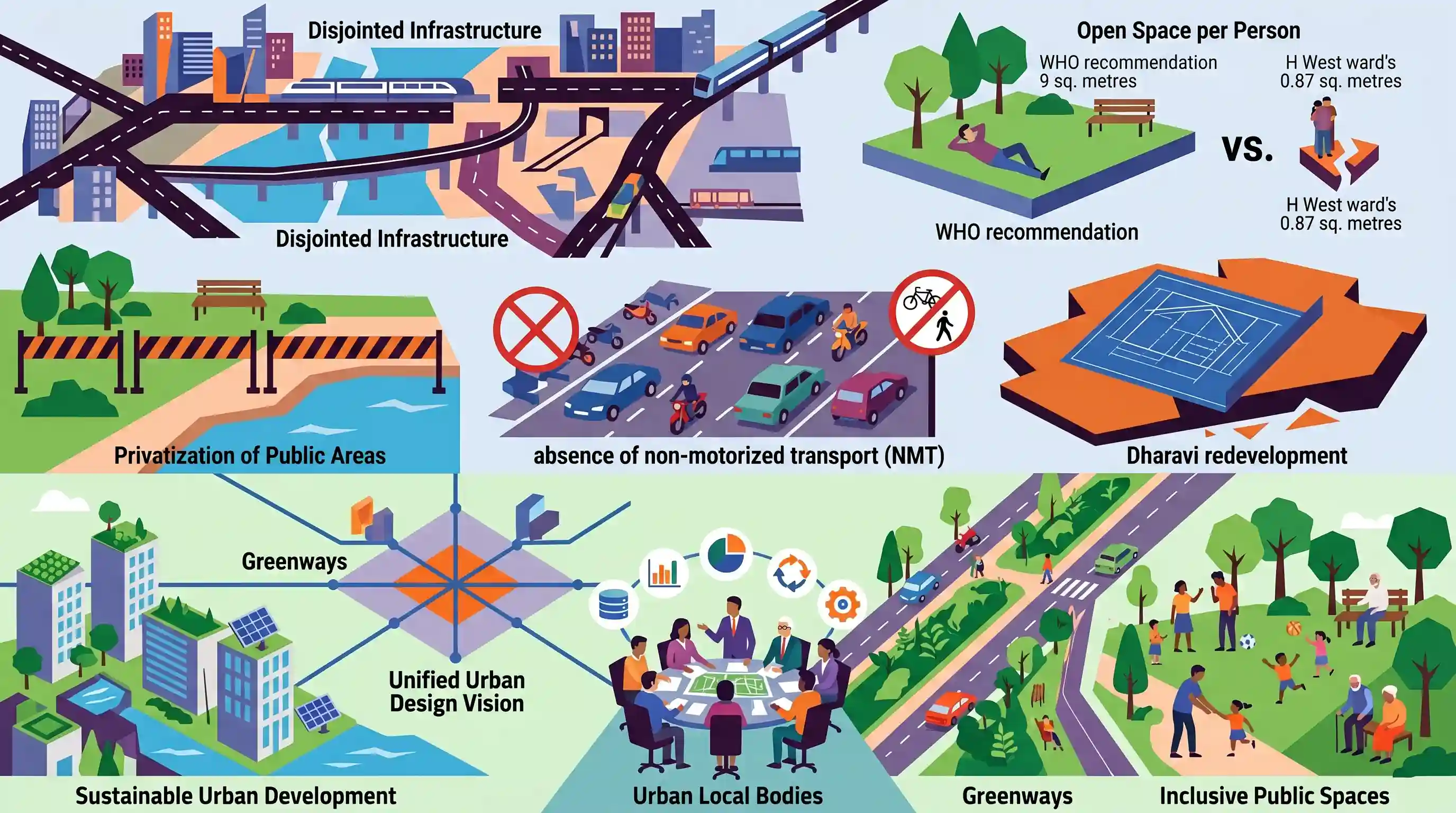
Shiv Sena (UBT) leader Aaditya Thackeray has stressed the need for a unified urban design vision for Mumbai to resolve issues of disjointed infrastructure and haphazard aesthetics. An exhibition titled "The Everyday City" highlighted significant shortfalls in urban planning, noting that Mumbai’s H West ward has only 0.87 sq. metres of open space per person, falling drastically short of the WHO’s 9 sq. metres recommendation. Key concerns involve the privatization of public areas, the absence of non-motorized transport (NMT) infrastructure, and the necessity of incorporating structured aesthetic frameworks into major projects like the Dharavi redevelopment. The discussion emphasized transitioning towards sustainable urban development, greenways, and inclusive public spaces under capable Urban Local Bodies.
Key Points
- Mumbai currently lacks a unified urban aesthetic, with infrastructure and buildings being developed without a cohesive design language or vision.
- A recent study highlighted severe deficits in open space, showing only 0.87 sq. metres per person in certain wards against the WHO recommendation of 9 sq. metres.
- Public recreation spaces are increasingly suffering from privatization and strict timing regulations, reducing overall public accessibility.
- There is an urgent need to integrate non-motorized transit (NMT) infrastructure like pedestrian paths and cycling tracks, which were historically neglected by city planners.
- Major infrastructural plans such as the Dharavi redevelopment and the preservation of the Mahalaxmi Racecourse must be guided by sustainable architectural principles rather than haphazard commercialization.
Important Terms
Urban Local Bodies (ULBs)

Constitutionalized by the 74th Amendment Act (1992), these are the third tier of government managing urban areas through Municipal Corporations, Councils, and Nagar Panchayats.
UPSC context
GS-II (Governance/Polity); tests understanding of the 74th Amendment, 12th Schedule, and urban decentralization.
Brihanmumbai Municipal Corporation (BMC)
India's wealthiest municipal corporation, responsible for the civic administration and infrastructure of Mumbai; it serves as a primary example of local self-governance.
UPSC context
GS-II (Local Governance); relevant for case studies on municipal administration and urban challenges.
Non-Motorized Transport (NMT)
Human-powered transport modes like walking and cycling that are environmentally friendly, low-cost, and essential for sustainable urban mobility.
UPSC context
GS-III (Infrastructure/Environment); tests knowledge of sustainable transport policies and carbon footprint reduction.
Dharavi Redevelopment Project
A government-led project to transform Asia’s largest slum into a modern urban zone with planned housing, infrastructure, and formalized economic opportunities.
UPSC context
GS-I (Society/Urbanization) and GS-III (Environment); relevant for slum rehabilitation and inclusive urban growth models.
Open Space Per Capita
A metric for urban liveability; the WHO recommends a minimum of 9 sq. metres of urban green space per person for health and well-being.
UPSC context
GS-III (Urban Planning/Environment); tests knowledge of liveability standards and environmental sustainability.
World Health Organization (WHO)
A UN specialized agency that sets international public health standards, including benchmarks for urban green space and environmental health.
UPSC context
GS-II (International Institutions); relevant for global standards in public health and sustainable development.
Prelims Trap
"The WHO recommends 10 to 12 sq. metres of open space per person for sustainable urban living."
The 10-12 sq.m norm is from India's URDPFI guidelines. WHO recommends a minimum of 9 sq.m of unpaved open space per capita.
Static Concepts Connected
What are the key features of the National Transit Oriented Development (TOD) Policy?
- Core Objective: To integrate land use and transport planning, reducing private vehicle dependency and promoting public transit.
- Non-Motorised Transport (NMT): Mandates developing pedestrian-friendly environments and cycling tracks to ensure last-mile connectivity to transit hubs.
- High Density & FAR: Promotes mixed land-use and higher Floor Area Ratio (FAR) along transit corridors to optimize space.
How do URDPFI guidelines approach urban open spaces in India?
- Per Capita Norms: Recommends 10 to 12 sq. metres of open space per person for plain areas, with modified limits for hill towns.
- Hierarchy of Spaces: Suggests a tiered system ranging from housing cluster parks to neighbourhood, city-level, and regional parks.
- Ecological Function: Emphasizes retaining natural drainage and increasing permeable surfaces to prevent urban flooding and enhance groundwater recharge.
Cross-Topic Patterns
Urban open spaces + Urban Heat Islands
Deficit of unpaved open spaces directly exacerbates Urban Heat Island (UHI) effects and localized urban flooding due to reduced groundwater recharge capacity.
Privatization of space + Spatial Inequality
Commercializing public recreational areas creates severe spatial inequality, restricting the urban poor's access to basic civic amenities and their broader 'Right to the City'.

Urban spatial inequality (URDPFI norms vs actuals) and NMT deficits could form a core 15-marker on urban planning failures in GS1 2026.
Linked PYQs · 4
Linked PYQs · 4
- 2025MainsGS1
How does smart city in India, address the issues of urban poverty and distributive justice?
- 2016MainsGS1
With a brief background of quality of urban life in India, introduce the objectives and strategy of the 'Smart City Programme'.
- 2023MainsGS1
Does urbanization lead to more segregation and/or marginalization of the poor in Indian metropolises?
- 2023MainsGS2
“The states in India seem reluctant to empower urban local bodies both functionally as well as financially.” Comment.
