Mumbai Congestion Tax Proposal Sparks Urban Transit and AQI Debate
Source:Indian Express ↗
Why It Matters
High vehicular density in mega-cities necessitates traffic demand management strategies like congestion pricing. However, this debate illustrates that implementing such policies requires robust public transport alternatives to be equitable. It also underscores the growing relevance of urban air pollution (AQI, PM2.5/PM10) in municipal governance and public policy.
Summary
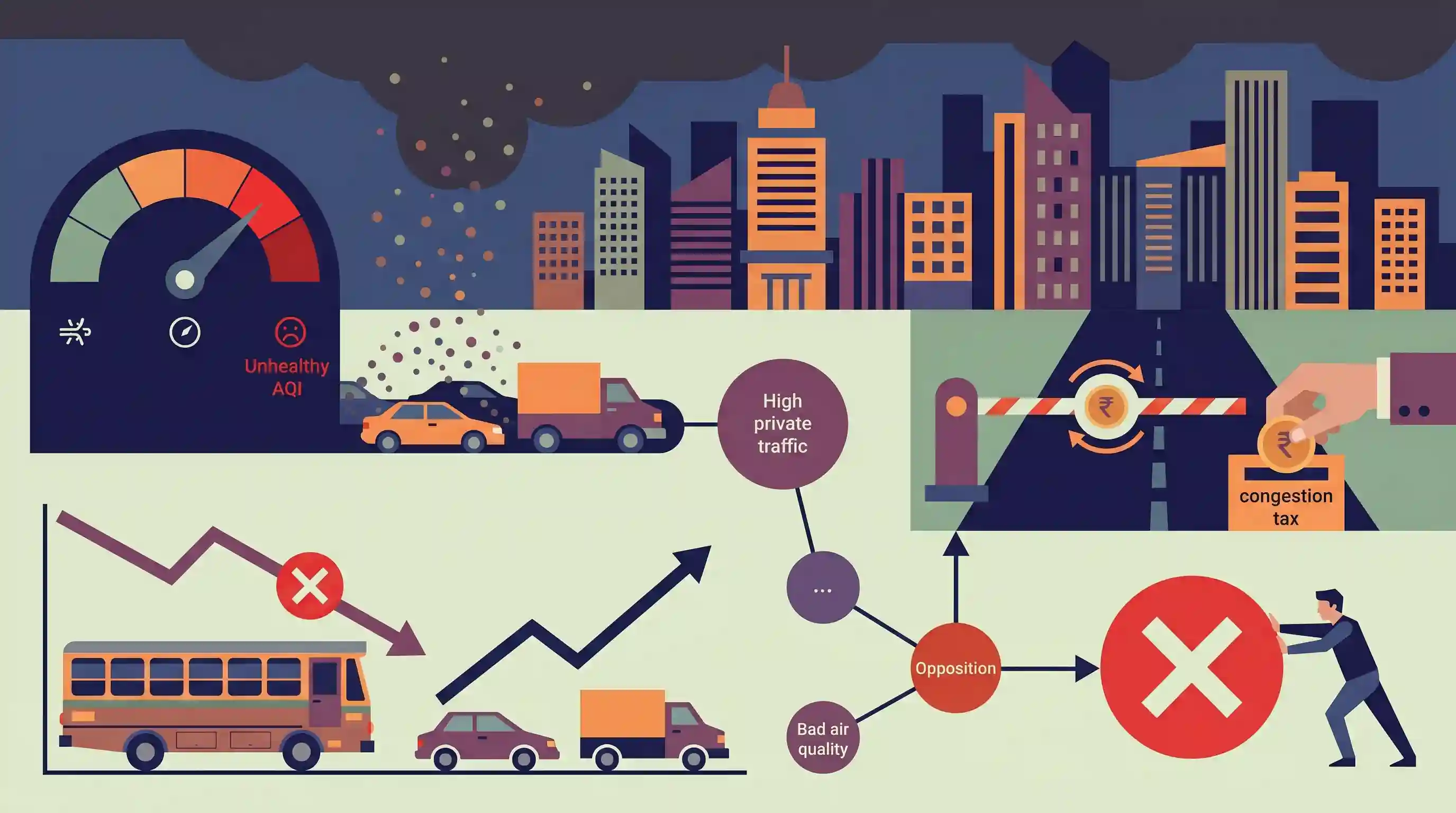
Shiv Sena (UBT) leader Aaditya Thackeray criticized a BJP proposal to introduce a "congestion tax" in select central business districts of Mumbai. Thackeray argued that levying such a surcharge is unjustified given the city's declining public transport infrastructure—specifically citing a reduction in BEST buses to favor private contractors—and its worsening air quality. He noted that Mumbai's AQI recently recorded unhealthy levels due to suspended particulate matter (SPM). The debate highlights the tension between traffic demand management strategies like congestion pricing and the prerequisite need for robust public transit alternatives.
Key Points
- A BJP corporator proposed implementing a congestion tax in Mumbai's central business districts to reduce vehicular traffic.
- Shiv Sena (UBT) leader Aaditya Thackeray opposed the proposal, citing the city's poor air quality and lack of basic amenities.
- Thackeray highlighted that Mumbai's Air Quality Index (AQI) was at 117 (unhealthy for sensitive groups), largely driven by suspended particulate matter (SPM).
- He pointed out a significant reduction in the city's public transport fleet (BEST buses), alleging it was done to benefit private contractors, making a congestion tax unfair to commuters.
- Congestion tax is a surcharge levied on vehicles entering densely populated areas during peak hours, a model used internationally in cities like London and Stockholm.
Important Terms
Congestion Tax

A market-based surcharge imposed on vehicles entering designated high-traffic zones during peak hours to discourage private vehicle use and reduce urban traffic.
UPSC context
GS Paper 1 & 3: Urbanization challenges, infrastructure, and traffic demand management strategies in Indian cities.
National Air Quality Index (AQI)
A 'One Number-One Color-One Description' tool launched in 2014 by the CPCB to simplify air quality data for the public across eight major pollutants.
UPSC context
GS Paper 3: Environmental pollution monitoring, public health, and government initiatives like Swachh Bharat Abhiyan.
Transportation Demand Management (TDM)
A policy framework using 'push' (disincentives like taxes) and 'pull' (public transit improvements) strategies to reduce private vehicle dependency and improve transport efficiency.
UPSC context
GS Paper 3: Infrastructure development and sustainable urban transport management policies.
Particulate Matter (PM)
Microscopic inhalable particles (PM10) and fine particles (PM2.5) suspended in the air, primarily from combustion and dust, known for severe respiratory and cardiovascular impacts.
UPSC context
GS Paper 3: Environment, specifically health hazards and air quality standards (NAAQS).
Central Pollution Control Board (CPCB)
The statutory organization under the Ministry of Environment, Forest and Climate Change responsible for implementing environmental laws and monitoring national air and water quality.
UPSC context
GS Paper 2 & 3: Statutory bodies and institutional frameworks for environmental protection.
Prelims Trap
Carbon dioxide (CO2) is a key vehicular pollutant measured under the National Air Quality Index (NAQI).
Aspirants often confuse Carbon Monoxide (CO, which IS in NAQI) with Carbon Dioxide (CO2, which is a major greenhouse gas but NOT measured in NAQI).
Static Concepts Connected
What are the 8 pollutants measured under the National Air Quality Index (NAQI)?
- Particulates: PM10 and PM2.5, which are microscopic and can bypass respiratory defenses to enter the bloodstream.
- Toxic Gases: Nitrogen Dioxide (NO2), Sulphur Dioxide (SO2), Carbon Monoxide (CO), Ozone (O3), Ammonia (NH3).
- Heavy Metals: Lead (Pb). Note that Carbon Dioxide (CO2) is explicitly excluded from this index.
What are the core principles of the National Urban Transport Policy (NUTP)?
- Core Philosophy: Focuses on "moving people, not vehicles" by prioritizing investments in mass transit (buses, metro) over private car infrastructure.
- Transit Oriented Development: Integrating land use and transport planning to minimize travel distances and promote non-motorized transport (NMT) like walking and cycling.
Cross-Topic Patterns
Congestion pricing vs. spatial equity
Without affordable public transit, congestion taxes act as regressive levies. This links GS3 infrastructure policies directly to GS1 urban social geography (exclusionary urbanization).
ULB Finance & Green Taxation
Urban Local Bodies (ULBs) are floating congestion taxes not just for traffic control, but to augment their own-source revenues, addressing structural gaps in 74th Amendment devolution.

Expect a GS3 Mains question assessing 'Congestion Tax' viability in Indian megacities against the backdrop of inadequate public transit.
Linked PYQs · 3
Linked PYQs · 3
- 2014MainsGS3
National Urban Transport Policy emphasises on 'moving people' instead of 'moving vehicles'. Discuss critically the success of the various strategies of the Government in this regard.
- 2020MainsGS3
What are the key features of the National Clean Air Programme (NCAP) initiated by the Government of India?
- 2022PrelimsGS1
In the context of WHO Air Quality Guidelines, consider the following statements: 1. The 24-hour mean of PM2.5 should not exceed 15 µg/m³ and annual mean of PM2.5 should not exceed 5 µg/m³. 2. In a year, the highest levels of ozone pollution occur during the periods of inclement weather. 3. PM10 can penetrate the lung barrier and enter the bloodstream. 4. Excessive ozone in the air can trigger asthma. Which of the statements given above are correct?
