Implementation Challenges of New Criminal Justice Codes
Source:The Hindu ↗
Why It Matters
The overhaul of the fundamental criminal laws is a generational shift in India's legal landscape. UPSC aspirants must understand the rationale behind replacing colonial statutes, the key substantive changes introduced by the new codes, and the administrative challenges of implementing them. This directly impacts GS-2 (Governance, Constitution, and Polity) and Essays on justice and decolonisation.
Summary
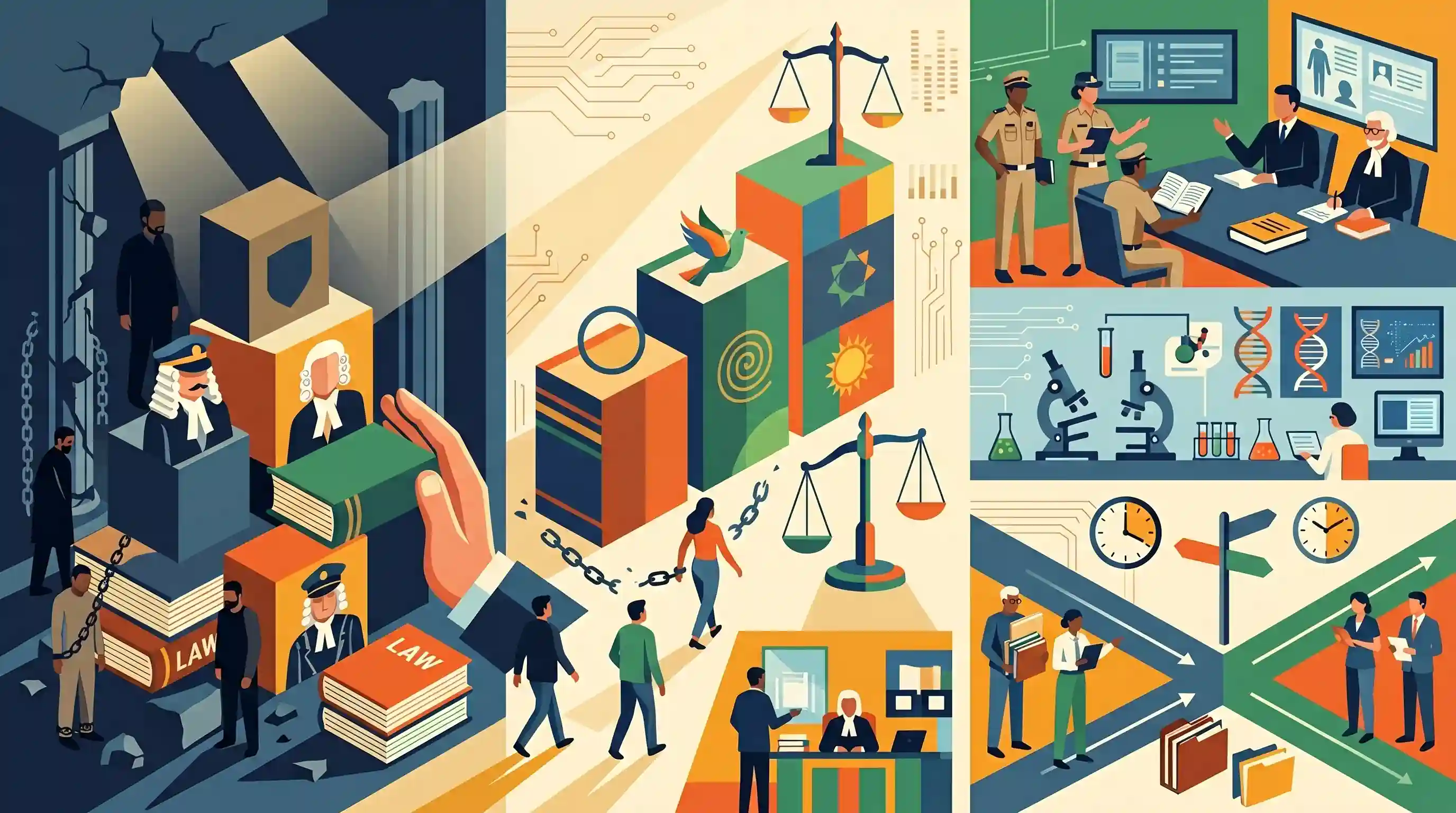
The article reflects on the transition from India's colonial-era criminal statutes (IPC, CrPC, IEA) to the newly enacted criminal codes: Bharatiya Nyaya Sanhita, Bharatiya Nagarik Suraksha Sanhita, and Bharatiya Sakshya Adhiniyam. This legal overhaul aims to 'decolonise' the justice system by prioritizing citizen rights and updating archaic provisions. However, the operationalization of these new codes poses significant systemic challenges, including the need to retrain law enforcement and judicial officers, upgrade forensic infrastructure, and manage a transition period where old and new legal paradigms will temporarily coexist.
Key Points
- India is replacing its colonial-era criminal justice frameworks—namely the IPC, CrPC, and Indian Evidence Act—with the Bharatiya Nyaya Sanhita (BNS), Bharatiya Nagarik Suraksha Sanhita (BNSS), and Bharatiya Sakshya Adhiniyam (BSA).
- A primary objective of the new codes is the decolonisation of the Indian legal framework, aiming to align criminal laws more closely with contemporary democratic realities and citizen rights.
- The successful implementation of these laws demands extensive capacity building, including police training, judicial orientation, and infrastructural upgrades across states.
- The transition period presents challenges related to pending cases under the old regimes and the harmonization of precedents with the new statutory provisions.
Important Terms
Bharatiya Nyaya Sanhita (BNS)

India's new substantive criminal code replacing the IPC. Effective July 1, 2024, it introduces offences like terrorism and organized crime while replacing sedition with 'acts endangering sovereignty' and adding community service as punishment.
UPSC context
GS Paper II (Governance/Polity). Tests understanding of substantive legal reforms and the modernization of criminal liability frameworks in India.
Bharatiya Nagarik Suraksha Sanhita (BNSS)
The procedural law replacing the CrPC to govern criminal investigations, arrests, and trials. It mandates forensic evidence for serious crimes, sets strict judicial timelines, and integrates digital/electronic processes into the legal system.
UPSC context
GS Paper II. Focuses on procedural fairness, police powers, and the balance between state authority and individual rights in criminal proceedings.
Bharatiya Sakshya Adhiniyam (BSA)
The law replacing the Indian Evidence Act to modernize rules on admissibility. It specifically prioritizes electronic and digital records as primary evidence and aligns the legal framework with contemporary technological advancements.
UPSC context
GS Paper II/Law Optional. Examines the evolution of evidence standards and the impact of technology on judicial transparency and fair trials.
Indian Penal Code (IPC)
The 1860 colonial-era statute that served as India's primary substantive criminal code for 162 years. It defined most criminal offences and punishments until its replacement by the BNS in 2024.
UPSC context
GS Paper II (History/Polity). Historical context for India’s legal evolution and the transition from colonial to democratic criminal jurisprudence.
Code of Criminal Procedure (CrPC)
The primary legislation (1973) governing the administration of criminal law in India before BNSS. it established the machinery for investigation, prosecution, and the hierarchy of criminal courts.
UPSC context
GS Paper II. Fundamental for understanding the traditional 'due process' and 'procedure established by law' in Indian criminal justice.
Indian Evidence Act (IEA)
The 1872 legislation that governed how facts are proved in Indian courts. It defined the relevance and admissibility of oral and documentary evidence before being updated by the BSA.
UPSC context
GS Paper II. Relevant for studying the history of judicial procedures and the shift toward recognizing digital-age evidence.
Decolonisation of Laws
The legislative objective of removing archaic colonial structures and philosophies—such as 'master-servant' dynamics—from the legal system to prioritize citizen rights and indigenous values in the judiciary.
UPSC context
GS Paper II/Ethics (Paper IV). Discusses judicial philosophy, sovereignty, and reformist governance in the transition to 'Amrit Kaal' legal frameworks.
Prelims Trap
Crimes committed before the enforcement date will be transferred and tried under the new Bharatiya Nyaya Sanhita.
Article 20(1) prohibits ex post facto laws. Substantive offences committed before the new codes' enforcement date will continue to be investigated, tried, and punished under the IPC.
Static Concepts Connected
How does Article 20 restrict the application of new criminal laws?
- Retrospective Liability Bar: No person shall be convicted for an act that was not an offence at the time of its commission (protection against ex post facto laws).
- Penalty Restriction: An offender cannot be subjected to a penalty greater than what existed under the law in force at the time of the offence.
- Substantive vs Procedural: While substantive laws (like IPC/BNS) cannot be applied retrospectively, procedural laws (like CrPC/BNSS) generally apply to pending proceedings unless expressly barred.
What were the key themes of the Malimath Committee on Criminal Justice Reforms?
- Inquisitorial Elements: Suggested moving from an adversarial system toward an inquisitorial system where judges actively participate in fact-finding.
- Standard of Proof: Recommended lowering the standard of proof from 'beyond reasonable doubt' to 'clear and convincing evidence'.
- Victim-Centric Approach: Emphasized providing compensation, legal representation, and participatory rights to victims in criminal proceedings.
Cross-Topic Patterns
Criminal Law + Schedule VII
Criminal law and procedure fall under the Concurrent List. States can still amend these new central codes for local application, provided they secure the President's assent under Article 254(2).
Evidentiary standards + Cyber forensics
The BSA mandates extensive use of electronic evidence. This bridges GS2 legal reforms with GS3 internal security, highlighting the urgent need to modernize State Forensic Science Laboratories (FSLs).

Expect a Mains GS2 question evaluating whether the statutory overhaul of criminal laws outpaces state-level forensic and police readiness.
Linked PYQs · 3
Linked PYQs · 3
- 2023MainsGS2
“Constitutionally guaranteed judicial independence is a prerequisite of democracy.” Comment.
- 2025MainsGS2
Comment on the need of administrative tribunals as compared to the court system. Assess the impact of the recent tribunal reforms through rationalization of tribunals made in 2021.
- 2016PrelimsGS1
The Montague-Chelmsford Proposals were related to
