Women in non-traditional livelihoods and economic participation
Source:Indian Express ↗
Why It Matters
The topic directly intersects with the GS Paper 1 syllabus on the 'Role of Women and Women's Organization' and GS Paper 2 on 'Social Justice'. UPSC frequently asks about gender equity, changing economic structures (like gig economy or non-traditional roles), and the barriers to women's economic empowerment.
Summary
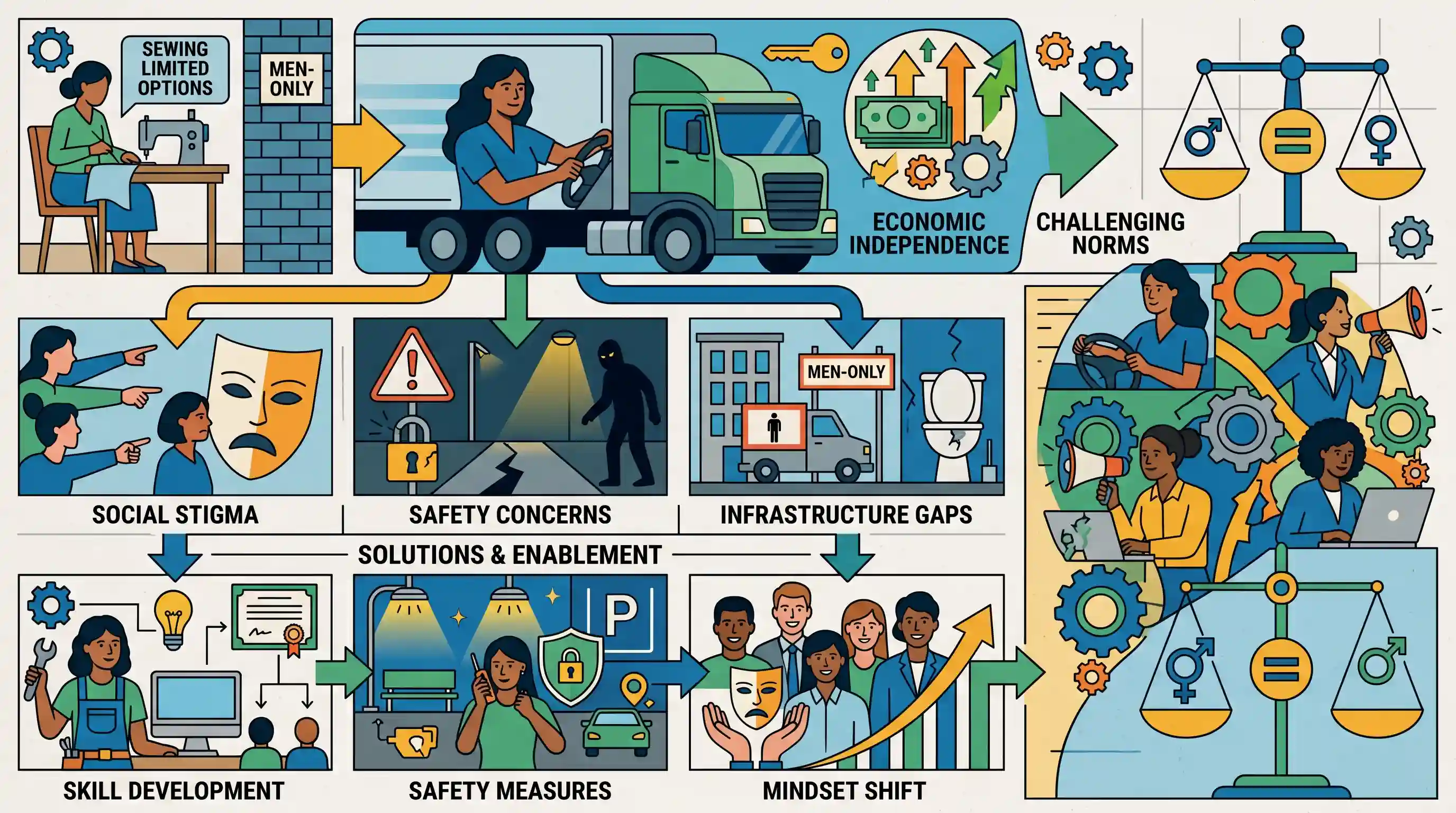
The article discusses the transformative impact of women entering non-traditional roles, particularly in the transport and commercial driving sectors. Breaking away from gendered occupational segregation, women in the 'driver’s seat' not only achieve economic independence but also challenge patriarchal norms. However, their integration into these fields is hindered by social stigma, safety concerns, and a lack of gender-friendly infrastructure. The piece emphasizes the need for targeted skill development, robust safety measures, and a shift in societal mindsets to facilitate and sustain women's participation in non-traditional livelihoods, thereby boosting overall female workforce participation.
Key Points
- Women's entry into non-traditional livelihoods (NTLs), such as commercial driving, challenges deeply entrenched gender stereotypes and promotes gender equality.
- Enhancing female representation in the transport and logistics sectors can significantly boost the Female Labour Force Participation Rate (FLFPR) and foster economic independence.
- Key barriers include social stigma, lack of gender-sensitive infrastructure (like safe public restrooms and secure rest stops), and inadequate access to targeted training programs.
- Systemic interventions, including supportive government policies, corporate sensitization, and better working conditions, are essential to sustain women in these non-traditional roles.
Important Terms
Female Labour Force Participation Rate (LFPR)

The percentage of women in the working-age population (15+) who are either employed or actively seeking work. It is a key indicator of gender-inclusive economic growth.
UPSC context
GS Paper 3 (Economy); GS Paper 1 (Social issues). Tests understanding of employment trends and demographic dividend.
Gendered Occupational Segregation
The concentration of genders in specific sectors (horizontal) or hierarchical levels (vertical). In India, women are often restricted to 'feminized' low-paid roles like agriculture or care work.
UPSC context
GS Paper 1 (Social Issues); GS Paper 2 (Social Justice). Relevant for analyzing structural barriers to gender parity.
Non-Traditional Livelihoods (NTL)
Employment sectors where women's participation has historically been low or absent, such as commercial driving, masonry, or STEM. These roles challenge traditional gender norms and enhance economic independence.
UPSC context
GS Paper 1 (Women Empowerment). Useful for discussing shifts in societal mindsets and economic diversification.
Skill India Mission
Launched in 2015, a flagship initiative of the Ministry of Skill Development to equip the Indian workforce, including women, with industry-relevant, market-demand skills.
UPSC context
GS Paper 3 (Skill Development); GS Paper 2 (Social Justice). Essential for questions on human resource development.
Pradhan Mantri Kaushal Vikas Yojana (PMKVY)
The flagship scheme under Skill India offering short-term training and certification. It aims to boost employability and promote self-employment through industry-aligned vocational courses.
UPSC context
GS Paper 3 (Indian Economy); GS Paper 2 (Government Schemes). Evaluates knowledge of social welfare and employment initiatives.
Recognition of Prior Learning (RPL)
A component of PMKVY that assesses and certifies an individual's existing skills acquired through informal means, helping them transition into formal, higher-paying employment.
UPSC context
GS Paper 3 (Employment). Critical for discussing the formalization of the workforce and empowering informal sector workers.
Prelims Trap
"Beti Bachao Beti Padhao focuses solely on child sex ratio and primary education, excluding vocational skilling."
The government recently expanded the BBBP scheme's mandate to explicitly include the skilling of girls in Non-Traditional Livelihoods (NTLs) and STEM subjects.
Static Concepts Connected
How does occupational segregation define different 'collar' workers in the economy?
- Pink-Collar: Care-oriented, traditionally female-dominated jobs characterized by lower pay and informality, such as nursing, primary teaching, and domestic work.
- Blue-Collar: Manual labor, manufacturing, or operational jobs (like commercial driving) that have historically been male-dominated.
- White-Collar: Salaried professional, managerial, or clerical office workers.
What are the statutory mandates for gender-sensitive workplace infrastructure in India?
- Maternity Benefit Act: Mandates crèche facilities for establishments with 50 or more employees to support working mothers.
- Factories Act 1948: Requires separate, adequately enclosed, and well-lit restrooms and washing facilities for female workers.
- OSHWC Code 2020: Permits women to work night shifts across all establishments, provided employers ensure adequate safety conditions and secure explicit consent.
Cross-Topic Patterns
Gig Economy unlocking NTLs
Platform-based gig work (like cab driving or delivery) offers flexible entry points into male-dominated sectors, tightly linking women's NTL participation to debates around the Social Security Code for gig workers.
Feminist Urbanism in smart cities
The lack of safe public restrooms and well-lit transit hubs restricts female mobility, directly connecting GS1 urban planning (feminist urbanism) to GS3 workforce participation.

Expect a Mains question linking occupational segregation and 'pink-collar' saturation to the necessity of NTL skilling for boosting FLFPR.
Linked PYQs · 3
Linked PYQs · 3
- 2024MainsGS1
Distinguish between gender equality, gender equity and women's empowerment. Why is it important to take gender concerns into account in programme design and implementation?
- 2021MainsGS1
Examine the role of 'Gig Economy' in the process of empowerment of women in India.
- 2025MainsGS2
Women's social capital complements in advancing empowerment and gender equity. Explain.
